

To measure AI search visibility, track how often your brand is mentioned and cited in AI-generated answers, how prominently it appears, and how that compares with competitors. Then connect those signals to AI referral traffic, conversions, and revenue. No single score does this well, so you need a small set of metrics that work together.
Rankings and organic clicks used to tell most of the search story. They don’t anymore. People now ask ChatGPT, Gemini, Perplexity, and Google’s AI features for recommendations, and many make up their minds before visiting a single website. This guide gives you a practical way to measure AI search visibility: what to track, how to calculate it, where the data comes from, and what to do with the results.
What Is AI Search Visibility?
AI search visibility is how often, and how prominently, your brand or content shows up inside AI-generated answers. That includes being named in the answer, being linked as a source, and being recommended next to competitors.
It’s a close cousin of search engine optimization, but the unit of measurement is different. You’re not asking “what position do I rank in?” You’re asking “does the answer include me, and how is it described?”
AI search visibility vs traditional search visibility
Traditional visibility is built on a stable list of ranked results. AI answers are written fresh each time, so the same question can return different brands on different runs. That changes how you measure, and it’s one of the biggest differences between older and AI SEO methods.
| Traditional SEO | AI search |
| Ranking position | Presence and prominence in the answer |
| Impressions | Appearances in AI answers |
| Backlinks | Sources the AI chooses to cite |
| Click-through rate | Referral rate from AI platforms |
| SERP competitors | Brands named in the same answers |
| Share of rankings | Share of voice across answers |
AI visibility vs AI traffic
These are not the same thing. A brand can be named in thousands of answers and still get few clicks, because the answer already gave the user what they needed. This is the same pattern people noticed with featured snippets and the broader rise of zero-click searches.
The reverse happens too. A page can earn steady AI referral traffic from one narrow topic while the brand is invisible across the wider category. Measure both, and never treat one as a stand-in for the other.
AI visibility vs GEO and AEO
Generative engine optimization (GEO) and answer engine optimization (AEO) are the work you do to improve your presence in AI answers. AI search visibility is the result you measure. Think of GEO as the training plan and visibility as the race time.
What counts as a visibility event?
Before you track anything, decide what you’ll count. I use five events:
- A brand mention in the answer text
- A recommendation of your product or service
- A citation (a link or source reference to your domain)
- A specific cited URL
- Inclusion in a comparison or shortlist
What Metrics Should You Use to Measure AI Search Visibility?
There are a lot of possible metrics. Most teams get into trouble by tracking too many, or by collapsing everything into one “AI visibility score” they can’t explain.
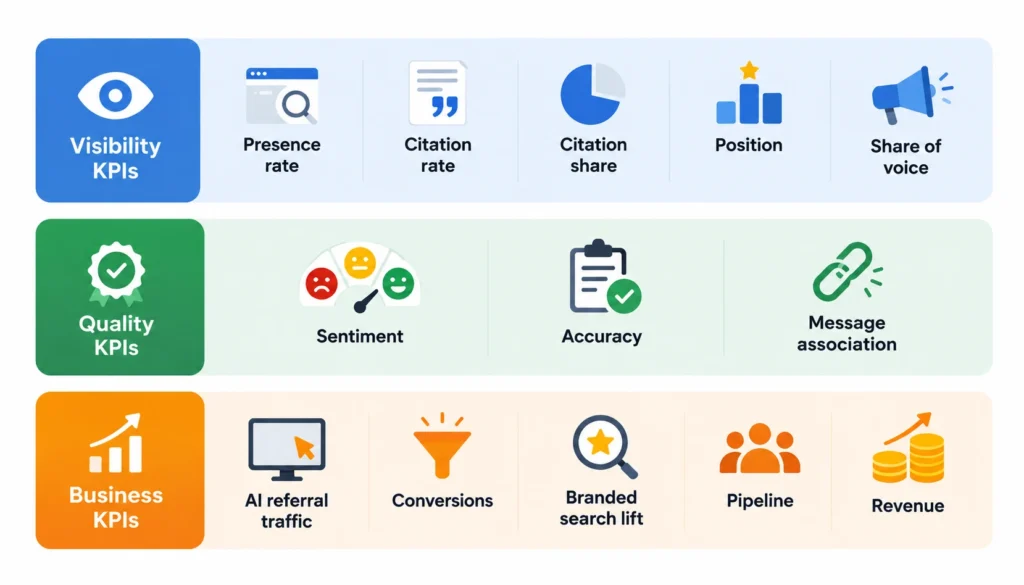
A cleaner approach is to group them into three layers.
- Visibility KPIs: presence rate, citation rate, citation share, position, share of voice
- Quality KPIs: sentiment, accuracy, message association
- Business KPIs: AI referral traffic, conversions, branded search lift, pipeline, revenue
Here are the core metrics with simple formulas. Use the same formula every time, or your trend lines mean nothing.
| Metric | Formula | What it tells you |
| Presence rate | Responses that mention your brand ÷ total responses tested × 100 | How often you appear |
| Prompt presence rate | Prompts where you appear at least once ÷ total prompts × 100 | How broad your coverage is |
| Citation rate | Responses citing your domain ÷ total responses tested × 100 | How often AI relies on your content |
| Citation share | Your citations ÷ all citations across tested responses × 100 | Your slice of the source pool |
| AI share of voice | Your mentions ÷ (your mentions + competitor mentions) × 100 | Your strength versus rivals |
| AI conversion rate | Conversions from AI referrals ÷ AI referral sessions × 100 | Quality of AI visitors |
A note on citation rate: some guides divide by responses that mention you. That’s a fine variation, but pick one definition and write it down. I prefer total responses because the denominator stays fixed.
Position and prominence
Being named first in a list of five brands is not the same as being named last. Record where you appear: first mention, top three, or buried. Some tools report this as an average position, and you can also do it by hand.
Sentiment and accuracy
Visibility isn’t always good news. If an AI describes your product with an outdated price or a feature you dropped two years ago, the mention is doing harm. Score each mention as positive, neutral, or negative, and separately flag whether the facts are right.
Branded search lift and pipeline
Some AI influence shows up later as people searching your brand name or typing your URL. You can watch branded search in Google Search Console and direct traffic in analytics. Treat these as supporting evidence, not proof. Plenty of things move branded search.
The AI Search Visibility Measurement Framework
Here is the process I’d follow for a new project. It works with a spreadsheet and no budget, and it scales up to paid tools later.
Step 1: Define what visibility means for your business
Pick the kind of visibility that matters to you. A local accounting firm cares about being recommended for “best accountant for small business in Leeds.” A SaaS company cares about category lists and comparisons. A publisher cares about being cited as a source.
Write down one objective, such as “appear in more category-level recommendations than our top two competitors.” Everything else flows from that.
Step 2: Choose the AI platforms to monitor
Start with where your customers actually are. For most businesses that means Google AI Overviews, Google AI Mode, ChatGPT, Gemini, Perplexity, and Microsoft Copilot. Add Claude if your audience skews technical or professional.
Four platforms tracked well beats seven tracked badly. You can always expand.
Step 3: Build a representative prompt set
Your prompt set is your sample. If it’s lopsided, your results will be too.
Build it from real language. Mine sales calls, support tickets, onboarding questions, and community threads such as r/SEO on Reddit for how people actually phrase problems.
Then balance the set across prompt types:
- Branded: “Is [your brand] good for…?”
- Category: “Best project management software for small teams”
- Problem-aware: “How do I stop missing project deadlines?”
- Comparison: “[Your brand] vs [competitor]”
- Commercial: “Pricing for…” or “Which tool should I buy for…”
- Reputation: “Is [your brand] legit?” or “Problems with [your brand]”
Tag each prompt by funnel stage and topic. This lets you report on “visibility in problem-aware prompts” rather than one blended number. A sensible starting size is 50 to 100 prompts. Smaller works for a pilot, but expect noisier results.
Step 4: Establish your baseline
Before you change anything, run the full set once and record the results. Without a baseline you can’t say whether anything improved.
Use a simple tracking sheet with these columns:
| Prompt | Platform | Date | Brand mentioned? | Position | Cited? | Cited URL | Competitors named | Sentiment | Accurate? | Screenshot | Notes |
Take screenshots or save the raw text. Answers change, and you’ll want proof of what was said on a given day.
Step 5: Run prompts consistently
AI answers are non-deterministic, which just means the same question can produce a different answer each time. One run tells you very little.
To reduce the noise:
- Run each prompt several times per platform. I’d start with three to five.
- Keep your prompt wording fixed between rounds.
- Test in a consistent environment, ideally logged out or in a clean profile, so personalization has less influence.
- Keep the same market and language.
- Run on a regular schedule, such as weekly.
- Don’t swap prompts in and out every month. If you must update the set, keep a core group that never changes.
Then report aggregates, not single runs. “We appeared in 34% of responses across 400 runs” is defensible. “ChatGPT mentioned us yesterday” is an anecdote.
A quick worked example
Imagine a project management tool called TaskLoop. They test 60 prompts across four platforms, five runs each. That’s 1,200 responses.
TaskLoop is mentioned in 252 of them. Presence rate is 252 ÷ 1,200 × 100, which is 21%. Their domain is cited in 96 responses, so citation rate is 8%.
Across all responses, TaskLoop and its named competitors receive 900 total brand mentions, and TaskLoop’s 252 is 28% of that. That’s their AI share of voice. (These numbers are invented to show the math, not benchmarks.)
The gap between 21% presence and 8% citation is a useful signal. The AI knows the brand exists but rarely uses its website as a source.
How to Measure AI Visibility on Each Major Platform
Each platform gives you different amounts of first-party data. Here is the realistic picture. Platform reporting changes quickly, so check current documentation before you build a process around it.
| Platform | What to measure | Native data available? | Best method |
| Google AI Overviews | Presence, citations, impressions | Partial | Search Console plus a tracker |
| Google AI Mode | Presence, citations | Partial | Search Console plus a tracker |
| ChatGPT | Mentions, citations, position | Limited | Prompt tracking, GA4 for referrals |
| Perplexity | Mentions, citations, position | Limited | Prompt tracking, GA4 for referrals |
| Gemini | Mentions, citations | Limited | Prompt tracking |
| Microsoft Copilot | Citations by page and query | More | Bing Webmaster Tools |
| Claude | Mentions, citations | Limited | Prompt tracking |
Google AI Overviews and AI Mode
Google explains how its AI features work with Search, including how links to your site can appear in them. Google also states that traffic from these features is counted in the overall Search Console performance data. To see how Overviews impact SEO more broadly, and what to change in response, read our breakdown.
The practical catch is that you can’t easily isolate AI impressions from regular ones in the standard report. Google may add more reporting over time, so look in Search Console for anything new. Until then, pair Search Console with prompt-level tracking to see whether you actually appear in AI Overviews.
ChatGPT, Perplexity, Gemini, and Claude
These platforms don’t give site owners a performance dashboard. Your options are manual prompt testing, a third-party tracker, or both. Your own analytics will show the clicks that do arrive, which I cover below.
Microsoft Copilot
Copilot is the exception. Bing Webmaster Tools now includes an AI Performance report that shows how often your pages are cited in Copilot and Bing’s AI summaries, along with the grounding queries involved. Search Engine Land covered the early rollout, and Adobe has a walkthrough of what the report includes.
Two limits matter. The report doesn’t show clicks, and it covers Microsoft’s AI experiences, not ChatGPT or Gemini. Still, it’s free first-party data, so set it up.
How to Measure AI Citations
An AI citation is a link or source reference to your content inside an AI answer. It’s a stronger signal than a mention because it shows the AI used your page as evidence.
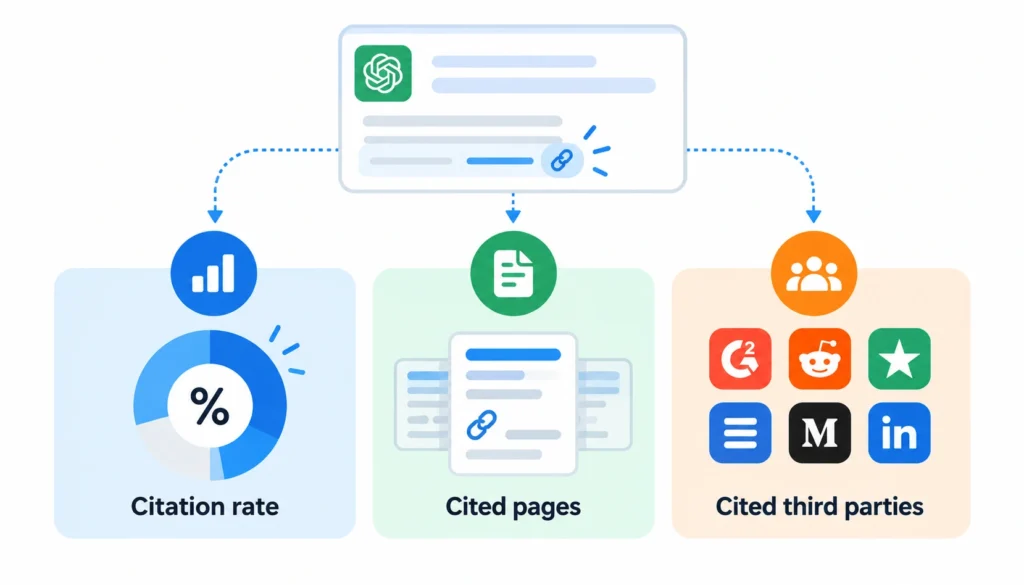
Track three things:
- Citation rate: how often you’re cited across your test set
- Cited pages: which URLs get picked, so you know what’s working
- Cited third parties: which outside sites (review platforms, forums, publications) shape answers about your category
That last one is easy to miss. Often the sources influencing the answer aren’t yours. If a review site or forum thread keeps getting cited for your category, that’s where your reputation work needs to happen.
When a competitor is cited and you aren’t, open the cited page. Look at what it offers: original data, clearer definitions, a better comparison table. That tells you what to build.
How to Measure AI Share of Voice
AI share of voice shows how visible you are compared with competitors. The formula is your mentions divided by the total mentions of you and your tracked competitors.
It works best when you split it up. Calculate it by platform, topic, prompt category, funnel stage, and market. A brand might own 45% of voice on branded and comparison prompts but only 8% on problem-aware prompts. That second number is where new customers are found.
Keep the competitor list fixed and realistic. Include the three to six brands you actually lose deals to, not every name in your industry.
How to Measure AI Referral Traffic and Conversions
Traffic is the part you can measure with the most confidence, so build it first.
Track AI traffic in GA4
In Google Analytics 4, open your traffic acquisition report and look at session source. AI platforms often appear as referrals from domains such as chatgpt.com, perplexity.ai, gemini.google.com, copilot.microsoft.com, and claude.ai. Some platforms also add a UTM parameter to outbound links, which makes them easier to spot.
Create a custom channel group or a segment that matches these sources with a regex, so you can report AI traffic as its own line. Review the list every quarter because platforms change domains and add new ones.
For each AI source, track:
- Sessions and engaged sessions
- Landing pages
- Conversion rate
- Leads, sign-ups, or purchases
- Revenue where you have it
Why referral traffic is only part of the story
Some AI-influenced visits won’t be labeled. People read an answer, then open a new tab and type your name. That visit looks like direct or branded search traffic. Some apps also strip referrer data entirely.
So AI referral traffic is a floor, not a total. Report it as “measurable AI traffic” and say so.
How to Measure the Business Impact of AI Visibility
Here is the influence chain to watch:
AI exposure → AI referral or branded search → direct visit → conversion → revenue
You can measure the end of that chain well and the beginning only roughly. That’s fine, as long as you’re honest about it.
Useful supporting checks include:
- Branded search trend in Search Console after visibility gains
- Direct traffic trends to key landing pages
- A “how did you hear about us?” field on forms, with an option for AI tools
- Sales call notes mentioning ChatGPT, Perplexity, or similar
This is influence measurement, not proven causation. Present it that way to stakeholders, and you’ll keep their trust.
How to Measure Brand Accuracy and Sentiment in AI Answers
Visibility without accuracy is a liability. Review each answer that names you and ask four questions:
- Is the description of the brand correct?
- Is the information current (pricing, features, locations)?
- Is the tone positive, neutral, or negative?
- Are competitors described more favorably?
Log every error. Then trace it to a source. Often an outdated third-party listing or old blog post is feeding the wrong answer. Fix the source, not just your own site.
How to Build an AI Search Visibility Dashboard
Keep dashboards simple and split by audience.
Executive view: presence rate, citation share, share of voice versus competitors, AI traffic, conversions, and revenue where available.
SEO and content view: top cited pages, missing topics, cited third-party sources, competitor gaps, and prompt-level changes.
A workable rhythm is weekly monitoring, monthly KPI reporting, and a quarterly strategy review. Check more often after a product launch, rebrand, major content update, reputation issue, or a notable shift in how an AI platform behaves.
Manual vs Automated AI Visibility Tracking
You don’t need to buy software on day one.
| Method | Best for | Strength | Limit |
| Manual prompts | Small teams, pilots | Free and flexible | Slow, hard to repeat |
| Spreadsheet log | Baselines | Easy to customize | Difficult to scale |
| AI visibility tool | Ongoing tracking | Automation and history | Cost, differing methods |
| Analytics platforms | Traffic and conversions | Real business data | Can’t see full visibility |
| Combined system | Larger teams | Complete picture | More setup |
If you track fewer than about 30 prompts for one brand, manual testing is usually enough. Once you add markets, competitors, or several platforms, the time cost grows fast and a tool starts to pay for itself.
Best AI Search Visibility Tools
Several established SEO platforms now offer AI visibility tracking. Examples include Semrush, Ahrefs (Brand Radar), SE Ranking, Peec AI, AirOps, and Frase. New tools launch often, so verify current features on each vendor’s own site before you commit.
When you evaluate any tool, look for:
- Coverage of the platforms your audience uses
- Custom prompts, not only preset ones
- Citation and source tracking
- Competitor tracking
- Historical data and exports
- Sentiment and accuracy flags
- Page-level insight
- Geographic and language options
- Clear documentation of how prompts are run
That last point matters. Different tools sample prompts differently, so scores from two tools usually can’t be compared. Pick one and stay consistent.
Common AI Search Visibility Measurement Mistakes
These are the ones I see most often.
- Tracking only traffic. You’ll miss all the influence that happens before a click.
- Tracking only mentions. Mentions without citations or accuracy checks can mislead.
- Relying on one score. A single number hides what’s happening underneath.
- Testing a prompt once. Variation makes single runs unreliable.
- Changing the prompt set constantly. You lose your trend line.
- Ignoring competitors. Your presence rate means little without context.
- Mixing platforms without separating them. Each behaves differently.
- Treating referral traffic as total influence. It’s only the visible part.
- Assuming Google rankings equal AI visibility. They overlap, but they aren’t the same.
What AI Search Visibility Data Can’t Tell You
This section matters most for credibility. Say these things out loud in your reports.
- You can’t see every AI conversation. Trackers sample a set of prompts, not all user behavior.
- Not every AI-influenced visit is attributable. Many show up as direct or branded traffic.
- Answers vary. Even with repeated testing, you’re estimating a range.
- Tools use different methods. A 30% score in one tool isn’t a 30% score in another.
- Visibility isn’t always positive. Check sentiment and accuracy.
- Correlation isn’t causation. A rise in branded search after a visibility gain is a clue, not proof.
How to Turn AI Visibility Data Into Action
Measurement only matters if it changes what you do. Here’s how I read common patterns.
| What you see | Likely meaning | What to do |
| Low presence overall | You’re missing from the topic | Build content for the gaps, and earn coverage on sources AI already cites |
| High mentions, low citations | AI knows you but doesn’t use your site | Create clearer, more citable pages with original data and plain definitions |
| Cited, but low position | You’re included, not featured | Strengthen topical depth and authority |
| Competitor cited instead | They own the source ecosystem | Study their cited pages and the third-party sites behind them |
| Negative or wrong descriptions | Bad or outdated sources | Fix listings, update content, and address the reputation source |
| High visibility, low conversions | Wrong intent or weak landing page | Review the landing page and the questions it answers |
AI Search Visibility Measurement Checklist
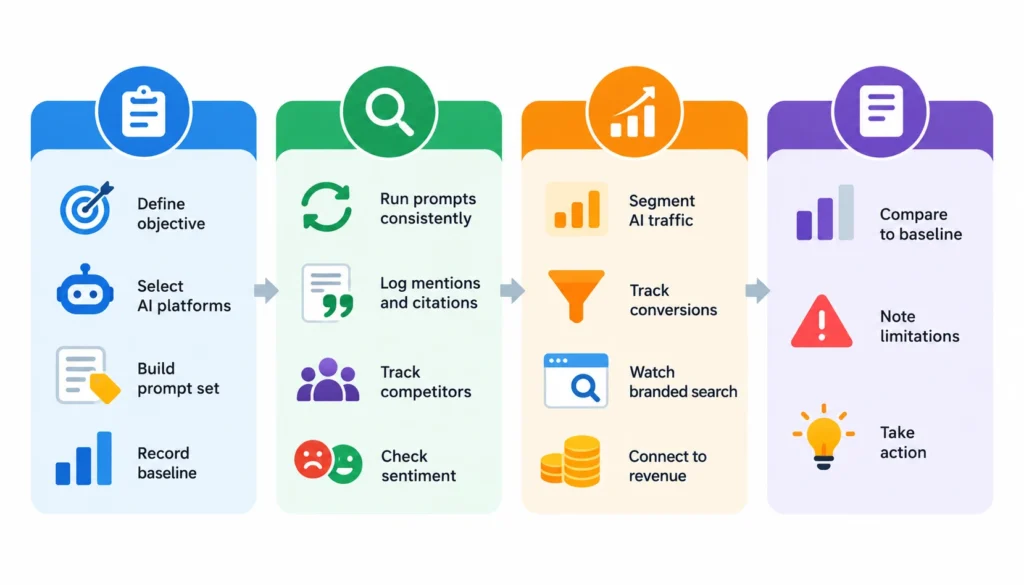
Before you measure
- Define the business objective
- Select your AI platforms
- Build and tag a prompt set
- Record a baseline
While you measure
- Run prompts consistently and repeatedly
- Log mentions, citations, and position
- Track competitors
- Check sentiment and accuracy
Business measurement
- Segment AI referral traffic in GA4
- Track conversions
- Watch branded search and direct traffic
- Connect to pipeline and revenue where possible
Reporting
- Compare to baseline and competitors
- Note limitations
- Pick one action per finding
Frequently Asked Questions
1. What is AI search visibility?
It’s how often and how prominently your brand or content appears in AI-generated answers, including mentions, citations, and recommendations.
2. How do you calculate AI search visibility?
Divide the number of responses that mention your brand by the total responses tested, then multiply by 100. Use a fixed prompt set and repeat runs for reliable results.
3. What is a good AI visibility score?
There is no universal benchmark. Scores depend on the tool, prompt set, and industry. Compare against your own baseline and your closest competitors instead.
4. How do you measure AI citations?
Count how often your domain appears as a source across your tested responses, and note which pages are cited. Bing Webmaster Tools reports this directly for Copilot.
5. Can GA4 track AI search traffic?
Yes, in part. GA4 can show visits that arrive from AI platforms as referrals. It can’t capture visits where the referrer is missing or where users searched your brand after seeing an answer.
6. Can Google Search Console measure AI visibility?
It includes traffic from Google’s AI features in its performance data, but historically hasn’t broken it out cleanly. Check Search Console for any newer reporting.
7. How often should you track AI visibility?
Weekly monitoring with monthly reporting works for most teams. Add checks after major launches or content changes.
8. What is the best AI visibility tracking tool?
It depends on your platforms, budget, and team size. Choose the one with the coverage and transparency you need, and stay consistent.
9. Is AI visibility the same as GEO?
No. GEO is the optimization work. AI visibility is what you measure to see whether it’s working.
10. Why does AI visibility change between searches?
AI systems generate answers fresh each time, and results can shift with wording, context, and updates to the underlying models. That’s why repeated sampling matters.
Final Takeaway
Measuring AI search visibility works best when you stop hunting for one perfect score. Track whether you appear, whether you’re cited, how you compare with competitors, whether the description is accurate, and whether any of it turns into traffic and revenue.
If you’re starting from zero, begin small: a fixed prompt set, a few platforms, a clean baseline, GA4 segments for AI referrals, and Bing Webmaster Tools for Copilot citations. Be upfront about what the data can’t show. That mix of rigor and honesty is what makes a measurement system trustworthy, and it’s what will let you show, with a straight face, whether your AI search work is paying off.

Nazish is a skilled content writer dedicated to creating high-quality, engaging, and SEO-focused blogs. She specializes in strategic keyword usage, search intent, and informative content that connects with readers while helping websites strengthen their visibility and rankings in search results.