
Entity SEO helps search engines and AI systems work out what a person, company, product, place or concept is, which facts belong to it, and how it connects to other things. In entity SEO and AI search, that clarity makes your content easier to retrieve, interpret and trust. It does not guarantee rankings, Knowledge Panels or AI citations, and Google says no special markup is needed for its AI features. What it does is remove guesswork, which is where most visibility problems start. This guide explains how the two fit together and what to do about it.
What Is Entity SEO?
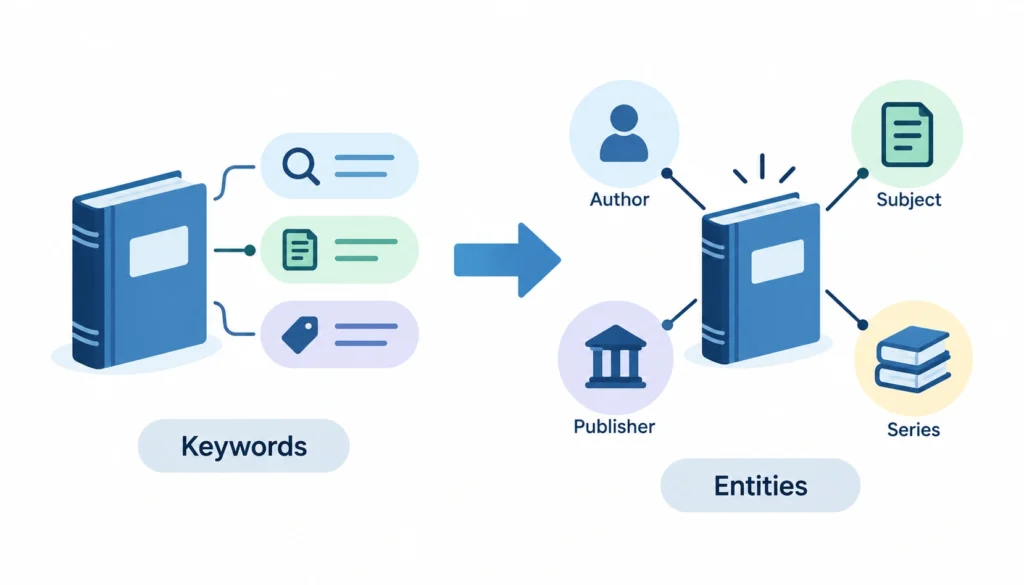
Entity SEO is the practice of making the “things” behind your content clear to machines. Instead of only matching words on a page to words in a query, you help search systems identify who or what you are talking about and how those things relate.
If you want a quick mental model, think of a librarian. Keywords are the words on the book spine. Entities are the author, the subject, the publisher and the series the book belongs to.
What is an entity in SEO?
An entity is a distinct, identifiable thing that can be described and told apart from other things. It can be a person, an organization, a brand, a product, a service, a place, an event or an abstract concept.
Take the name “Mercury.” It could be a planet, a chemical element, a car brand or a singer. The word is the same. The entities are different. Search systems need context to know which one you mean, and your site is part of that context.
Entity SEO vs keyword SEO
Keyword SEO starts with the phrases people type. Entity SEO starts with the things those phrases refer to. You still need both.
| Keyword SEO | Entity SEO | |
| Starting point | Search terms and demand | Identifiable things and facts about them |
| Main question | “What do people search for?” | “What is this, and how does it relate to other things?” |
| Typical output | Pages targeting queries | A connected set of pages, data and references |
| Risk when done alone | Thin pages that repeat phrases | Accurate but unfindable content |
Entity SEO vs semantic SEO
Semantic SEO is about meaning and context: covering a topic fully, using related terms naturally, and answering the questions around it. Entity SEO is narrower. It focuses on the specific things in that topic and the facts that define them.
You can see the overlap in practice. A strong semantic page about “project management software” will mention real tools, real features and real use cases. Those are entities. Entity SEO makes sure each one is named consistently and connected properly.
Entity SEO vs topical authority
Topical authority describes how thoroughly a site covers a subject. Entities are the building blocks of that coverage. If your site covers “payroll software” well, it probably covers entities such as tax forms, compliance rules, integrations and your own product, and it links them in a way that makes sense.
Why Entity SEO and AI Search Belong Together
AI search tools answer questions by pulling information from sources and putting it into a response. To do that well, they need to know which thing a source is talking about. Vague or conflicting pages make that harder.
Here is the part many articles skip: nobody outside the companies that build these systems knows the exact pipeline. What we can say is based on public documentation and consistent observation. I’ll mark which is which as we go.
How search engines understand entities
In simple terms, a search system reads text, spots the things mentioned, connects them to known records, and records facts and relationships. Think of it as a chain: text, then concepts, then entities, then attributes, then relationships.
Google publicly moved in this direction in 2012 when it introduced the Knowledge Graph with the line “things, not strings”. For background on how knowledge graphs work, the Wikipedia article on Google’s Knowledge Graph is a reasonable starting point.
A related idea is entity linking, where a system matches a mention in text to a specific record, such as deciding that “Apple” in a sentence about iPhones means the company and not the fruit.
What the Knowledge Graph is, and what it isn’t
The Knowledge Graph is Google’s database of entities and the relationships between them. It helps power features like Knowledge Panels. It is Google’s system. Other AI products may use different data sources and methods, so it is a mistake to assume they all work the same way.
Why entity clarity helps in AI-generated answers
AI answers depend on a few steps: finding relevant sources, deciding what they say, and combining them. Clear entities help at each step.
- Retrieval. A page that states plainly what it is about is easier to match to a question.
- Disambiguation. Explicit context stops your brand from being confused with another one.
- Consistency. If your pricing, location or founder differs across pages, a system has to guess which version is right.
- Corroboration. Facts repeated by independent sources are easier to trust than claims made only by you.
Many AI search tools use retrieval before generating an answer, a pattern often called retrieval-augmented generation. Clear, well-supported source pages fit that pattern well. That is an inference from how the approach works, not a published ranking rule. To see where entity clarity fits, it helps to understand AI answer systems and how they select and combine sources.
Entity SEO and Google AI Overviews
This is where the documentation matters. Google’s guidance on AI features in Search says AI Overviews and AI Mode build on its existing Search systems, may use a technique called query fan-out (running several related searches behind one question), and need no special technical requirements or special schema.
So be careful with anyone who sells an “AI Overview schema” or a secret entity trick. The documented path is the boring one: be crawlable, be indexed, publish helpful content, and keep important information in text. If you want to see how these summaries affect clicks and traffic, this breakdown of Google’s AI summaries and how to adapt is a useful companion.
Entity SEO and ChatGPT, Gemini and Perplexity
These tools differ in how they retrieve and cite sources, and they change often. There is no public evidence of a single “entity ranking factor” that works across all of them.
What holds up in practice is more modest. Brands with a clear identity, consistent facts and mentions from credible third parties tend to be described more accurately. Test this yourself by asking each tool about your brand and checking what comes back.
How Entity SEO, Semantic SEO, AEO and GEO Fit Together
These terms get mixed up constantly. They overlap, but each solves a different problem.
| Concept | What it focuses on |
| Entity SEO | What things are and how they relate |
| Semantic SEO | What concepts mean and how they connect in context |
| Topical authority | How completely a site covers a subject |
| Schema markup | A way to describe page content in a machine-readable format |
| AEO (answer engine optimization) | Being useful for question-and-answer experiences |
| GEO (generative engine optimization) | Visibility inside generative AI answers |
I use a simple working model with clients: entities, then relationships, then topics, then evidence, then retrieval, then answers. You define the things, connect them, cover the subject, back it up, and make it easy to find. Whether an AI tool then uses you is outside your control. Everything before that step is inside it.
The Core Parts of Entity SEO
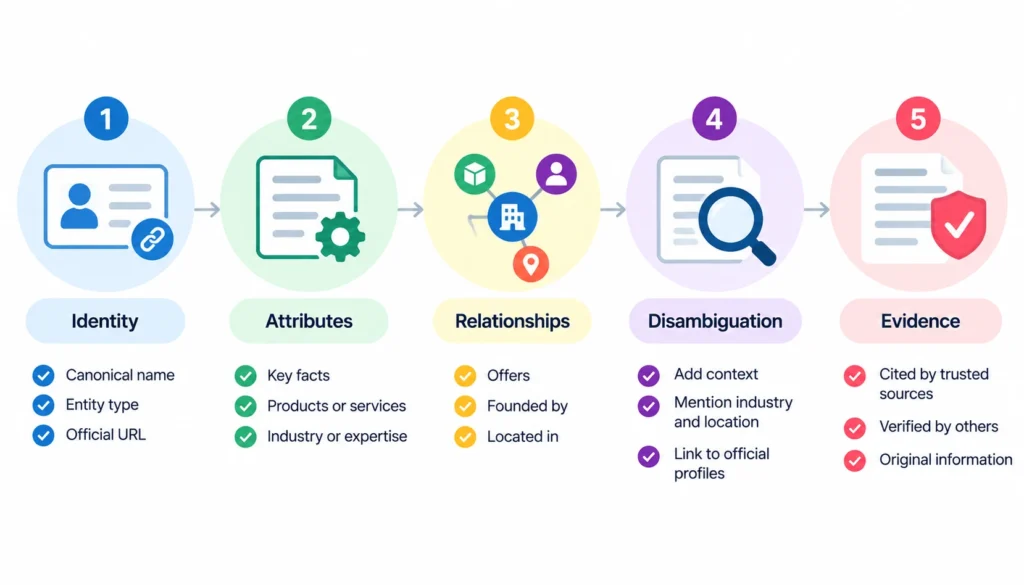
Identity
Identity answers the basic question: which thing is this? Decide on the canonical name, the entity type, the official URL and any recognized identifiers. Use them the same way everywhere.
Attributes
Attributes are facts about the entity. For a company, that could be its description, headquarters, founding year, industry, products and services. For a person, it could be job title, employer, expertise and publications.
Relationships
Relationships connect entities: a company offers a product, a founder founded a company, a business is located in a city, a tool integrates with another tool. These links are what turn a pile of pages into a map.
Disambiguation
If your name is shared with something else, give context early and often. State your industry, location and what you do near the top of key pages. Link to your official profiles. Avoid casual shortcuts in naming that create a second “version” of you.
Evidence and corroboration
A claim on your own site is a start. A claim confirmed by a reputable publication, a professional body, a directory or a customer review is stronger. This overlaps with what Google calls helpful, people-first content, which rewards expertise, original information and clear sourcing. Google has also said E-E-A-T is not a single ranking factor, so treat it as a quality lens, not a checkbox.
How to Build an Entity Map for Your Website
An entity map is a simple document that lists your entities, their facts and how they connect. I would rather you build a plain spreadsheet than buy a tool before you know what you need.
Here is an example. Say a fictional company called Northwind Analytics sells reporting software to retail chains. Its map might look like this:
Northwind Analytics → founded by Dana Reyes → offers Retail Dashboard → serves the retail industry → integrates with Shopify → headquartered in Austin → publishes a guide on inventory forecasting.
To build your own, follow these steps.
- Pick the primary entity. Usually your organization, or a person if you run a personal brand.
- List supporting entities. Products, services, founders, authors, locations, industries, integrations and key topics.
- Write down the attributes. Add the facts you want stated the same way everywhere.
- Draw the relationships. Use short verbs: offers, founded, located in, integrates with.
- Find the gaps. Which entities have no page, no schema, or no outside reference?
- Prioritize. Start with the relationships that affect revenue, such as brand to product and product to category.
Most teams find the gaps are boring and fixable. A founder with no author page. A product described three different ways. A location page that was never linked from the site.
How to Implement Entity SEO on a Website
1. Create clear pages for important entities
Give your main entities their own pages: an About page, author pages, product and service pages, and location pages where relevant. Each page should say plainly what the entity is and link to related entities. Avoid thin pages. A page with two sentences does not establish much.
2. Use consistent names and descriptions
Pick one name for each entity and use it everywhere: site, social profiles, directories and press releases. Small differences, like “Northwind Analytics Inc.” on one page and “Northwind Data” on another, create doubt.
3. Link related entities inside your content
When you mention your product on a blog post, link to the product page with a descriptive anchor. When you mention the author, link to their profile. These links tell readers and crawlers how things connect.
4. Build topic clusters around entities
A pillar page covers the main subject. Supporting pages cover related entities and questions. Link them in both directions. This is classic topic cluster work, applied with entities in mind.
5. Add structured data that matches the page
Structured data labels what is already visible on the page. Google explains that it uses structured data to understand content, and that markup should reflect what users can see (Google’s structured data intro). Common types include Organization, Person, Product, Service, Article, WebPage and WebSite.
How Schema Markup Supports Entity SEO
Schema.org is a shared vocabulary for describing things on the web, and JSON-LD is the format most sites use to add it. You can read the background on Schema.org or browse the vocabulary itself.
What schema actually does
Schema makes facts explicit. Instead of a crawler inferring that “Austin” is your headquarters, you can state it. That reduces ambiguity. It does not make a claim true, and it does not make anyone trust you.
@id vs sameAs
These two are often confused.
| Property | What it does | Example use |
| @id | Gives an entity a unique ID inside your own markup so other nodes can refer to it | Linking an Article to the same Organization node on every page |
| sameAs | Points to other pages that describe the same entity | Linking to your official LinkedIn page or Wikidata record |
The schema.org definition of sameAs describes it as a URL of a reference page that identifies the item. Use it only for pages that are truly about the same entity.
about, mentions, mainEntity, author and publisher
- mainEntity marks the primary subject of a page.
- about names what the content is about.
- mentions lists other entities referenced in passing.
- author and publisher connect content to a person and an organization.
A small JSON-LD example
This is a simplified example for the fictional company above. Replace the values with your real, visible information.
{
“@context”: “https://schema.org”,
“@graph”: [
{
“@type”: “Organization”,
“@id”: “https://www.example.com/#organization”,
“name”: “Northwind Analytics”,
“url”: “https://www.example.com/”,
“founder”: { “@id”: “https://www.example.com/about/dana-reyes/#person” },
“sameAs”: [
“https://www.linkedin.com/company/example-northwind”
]
},
{
“@type”: “Person”,
“@id”: “https://www.example.com/about/dana-reyes/#person”,
“name”: “Dana Reyes”,
“worksFor”: { “@id”: “https://www.example.com/#organization” }
},
{
“@type”: “Article”,
“headline”: “Inventory Forecasting for Retail Chains”,
“author”: { “@id”: “https://www.example.com/about/dana-reyes/#person” },
“publisher”: { “@id”: “https://www.example.com/#organization” }
}
]
}
Does schema markup create an entity?
No. Schema can describe and connect entities, but it does not create authority or guarantee that a search engine or AI system will recognize them. Google also states that structured data does not guarantee a search appearance. Treat it as clear labeling, not a ranking tool.
Entity Linking and Knowledge Graph Optimization
Internal and external entity links
Internal links connect your own pages. External links point to credible references that help define a concept. Linking out to a primary source or a reputable reference is normal and useful for readers.
Wikipedia and Wikidata
Wikidata is an open knowledge base run by the Wikimedia Foundation. If your organization or person meets the notability and sourcing rules, an entry may exist or may be created by independent editors. Do not write promotional entries about yourself. Those get removed, and they damage trust. If you are unsure, build real coverage in credible publications first.
Consistency across the web
Check the places search systems and people already look: company profiles, business directories, professional bodies, publisher bylines and social profiles. Fix mismatched names, addresses, descriptions and logos. For community perspective on what practitioners are seeing, forums like r/TechSEO and r/SEO are useful, though treat individual claims there as opinions to test, not facts.
How to Optimize Entity SEO for AI Search
None of these tactics is a trick. Together they make your content easier to understand and easier to trust.
- State who and what you are, early. Put a clear description near the top of key pages.
- Give full context. Add dates, places, versions, names and definitions so a passage still makes sense on its own.
- Connect related concepts. Link between entities and explain how they relate.
- Back claims up. Cite sources, show data and name authors with real credentials.
- Publish original information. Surveys, benchmarks, case notes and first-hand experience give a system something it can’t get elsewhere.
- Keep facts consistent. Update prices, addresses, team pages and product details everywhere when they change.
- Build depth around core entities. A few well-covered topics beat many shallow ones.
- Keep key information in text. Google’s AI features guidance says to make sure important content is available in text form, and that standard SEO fundamentals still apply.
Entity SEO Audit: 10 Things to Check
Run this audit once a quarter, or after any rebrand or site migration.
- Identity. Is there one clear canonical name, type and official URL for each core entity?
- Entity type. Is each one correctly labeled (company, person, product, service)?
- Naming. Do your site, profiles and directories use the same name?
- Attributes. Are core facts stated plainly and kept current?
- Relationships. Do your pages make clear who offers what, where and for whom?
- Internal links. Do related entity pages link to each other with descriptive anchors?
- Schema. Does your markup validate, and does it match visible content?
- External references. Do credible sites mention you consistently?
- Coverage. Are there important entities or questions your site never addresses?
- AI visibility. What do AI tools say about you, and is it accurate?
How to Measure Entity SEO Success
There is no single “entity score.” You look at a few groups of signals together.
Traditional metrics
Impressions, clicks, average position, click-through rate and conversions in Google Search Console and your analytics. These still tell you whether the work is paying off.
Entity-level signals
Branded search growth, visibility for queries that mention your products or people, Knowledge Panel presence where one is relevant, and how consistent your facts are across the web.
AI search signals
How often your brand or pages are cited or mentioned, whether you’re recommended for relevant questions, and whether the answers about you are accurate. You can check this by running a fixed set of prompts monthly in ChatGPT, Gemini and Perplexity and logging the results. Some SEO platforms also offer AI visibility tracking.
Treat these as diagnostics. AI answers vary by user, location, wording and time, so a single result proves little. Look for trends across many prompts. Tracking mentions and citations matters because AI visibility is becoming part of how people discover brands.
Entity SEO Tools
| Tool | Best use |
| Google Search Console | Indexing, queries, performance and structured data reports |
| Schema Markup Validator | Checking that schema.org markup is well formed |
| Google Rich Results Test | Checking eligibility for Google rich result features |
| Google Natural Language API | Seeing which entities a machine detects in your text |
| Ahrefs and Semrush | Backlinks, mentions, keyword and visibility tracking |
| InLinks and Schema App | Entity-focused content and schema workflows |
| Wikidata | Checking whether a public record exists for an entity |
Start with the free tools. Add paid ones only when your process outgrows a spreadsheet.
Common Entity SEO Mistakes
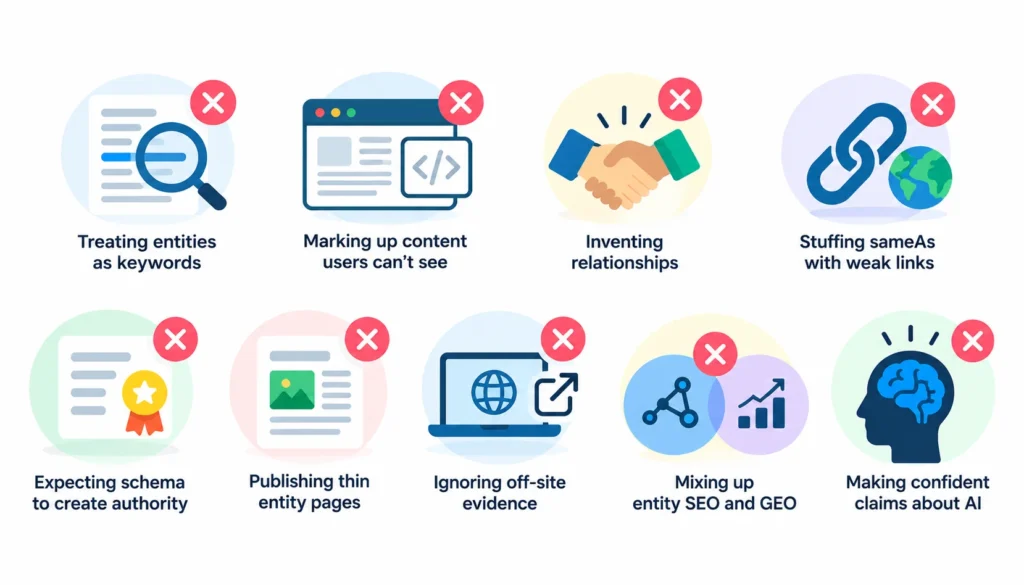
- Treating entities as fancy keywords. The goal is clarity about things, not another list of phrases.
- Marking up content users can’t see. Schema should match the page.
- Inventing relationships. Claiming partnerships or awards you can’t support hurts trust.
- Stuffing sameAs with weak links. Point only to pages truly about the same entity.
- Expecting schema to create authority. It labels. It doesn’t prove.
- Publishing thin entity pages. One paragraph rarely helps anyone.
- Ignoring off-site evidence. Your own site can’t corroborate itself.
- Mixing up entity SEO and GEO. One is a foundation. The other is a visibility goal.
- Making confident claims about AI algorithms. Most of what’s said online is educated guessing.
Entity SEO Examples
SaaS company. Company → product → industry → integrations → founder → customers. Key moves: a clear product page, integration pages that name each partner, and a founder profile with published work.
Local business. Business → location → service → category → reviews. Key moves: consistent name, address and phone details across directories, and a service page for each core service.
Ecommerce brand. Brand → product → category → manufacturer → attributes → reviews. Key moves: complete product attributes and consistent naming across variants.
Personal brand. Person → expertise → publications → employer → credentials. Key moves: an author page, bylines in credible outlets, and a consistent bio everywhere.
What Actually Matters: Myths vs Reality
| Claim | Reality |
| AI ignores keywords | Oversimplified. Language and terms still matter. |
| Schema creates an entity | No. It describes one. |
| Entity SEO guarantees AI citations | No. Nothing does. |
| Clear entities improve machine understanding | Yes, that is the purpose. |
| Traditional SEO still matters | Yes. Google says AI features build on it. |
| Third-party mentions help | Yes, as evidence and context. |
| AI visibility can be measured | Yes, but imperfectly. |
Frequently Asked Questions
1. What is entity SEO?
Entity SEO is the practice of making people, organizations, products, places and concepts clear to search engines, including their facts and relationships, so content is easier to interpret and match to searches.
2. How does entity SEO help AI search?
It reduces ambiguity. AI search tools need to know which entity a source describes and whether its facts are consistent. Clear identity, linked pages and independent references make that easier, though no outcome is guaranteed.
3. Does schema create an entity?
No. Schema describes and connects entities. Recognition and trust depend on the wider evidence about them.
4. What is the difference between entity SEO and semantic SEO?
Semantic SEO covers meaning and context across a topic. Entity SEO focuses on the specific things in that topic and the facts and relationships that define them.
5. Does entity SEO help AI Overviews?
It can help your content be clearer, but Google says no special optimization or markup is required for AI Overviews. Standard SEO fundamentals apply.
6. Does entity SEO improve ChatGPT citations?
There is no confirmed direct link. Clear, consistent, well-supported content gives any system better material to work with.
7. What is entity linking?
Entity linking is matching a mention of something in text to a specific record, such as deciding that “Mercury” means the planet and not the element.
8. What is sameAs?
sameAs is a schema.org property that points to other pages describing the same entity, such as an official profile or a Wikidata record.
9. How do I get my brand recognized as an entity?
Use one consistent name, publish clear pages about who you are, add accurate structured data, and earn mentions from credible independent sources over time.
10. How do you measure entity SEO?
Combine Search Console data, branded search trends, consistency checks and regular AI prompt testing. Look at trends, not single results.
Final Takeaway
Entity SEO and AI search work best as a pair. Entity SEO makes the people, organizations, products and ideas behind your content easier to identify, understand, connect and verify, and AI search tools reward sources that are clear and well supported.
It does not replace keyword research, quality content or links, and nothing here guarantees a citation or ranking. Start small: pick your core entities, fix inconsistencies, build the map, and check what AI tools say about you each month. Steady, honest clarity is the part you control.

Nazish is a skilled content writer dedicated to creating high-quality, engaging, and SEO-focused blogs. She specializes in strategic keyword usage, search intent, and informative content that connects with readers while helping websites strengthen their visibility and rankings in search results.