


Topical authority for AI SEO is the practice of showing search engines and AI systems that your site knows a subject well, through connected, accurate, well-sourced content. It makes your pages look relevant for a whole group of related questions instead of one keyword. It can improve your chances of ranking and of being used as a source in AI answers, but it does not guarantee either.
That last part matters because the term gets oversold. Google has no public topical authority score, and John Mueller once told SEOs not to worry about the label. The idea underneath it still holds up: sites that cover a subject thoroughly, link related pages sensibly, and back their claims with evidence tend to perform better. This guide covers how to build that coverage, how AI search systems may use it, and how to measure progress without making up numbers.
What Is Topical Authority in AI SEO?
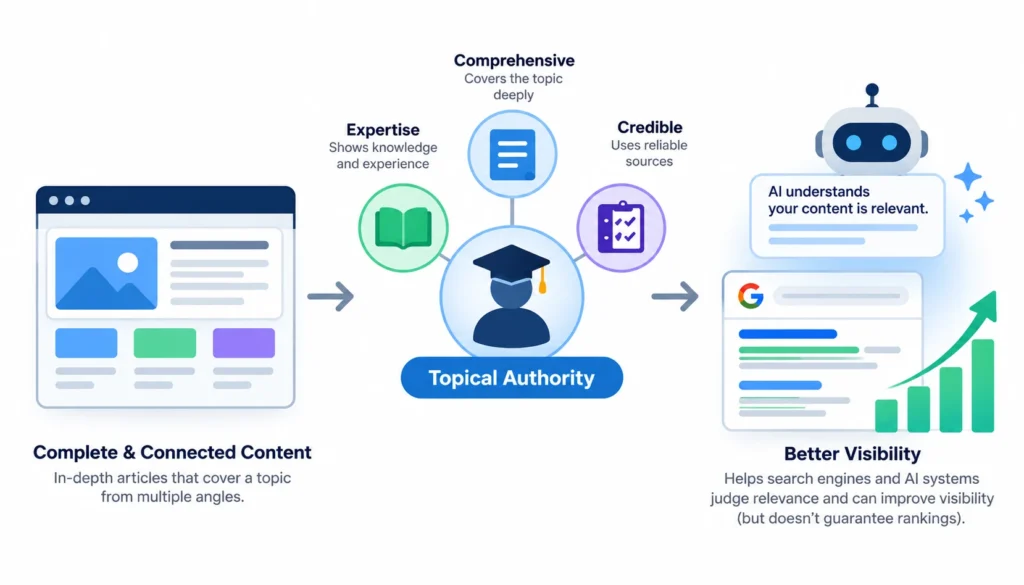
Topical authority in AI SEO is a website’s demonstrated expertise on a subject, shown through complete, connected, and credible content. It helps search engines and AI systems judge whether your pages are relevant to a topic. It supports visibility, but it does not guarantee rankings or AI citations.
What Is Topical Authority?
Picture a small bookshop that only sells cookbooks. Ask about sourdough, knife skills, or regional Thai cooking and it has a shelf for each. A general bookstore might carry a few of those titles, but the cookbook shop looks like the better place to ask.
Websites work the same way. A site that explains a subject from the basics to the edge cases, links those explanations together, and shows real experience gives search systems more reasons to treat it as relevant.
The term itself comes from the SEO community, not from Google. In a 2023 Reddit thread, a commenter called it a new name for relevancy. John Mueller agreed, then said people shouldn’t worry about it, as Search Engine Journal reported. Treat it as a planning lens, not a score you can raise.
What Does Topical Authority Mean for AI Search?
AI search tools take a question, pull in sources that seem relevant, and write an answer. Some show links, some name brands, and some do both. A site with clear, accurate coverage of the whole topic is easier for these systems to match to a question.
Here is what is documented. Google says its AI features, AI Overviews and AI Mode, follow the same basics as Search. Its guidance for site owners says there are no extra requirements to appear in them. A page needs to be indexed and eligible to show with a snippet, and good internal links help Google find it.
Here is what is a reasonable hypothesis: a site that covers a topic in depth gets retrieved for more of the related questions. Nobody outside these companies knows the exact weighting, and ChatGPT, Perplexity, Gemini, and Copilot may each pick sources differently. Subject relevance, content depth, information quality, source credibility, and clear relationships between concepts all plausibly play a part.
Topical Authority vs. Domain Authority
Domain authority is a third-party score. Moz created it, and Ahrefs has a similar Domain Rating. Neither is a Google metric. Topical authority is a different idea: how well a site covers one subject.
| Topical authority | Domain authority | |
|---|---|---|
| Definition | Depth and relevance of coverage on a subject | A domain-level strength score from a third-party tool |
| Measurement | No standard metric; judged through rankings, coverage, and citations | Calculated by tools such as Moz, mostly from backlink data |
| Main signals | Relevant content, expertise, internal links, credibility | Quantity and quality of backlinks |
| Scope | One topic | Whole domain |
| Role in SEO | A planning framework for content strategy | A rough benchmark for comparing sites |
| Limitations | Not a public Google score; easy to overstate | Not a Google metric; differs by provider |
A site can have strong domain authority and thin coverage of a specific topic. A small site can cover one niche better than a big publisher does. Smaller sites usually have more room to compete on depth than on links.
Topical Authority vs. Semantic SEO vs. Entity SEO
These ideas overlap, and people mix them up. They work at different levels.
| Concept | Main purpose |
|---|---|
| Topical authority | Show expertise and coverage within a subject |
| Semantic SEO | Write around meaning and the relationships between ideas, not single keywords |
| Entity SEO | Help search systems identify and understand the people, brands, and concepts you write about |
| AI SEO | Improve visibility across AI-powered search experiences |
AI SEO sits on top of regular search engine optimization, not beside it. Optimizing for AI-powered search reuses those fundamentals and adds work on citations, prompts, and brand mentions. The other three ideas feed into it.
Why Topical Authority Matters for AI SEO
How Topical Authority Supports Traditional SEO
Focused coverage helps in classic search because it answers more of what searchers want to know. A page that ranks for one query often picks up long-tail variations when the rest of the site backs it up.
The practical gains are easy to name. You rank for related queries, not just one. You find long-tail opportunities. Your content architecture gets cleaner. Internal links point somewhere useful. Visitors find the next answer without leaving. The two disciplines also overlap more than they differ, because classic SEO and AI-focused optimization both depend on relevance, crawlability, and helpful content.
How Topical Authority Can Support AI Search Visibility
AI answers are built from retrieved pages, so being relevant across a topic can help you get retrieved.
The platforms behave differently. Google’s AI Overviews work from Google’s index, and publishers adapt to how AI Overviews affect SEO mainly by keeping the fundamentals sound. ChatGPT uses its own search process, so how it finds and ranks content is a separate question from how Google does it. Perplexity, Gemini, and Microsoft Copilot each have their own habits. Don’t assume a tactic that works on one transfers to the others.
Why AI Search Requires More Than Content Volume
Publishing more is not the same as covering a topic well. Four different things get mixed together:
- Publishing more content means adding pages.
- Publishing relevant content means adding pages that fit your subject.
- Covering a topic comprehensively means answering the questions people actually ask about it.
- Demonstrating expertise means the content shows experience that a generic summary can’t.
Only the last two build authority. A site with 20 sharp, well-linked resources often serves readers better than one with 100 near-duplicates. Analysis by Kevin Indig of more than 21,000 AI citations found that breadth of topic coverage mattered more than domain authority in his sample, though that is one dataset and the full write-up sits behind a paywall at Growth Memo.
Topical Authority vs. AI Citation Eligibility
Being relevant to a topic does not mean you’ll be cited for a specific question. The AI picks sources for that exact question, and it weighs page relevance, source quality, and how well a passage answers the prompt.
Citations and brand mentions are also separate outcomes. A Semrush study with Growth Memo looked at 3,981 domain appearances across four AI engines and found that about 62% of citations came without the brand being named in the answer. The Semrush study also found that engines behave differently. A separate Semrush analysis of ChatGPT found that whether a brand was only cited or also mentioned by name depended on how close the category was to the brand’s core expertise.
The takeaway is practical. Stay close to your core topic if you want to be named, not just used as a source.
What Topical Authority Can and Cannot Do for AI SEO
Topical authority can:
- Show that your site covers a subject in depth
- Improve content organization and the reader’s path through your site
- Support organic visibility when combined with other SEO factors
Topical authority cannot:
- Guarantee AI citations
- Act as a public Google ranking score
- Replace technical SEO, content quality, or outside credibility
How AI Search Engines Understand Topical Relevance
How Search Systems Understand Topics and Entities
Search systems try to work out what a page is about, not just which words it contains. They look at entities (people, brands, products, concepts), how those entities relate, and what the searcher most likely wants. This is the basis of information retrieval, the field behind search.
For you, that means being specific and consistent. Name things clearly, define terms the same way across pages, and connect related ideas explicitly.
How Content Relationships Help Establish Topical Context
Pillar pages, supporting articles, and internal links show how your content fits together. A link from “how to track AI citations” to your main AI SEO guide tells a crawler and a reader that the two pages are related. Descriptive anchor text adds context that a bare “click here” never could.
Consistency matters too. A site that keeps returning to the same subject with fresh, specific angles looks more focused than one that jumps between topics.
How AI Search Retrieves and Uses Content
Many AI search tools use some form of retrieval-augmented generation, or RAG. In plain terms, the system first retrieves relevant passages from a collection of documents, then a language model writes an answer using them, and some tools attach citations.
Not every platform works this way, and the details are not public, so how AI search engines work can differ from one product to the next. The safe takeaway is that passages matter. A page with clear, self-contained sections gives a retrieval system more to work with.
What Makes a Page Useful as an AI Source?
These traits are reasonable hypotheses, not confirmed ranking factors:
- A direct answer near the top of each section
- Clear, descriptive headings
- Accurate, current information
- Evidence such as data, examples, or named sources
- Original insight a summary wouldn’t contain
- A readable structure with short paragraphs and tables where they fit
How to Build Topical Authority for AI SEO
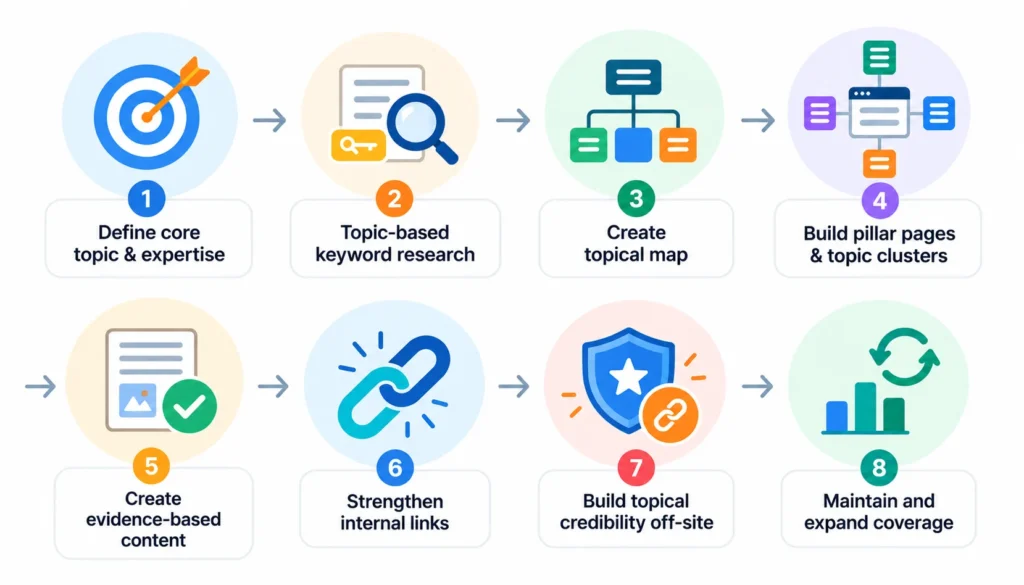
This is the working part. Follow these eight steps in order, and expect them to take months, not weeks.
Step 1: Define Your Core Topic and Expertise
Pick the one subject you can speak about from experience and that your customers search for. Every later decision gets measured against it.
Identify Your Main Business Topic
A project management SaaS company should own “project management,” not “productivity” in general. An SEO agency might own technical SEO for ecommerce. A climbing gear store might start with one slice, such as rope and belay equipment, and grow from there.
Define Your Topical Boundaries
Write a one-sentence scope statement, then test every idea against it. If your agency covers technical SEO, a post on social media dance trends fails the test. A post on JavaScript rendering passes.
Identify Your Audience’s Main Problems
List the ten problems customers raise most in sales calls, support tickets, and onboarding emails. These tell you more about real needs than a keyword tool does. Each problem becomes a candidate page or section.
Step 2: Conduct Topic-Based Keyword Research
Topic-based research starts with a seed list, expands into subtopics and questions, then adds the prompts people type into AI tools. Group results by intent, not by exact phrase.
Identify Seed Keywords
Choose five to ten broad, relevant terms. Check Google Search Console for queries you already get impressions for. Those show where you have a foothold.
Discover Related Keywords and Subtopics
Use a tool like Ahrefs or Semrush to pull primary, secondary, and long-tail keywords, plus related questions. Note the intent behind each: learning, doing, comparing, or buying. Two keywords with the same intent usually belong on one page.
Research AI Search Prompts
Type your seed topics into ChatGPT, Perplexity, Gemini, and Google AI Mode. Record the follow-up questions, the comparisons, and the formats the answers use. Prompts tend to be longer and more conversational than keywords, and the Semrush data above suggests longer prompts lead to more citations but fewer brand mentions.
Analyze Competitor Topic Coverage
List the subtopics your top competitors cover that you don’t. Then look at which sites the AI answers cite for your target prompts. If the same few domains appear every time, study what they cover and how they structure it.
Step 3: Create a Comprehensive Topical Map
A topical map is a plan listing the pillar topics, subtopics, and pages a site needs, with every keyword assigned to one page. Build it in five steps:
- Select a core business topic.
- Identify related subtopics and questions.
- Group them by search intent.
- Assign topics to pillar pages and supporting articles.
- Map internal links and prioritize publication.
Identify Pillar Topics
Pillar topics are the big subjects you want to own. For the project management company, that might be project planning, task management, resource allocation, methodologies, software comparisons, and automation. Keep the list short enough that you can cover each one properly.
Group Supporting Topics into Clusters
Under each pillar, group subtopics by meaning and intent. “What is a Gantt chart,” “how to read a Gantt chart,” and “Gantt chart vs. Kanban” are related but answer different needs, so they may need separate pages.
Map Keywords to the Correct Pages
Give each keyword one home. When two pages chase the same query, they compete with each other, which is called keyword cannibalization. If the intent is the same, merge. If it differs, keep them separate and make the difference obvious in the titles and opening lines.
Prioritize Topics Based on Business Value
Score each topic from 1 to 5 on the factors below and publish the highest totals first. This is a simple internal model, not an industry standard.
| Factor | Question to ask |
|---|---|
| Business relevance | Does this topic connect to what we sell? |
| Search demand | Do people actually search for this? |
| Competition | Can we realistically compete? |
| Content gap | Is the topic missing or weak on our site? |
| Existing authority | Do we already rank near this topic? |
| Conversion potential | Could readers become customers? |
Step 4: Build Pillar Pages and Topic Clusters
A pillar page covers a broad topic and links to detailed supporting articles. Each supporting article goes deep on one subtopic and links back.
What Is a Pillar Page?
A pillar page is the central guide for a topic. It gives a complete overview, answers the main questions briefly, and points to deeper pages. It differs from a normal blog post in scope: it’s built as a hub, not a single answer.
What Is a Topic Cluster?
A topic cluster is the group of supporting pages around a pillar. Each page covers one subtopic in detail, so the cluster as a whole covers the subject from several angles.
How to Structure a Topic Cluster for AI SEO
| Page type | Example |
|---|---|
| Pillar page | Complete Guide to AI SEO |
| Supporting article | How to Optimize for AI Overviews |
| Supporting article | How to Measure AI Search Visibility |
| Supporting article | How to Build Topical Authority |
| Supporting article | AI Citation Tracking |
| Supporting article | Entity SEO for AI Search |
When NOT to expand a cluster: stop adding pages when new ideas only restate existing ones, or when a topic drifts away from your real expertise. A cluster is finished when readers’ questions are answered, not when a page-count target is hit.
Step 5: Create High-Quality, Evidence-Based Content
Good content for authority work answers the question fully, shows where the information comes from, and adds something the reader can’t get from a generic summary.
Match Content to Search Intent
Look at what already ranks for the query. If the top results are step-by-step guides, a thin definition page won’t compete. If they’re comparison tables, a long essay won’t either. Match the format first, then beat the depth.
Demonstrate First-Hand Experience
Show your work. Include screenshots of your own dashboards, the checklist you actually use, or a mistake you made and fixed. If you have real client results, share them with the methodology. If you don’t, say less. Never invent a case study.
Add Evidence and Expert Insights
Cite original research, name the author and their credentials, and link to the source for any figure. A claim with a source is easier to trust, and easier for an AI system to reuse accurately.
Optimize Content for AI Retrieval
Start each major section with a direct answer of about 40 to 60 words, then add the detail. Use descriptive headings, define terms in plain language, and keep each section self-contained so it still makes sense if a system pulls only that passage. This is good editorial practice for readers. It is not a guarantee of a snippet or a citation.
Step 6: Strengthen Internal Linking
Internal links show how your pages relate and help crawlers and readers find them. Google’s own guidance lists findability through internal links as part of being eligible for AI features.
Link Supporting Articles to Pillar Pages
Every supporting article should link up to its pillar, and the pillar should link down to each supporting article. Add sideways links between closely related articles, where a reader would naturally want the next step.
Use Descriptive and Relevant Anchor Text
Write anchors that tell the reader what they’ll find. “Our guide to tracking AI citations” works. “Click here” and “read more” don’t. Vary the wording naturally instead of repeating one exact phrase.
Build a Logical Internal Linking Structure
A simple structure: pillar page at the center, supporting articles linked to and from it, and a few cross-links between neighbors. A before-and-after check helps. Before, a supporting article might have two inbound links from the blog index. After, it has links from the pillar and from three related articles, each with descriptive anchors.
Avoid Orphan Pages and Broken Links
Crawl your site with Screaming Frog or Sitebulb and list pages with zero inbound internal links. Fix them by adding relevant links from related content. Repair or remove broken links in the same pass.
Step 7: Build Topical Credibility Beyond Your Website
What others say about you carries weight that your own pages can’t. This is the slowest step and the hardest to fake.
Earn Relevant Backlinks
A link from a respected site in your field says more than ten from unrelated sites. Original data, free tools, and expert quotes tend to earn them. Relevance matters more than volume.
Build Brand Mentions
Get your brand named in industry publications, podcasts, and communities where your audience already reads. Growth Memo reports that LinkedIn ranks among the most cited sources across ChatGPT Search, Perplexity, and Google AI Mode in the data it analyzed, which is one reason original posts by named experts are worth the effort.
Demonstrate Expertise Across Relevant Channels
Contribute guest articles, answer questions in forums where your topic is discussed, and speak at events. Use the same author name and bio across them so people, and systems, can connect the work to one expert.
Step 8: Maintain and Expand Your Topical Coverage
Topical authority is a maintenance job. Content ages, gaps appear, and competitors publish.
Identify Missing Subtopics
Re-run your keyword and prompt research every quarter. Compare it against your topical map and add what’s missing.
Update Outdated Content
Update a page when facts, tools, or search behavior have changed, not just to change the date. Replace stale statistics, fix screenshots, and add what you’ve learned since publishing.
Consolidate Overlapping Articles
If two pages target the same intent, merge them into the stronger one and redirect the weaker URL. Keep the best material from both.
Expand into Adjacent Topics
Move into a neighboring topic only after the core is covered and you have real expertise there. Expanding because a keyword has volume is how sites end up with content they can’t back up.
How to Create a Topical Map for AI SEO
A topical map becomes useful once it’s written down with page types and intents next to every topic. Here is a worked example for a site focused on AI search optimization.
Topical Map Example: AI SEO
| Pillar topic | Supporting topic | Example search intent |
|---|---|---|
| AI SEO | AI SEO fundamentals | Informational |
| AI SEO | AI search visibility | Informational |
| AI SEO | AI citation tracking | Practical |
| AI SEO | AI Overviews optimization | Practical |
| AI SEO | Entity SEO | Informational |
| AI SEO | Generative engine optimization | Informational |
| AI SEO | AI SEO tools | Commercial investigation |
Now take a different case: a site with 30 SEO articles and no clear structure. A quick audit usually turns up the same problems:
| What to check | What you’re looking for |
|---|---|
| Missing subtopics | Questions in your topical map with no page |
| Overlapping articles | Two or more pages targeting the same intent |
| Weak internal linking | Pages with few or no relevant inbound links |
| Uncovered intents | Queries where you only have one format, such as guides but no comparisons |
| Irrelevant content | Pages far from your core subject |
| Missing evidence | Claims with no source, data, or first-hand detail |
This scenario is illustrative, not a client result. The point is the method: list every URL, tag it with a topic and intent, and the gaps show up.
How to Turn a Topical Map into a Content Calendar
- Prioritize high-value topics using the scoring table above.
- Identify dependencies, such as definitions other pages will link to.
- Publish the pillar page first.
- Write the supporting articles.
- Add contextual internal links in both directions.
- Measure results after a few weeks.
- Expand based on performance and the gaps you find.
How to Avoid Keyword Cannibalization in Topic Clusters
Put related keywords on one page when the searcher wants the same thing. “AI SEO guide” and “guide to AI SEO” are one page. Split them when the need differs. “How to track AI citations” is a how-to, and “best AI citation tracking tools” is a comparison. Check Search Console for queries where two of your URLs swap positions. That is a common sign of cannibalization.
How to Measure Topical Authority for AI SEO
You can’t measure topical authority with one number. You can track several observable signals over time and see whether they move together.
Is There a Universal Topical Authority Score?
No. Google has not published one, and no third-party figure should be treated as Google’s view. Some tools offer proprietary scores. Semrush, for example, describes its Topical Authority metric as its own AI-based estimate of how closely a domain’s content matches a seed keyword. That makes it a useful comparison inside one tool and nothing more.
Kevin Indig has proposed a method that combines several signals in his Search Engine Journal piece on how to measure topical authority. It’s worth reading as one practitioner’s approach, not a standard.
Key Metrics for Measuring Topical Authority
| Metric | What it measures |
|---|---|
| Topic-level organic visibility | Search presence across related queries |
| Keyword coverage | Number and range of relevant keywords you rank for |
| Organic impressions | Search exposure |
| Organic clicks | Search traffic |
| Ranking distribution | How many cluster pages sit in positions 1 to 3, 4 to 10, and beyond |
| AI citation frequency | How often your pages are cited in AI answers |
| AI brand mentions | How often your brand is named |
| Citation coverage | Share of your tracked prompts where you appear |
| Content gap closure | Progress on the subtopics in your map |
How to Measure AI Search Visibility
AI answers change from run to run, so one check proves little. Use a fixed prompt set and repeat it. Tracking AI search visibility comes down to how often AI answers cite or mention you across that set.
Track AI Citations
Pick 30 to 50 prompts that reflect your topics. Run them on a schedule and log which pages, if any, get cited. Citation coverage is simply the share of prompts where you appear. If you’re cited on 12 of 40 prompts, that’s 30%.
Track Brand Mentions
Record mentions separately from citations. As the Semrush data showed, a page can be cited without your brand being named, and the reverse can happen too.
Track Visibility Across Multiple Platforms
Check Google AI Overviews, ChatGPT, Perplexity, and Gemini separately, where your tools allow it. Averages can hide the fact that you’re visible on one and absent on another.
Monitor Changes Over Time
Compare month to month, not day to day. Expect noise. Treat a change as real only if it holds across several runs and several prompts.
How to Build a Topical Authority Measurement Dashboard
A spreadsheet works fine. Create one row per topic cluster and fill in the columns monthly.
| Cluster | Impressions | Clicks | Ranking distribution | AI citations | Brand mentions | Citation coverage | Gap status |
|---|---|---|---|---|---|---|---|
| AI Overviews optimization | |||||||
| AI citation tracking | |||||||
| Entity SEO |
The numbers on their own won’t prove cause and effect. Rankings can rise for many reasons, so write down what you changed each month and read the dashboard with that log beside it.
Best Tools for Building Topical Authority for AI SEO
No single tool gives a definitive topical authority score. Use each for what it does well.
1. Ahrefs for Topic Research and Content Gaps
Ahrefs is strong for keyword research, competitor analysis, and finding topics your competitors rank for that you don’t. Use its content gap view when you build the topical map.
2. Semrush for Keyword Research and AI Visibility
Semrush covers topic research and competitor analysis, and it includes AI visibility monitoring. Remember that its topical metrics are its own estimates.
3. Google Search Console for Organic Performance
Search Console is free and comes straight from Google. It shows impressions, clicks, queries, and indexing status, so it’s the baseline for every cluster you track. Google says sites appearing in AI features are included in the overall search traffic reported there.
4. Screaming Frog for Internal Linking and Technical Audits
Screaming Frog crawls your site and shows internal links, broken links, and orphan pages. Run it before and after you restructure a cluster.
5. AI Search Visibility Tools
These platforms run your prompt set across AI engines and log citations and mentions. They save time on repetition. Check how each one collects its data before you trust its trends.
Common Topical Authority Mistakes That Hurt AI SEO
Publishing Too Much Low-Quality Content
Volume doesn’t prove expertise. Thin pages dilute a site that otherwise has something to say.
Targeting Irrelevant Topics
Content far from your core subject makes the site look unfocused and is hard to support with real experience.
Creating Too Many Similar Articles
Near-duplicate pages compete with each other. Merge them or give each a clearly different purpose.
Ignoring Internal Linking
Disconnected pages are harder for readers and crawlers to find, and they waste the work you put into the cluster.
Treating AI Citations as Guaranteed
No amount of coverage guarantees a citation. Plan for the possibility that you’re relevant and still not selected for a given prompt.
Relying Only on AI-Generated Content
AI drafts are fine as a starting point, but unedited output has no first-hand experience in it. Add your own data, examples, and judgment before publishing.
Measuring Only Organic Rankings
Rankings miss citations and brand mentions in AI answers. Track both sets.
Topical Authority for AI SEO: A Practical Checklist
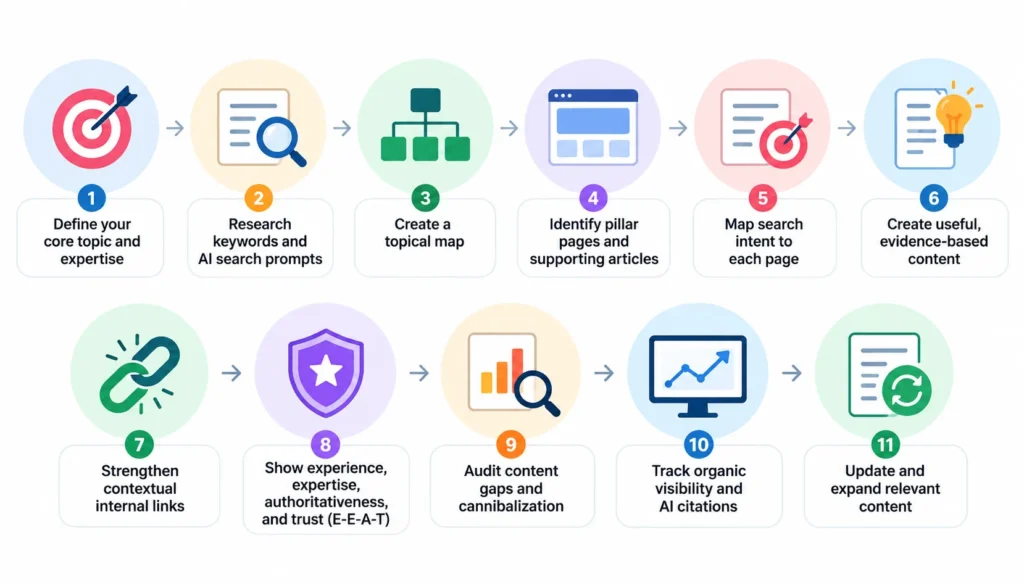
Copy this list into your project tracker.
- Define your core business topic and expertise
- Research keywords and AI search prompts
- Create a topical map
- Identify pillar pages and supporting articles
- Map search intent to each page
- Create useful, evidence-based content
- Strengthen contextual internal links
- Show experience, expertise, authoritativeness, and trust (E-E-A-T)
- Audit content gaps and cannibalization
- Track organic visibility and AI citations
- Update and expand relevant content
Frequently Asked Questions About Topical Authority for AI SEO
1. What Is Topical Authority in AI SEO?
It is a site’s demonstrated expertise and full coverage of a subject, supported by connected, credible content. It can help search engines and AI systems see your relevance, but it doesn’t guarantee rankings or citations.
2. Does Topical Authority Help AI Overviews?
It may. Google says AI Overviews follow the same SEO basics as Search, so relevant, helpful, indexed content is the starting point. There is no confirmed standalone benefit.
3. How Do You Build Topical Authority?
Define your topic, research keywords and prompts, build a topical map, publish pillar and supporting pages, link them, show real expertise, measure, and keep updating.
4. How Many Articles Are Needed to Build Topical Authority?
There’s no fixed number. It depends on how broad the topic is, what your audience needs, and how strong your competition is. Cover the questions that matter and stop there.
5. How Long Does It Take to Build Topical Authority?
Months, and often longer. Results depend on competition, your starting content, site quality, and how consistently you publish.
6. Is Topical Authority a Google Ranking Factor?
Not as a named factor. Google hasn’t confirmed a standalone topical authority signal, and Mueller has downplayed the term. The practices behind it, such as relevance and helpful content, do matter for ranking.
7. What Is the Difference Between Topical Authority and Domain Authority?
Topical authority describes depth on one subject. Domain authority is a third-party, backlink-based score for a whole domain. Neither comes from Google.
8. Can a Small Website Build Topical Authority?
Yes, by staying narrow. A small site that covers one niche thoroughly can compete where a broad site spreads itself thin.
9. Does Topical Authority Increase AI Citations?
Relevant coverage may help you get retrieved, but selection depends on the prompt, the page, and the platform. Treat it as one input.
10. How Can You Measure Topical Authority?
Combine topic-level organic visibility, keyword coverage, ranking distribution, citation coverage, brand mentions, and content gap closure. Avoid relying on any single score.
Conclusion:
Topical authority for AI SEO comes down to covering a subject you truly know, organizing that coverage so it’s easy to follow, and backing it with evidence. It supports your chances in both Google results and AI answers, but it works alongside technical SEO, content quality, and outside credibility, and it can’t promise a ranking or a citation. AI SEO builds on established search practice, so the fundamentals still do most of the work.
If you want a first step, run a topical audit this week. List your existing pages, tag each with a topic and intent, find the gaps and overlaps, then draft a topical map. Once that’s in place, you’ll know what to publish next, and you’ll have clear evidence to show your team when you ask for time to do the work.

Nazish is a skilled content writer dedicated to creating high-quality, engaging, and SEO-focused blogs. She specializes in strategic keyword usage, search intent, and informative content that connects with readers while helping websites strengthen their visibility and rankings in search results.