
AI search visibility is how often, and how prominently, a brand, website, or product appears in AI-generated answers on platforms like ChatGPT, Google AI Overviews, Gemini, and Perplexity. It is not a rank on a list. It is whether the AI names you, cites you, or recommends you when someone asks a question.
That difference matters because more people now get an answer without scrolling through ten blue links. Your page can sit at #1 on Google and still be missing from the answer a buyer reads. If you have ever wondered what AI search visibility is and why a competitor keeps showing up instead of you, this guide is for you.
Here you will learn what visibility actually consists of, how AI systems pick their sources, how to measure it without paying for a tool, and what to fix first. One caution up front: the field is young, and nobody has a single agreed-upon score. I will tell you where the evidence is solid and where it is not.
What Is AI Search Visibility?
AI Search Visibility Definition
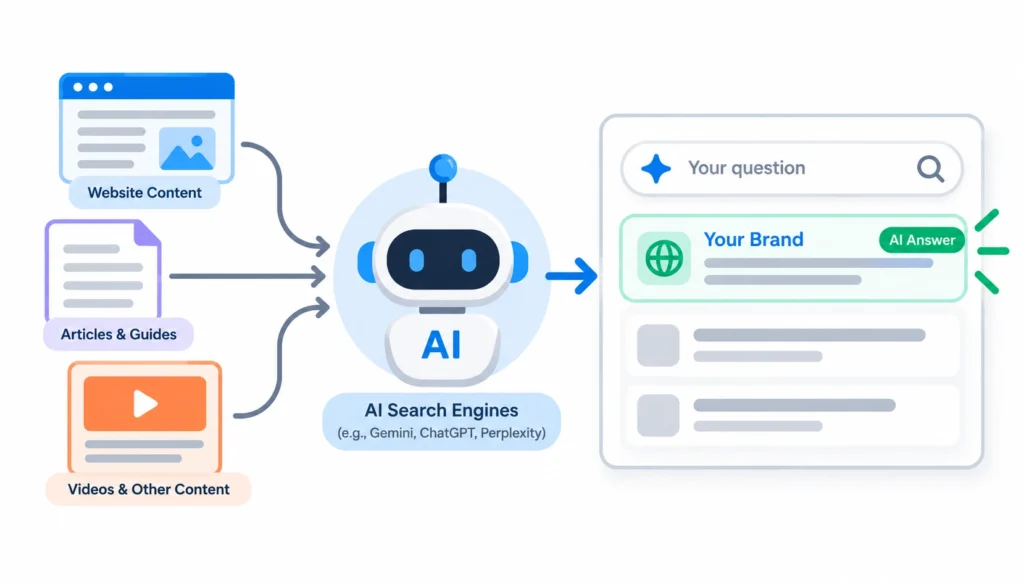
AI search visibility is the extent to which a brand, website, product, or its information appears in AI-generated answers when people search through AI-powered platforms such as ChatGPT, Google AI features, Gemini, or Perplexity.
Think of it as presence inside the answer, not position on a results page. In classic search, you compete for a spot in a list. In AI search, you compete to be part of a single written response.
One important note: there is no universal, standardized definition yet. Tool vendors each measure slightly different things, such as mentions, citations, share of voice, or sentiment. The practical definition above holds up across all of them.
What Does It Mean in Practice?
Picture someone typing: “What’s the best project management tool for a small design agency?” The AI writes a short answer, names three tools, and links to two sources.
If your tool is one of the three, you have visibility. If your blog post is one of the two links, you have visibility of a different kind. When the AI says ‘start with Tool X,’ you have the strongest kind. We will separate these shortly.
What Counts as Being Visible?
A brand can show up in AI answers in several ways:
- Mention: the AI names your brand or product.
- Citation: the AI uses your page as a source, often with a link.
- Recommendation: the AI tells the user to choose you.
- Accurate representation: the AI describes what you do correctly.
These are related, but they are not the same thing. Treating them as one number hides what is really going on.
How AI Search Visibility Works
You do not need to know the math behind large language models. You do need a simple picture of the flow, because each step is a place where you can win or lose visibility.
Step 1: A user asks a prompt. People write full questions and add context, like their budget or team size. These prompts are longer and more specific than typical keyword searches.
Step 2: The system retrieves information. Many AI search tools pull in fresh web content before answering. This pattern is often called retrieval-augmented generation. The model also relies on what it learned in training.
Step 3: The system selects and blends sources. It does not just copy the top result. It combines facts from several pages and decides which ones to trust.
Step 4: Your brand or page appears, or it does not. This is where a mention or a citation happens.
Step 5: The AI may recommend. Showing up in a list is one thing. Being the pick is another.
Every AI product works a little differently, so treat this as a general model, not a rulebook.
The Five Levels of AI Search Visibility
Most definitions stop at “appearing in AI answers.” That is too blunt to act on. It helps to think of visibility as a ladder with five rungs.
- Retrieval visibility. The system finds your content while gathering information. You may never see this one, but without it nothing else can happen.
- Mention visibility. The AI names your brand or product in its answer.
- Citation visibility. The AI uses your page or domain as a source.
- Recommendation visibility. The AI actively suggests you as a good choice.
- Accurate and favorable visibility. The AI recommends you and describes you correctly, with fair context.
Here is why the ladder matters. Say an AI names Company A but links to Company B’s article. Company A earned a mention. Company B earned a citation. Neither automatically earned a recommendation.
If you only track “did we appear,” you can feel good about a mention that does nothing for sales. If you track each rung, you see where you are stuck.
This ladder is a working framework, not an industry standard. It builds on a distinction that several SEO publishers have also drawn between retrieval, citation, and recommendation.
AI Search Visibility vs Traditional SEO Visibility
The Core Difference
| AI Search Visibility | Traditional SEO Visibility | |
| What it measures | Presence in AI-written answers | Rankings, impressions, clicks |
| Typical signals | Mentions, citations, recommendations | Position, click-through rate |
| Starting point | A conversational prompt | A keyword or query |
| Sources | Usually blended from many pages | One result per listing |
| Consistency | Answers can change between runs | Results shift, but are more stable |
SEO asks, “Where do I rank?” AI visibility asks, “Am I part of the answer?” The gap between these two optimization approaches is smaller than it looks, since both rest on the same technical and content foundations.
Why a #1 Google Ranking Does Not Guarantee AI Visibility
Imagine your page ranks first for “best CRM for startups.” A founder asks ChatGPT the same thing and gets HubSpot, Salesforce, and Pipedrive. Your page never comes up, and the reason usually sits in ChatGPT’s source selection.
There are a few reasons this happens. AI systems blend many sources, so one great page is not enough. They also lean on brand reputation and on what other sites say about you. And they need content they can pull a clean fact from, not just a page that matches a keyword.
The numbers back this up. One Semrush study found that only 44.3% of pages in Google’s top 10 also appeared in at least one AI-generated answer in the dataset it analyzed. You can read the details on Semrush’s AI visibility guide. Treat that figure as a snapshot of one study, not a law.
Can a Page Rank Poorly and Still Get Cited?
Yes. AI tools sometimes cite pages that do not sit in the top results, such as forum threads, niche blogs, or documentation. A page that answers a narrow question clearly can beat a stronger page that answers it vaguely.
How SEO and AI Visibility Work Together
Do not read any of this as “SEO is dead.” Semrush’s research on SEO and AI search reported a strong relationship between a site’s organic keyword footprint and how often it is cited by AI platforms. The authors note that correlation is not proof of cause.
A sensible reading is this. Good SEO builds authority and discoverability. AI visibility adds new questions on top: how easy is your content to extract, and who else vouches for you? If you are new to the basics, Wikipedia’s overview of search engine optimization is a fair starting point.
Where Does AI Search Visibility Happen?
Visibility is not one place. It is spread across several products, and they do not behave alike.
- ChatGPT: conversational answers, sometimes with web sources and links.
- Google AI Overviews: summaries shown above or within regular Google results. Google explains how they work in its AI features documentation.
- Google AI Mode: a more conversational, follow-up style search experience inside Google.
- Gemini: Google’s AI assistant.
- Perplexity: an answer engine that shows its sources prominently.
- Microsoft Copilot: AI answers tied to Microsoft’s search and apps.
- Claude and other assistants: growing sources of research and recommendations.
Do not assume one platform tells you how the rest behave. A brand can be well represented in one and absent in another.
What Does AI Search Visibility Look Like? Examples
The examples below are illustrative. They show the pattern, not real results.
Informational query: “What is schema markup?” The AI gives a short definition and may cite a documentation page or a well-known guide. Visibility here usually means being cited as the source.
“Best” query: “Best running shoes for flat feet.” The AI lists a few models. Visibility means being named, and ideally being the first or most-praised pick.
Comparison query: “Notion vs Asana for a five-person team.” Both brands are mentioned by default. The real contest is the framing: who is called simpler, cheaper, or better for small teams.
Local query: “Best dentist near me.” Visibility often depends on consistent business listings, reviews, and location details across the web.
B2B query: “Which tool helps track employee time across projects?” Third-party reviews, comparison articles, and community discussions often shape who gets named.
In each case, ask the same four questions. Were we mentioned? Were we cited? Were we recommended? Was it accurate?
How Is AI Search Visibility Measured?
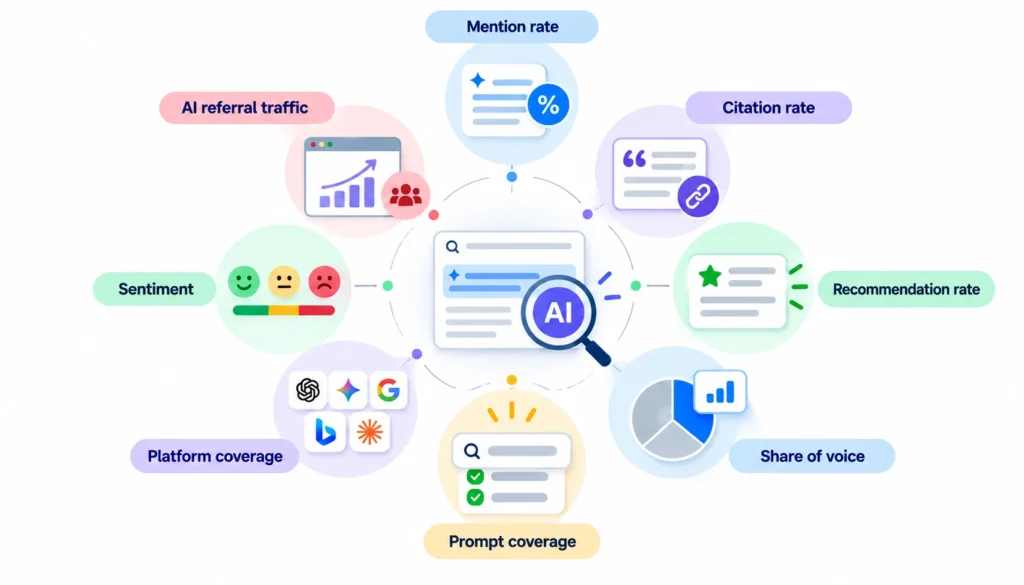
Because the field is new, metrics vary by tool. These are the ones you will see most often, and they are the ones I would start with.
- Mention rate: the share of tested prompts where your brand is named.
- Citation rate: the share of prompts where your pages are used as sources.
- Recommendation rate: how often the AI suggests you as a choice.
- Share of voice: your mentions as a percentage of all brand mentions in the set, yours plus competitors’.
- Prompt coverage: how many of your important topics produce any visibility at all.
- Platform coverage: how many AI platforms show you.
- Sentiment: whether the context around your name is positive, neutral, or negative.
- Citation quality: whether you are cited as a main source or a passing one.
- AI referral traffic: actual visits that arrive from AI platforms, which you can check in your analytics.
No single metric tells the whole story. Pair a presence metric, like mention rate, with an outcome metric, like referral traffic.
How to Measure AI Search Visibility Without a Paid Tool
You can learn a lot with a spreadsheet and an hour or two. Here is a simple method.
- Build a prompt list. Write 20 to 50 questions your customers really ask. Use their words, not your internal jargon.
- Group prompts by intent. Label each one informational, commercial, comparison, transactional, or local.
- Test several platforms. Run the same prompts in ChatGPT, Gemini, Perplexity, and Google’s AI features.
- Record mentions and citations. For each answer, note whether you were named and whether your site was linked.
- Record competitors. Note who else appears, and in what order.
- Check context. Is the description accurate? Is the tone positive, neutral, or negative?
- Calculate share of voice. Divide your mentions by all brand mentions, then multiply by 100.
- Repeat. Run the same set weekly or monthly and track the trend.
Here is what a result might look like for a fictional SaaS company that tested 100 prompts:
| Metric | Result |
| Prompts tested | 100 |
| Brand mentions | 38 |
| Citations | 24 |
| Recommendations | 12 |
| Competitor mentions (all rivals) | 61 |
| Share of voice | 38% (38 ÷ 99 total mentions) |
The story in that table: the brand is named often, but it is recommended only about a third as often as it is mentioned. That tells you where to focus.
Why one test is not enough. AI answers are not fixed. The same prompt can produce different results on different days or even back to back. Zapier makes the same point in its guide to AI visibility tools. So treat any single response as a data point, not a verdict. Repeat prompts, use more than one platform, and keep your method consistent.
What Is a Good AI Visibility Score?
Honestly, there is no universal answer. Each tool calculates its score differently, and SE Ranking itself says there is no industry benchmark yet for a good score.
A more useful approach is to compare like with like:
- The same prompts
- The same platforms
- The same time period
- The same set of direct competitors
A 20% share of voice might be strong in a crowded market and weak in a niche one. Your trend against your rivals matters more than any isolated number.
Why AI Search Visibility Matters
People use AI tools to build shortlists, compare options, and get quick explanations. If you are not in the answer, you may be out of the running before the buyer ever opens Google.
Here is what is at stake:
- Discovery: AI is becoming a place where people first hear about brands.
- Consideration: being named shapes which options feel credible.
- Reputation: the way AI describes you can stick with the reader.
- Referral traffic: some visitors do click through to cited sources.
- Early-funnel influence: you may be shaping decisions long before a click.
I would stay measured here. How much traffic and revenue AI visibility drives still varies a lot by industry, and public data is limited. Track your own numbers rather than relying on broad claims.
Why Your Brand May Not Appear in AI Search
If competitors keep showing up and you do not, one of these is usually the cause.
- Thin topical authority. You have a page or two on a topic where others have a full library.
- Unclear information. Your pricing, features, or audience are vague or buried.
- Weak entity signals. Your brand name, description, and details are inconsistent across the web.
- Little first-party evidence. You make claims but share no data, case studies, or original research.
- No third-party corroboration. Few reviews, articles, or community discussions mention you.
- Crawl and access problems. Pages are blocked, slow, or hard to read. Check your robots.txt rules and each AI provider’s crawler documentation, such as OpenAI’s bots page.
- Stronger competitor sources. Rivals simply have better-supported pages.
- Prompt mismatch. The questions people ask do not match how you describe your product.
- Natural variation. Sometimes you appear, sometimes you do not, so test more than once.
How to Improve Your AI Search Visibility
There is no trick that guarantees results. What works is solid content, clear signals, and consistent measurement.
Give direct answers. Start sections with a plain answer, then explain. Clear, self-contained passages are easier for both people and machines to lift.
Build topical depth. Cover a subject thoroughly and link related pages together. Google’s guidance on helpful, people-first content applies here too.
Publish original data. Your own surveys, benchmarks, and case studies give others something to cite.
Earn third-party mentions. Reviews, industry articles, and genuine community participation help. Communities like r/SEO show how practitioners discuss and compare these topics. Join in honestly and avoid spammy self-promotion.
Keep your brand details consistent. Use the same name, description, and key facts across your site, profiles, and listings. Pages on LinkedIn and other profiles should match your website.
Make information easy to extract. Use clear headings, short paragraphs, and tables where they genuinely help.
Keep content fresh. Update outdated stats and pricing, since stale facts can lead to inaccurate AI answers.
Fix technical basics. Make sure important pages are crawlable, fast, and indexable. Add structured data, such as Schema.org markup, where it fits the content. Do not expect it to guarantee anything.
If you want a repeatable plan, work through it in this order: set a baseline, find the gaps, study who is cited instead of you, improve existing pages, create what is missing, build outside authority, fix technical blockers, then track and repeat.
AI Search Visibility, GEO, AEO and AI SEO: What’s the Difference?
The vocabulary is messy, and people use these terms loosely. Here is a simple way to keep them straight.
- AI search visibility is the outcome you measure.
- GEO (generative engine optimization) is the work of improving that outcome in generative AI tools.
- AEO (answer engine optimization) is the practice of structuring content so answer engines can use it.
- AI SEO is a broad, informal label for SEO work aimed at AI search.
- LLMO (large language model optimization) is another label, often used for LLM-focused efforts.
Are they truly different disciplines? Mostly, they overlap heavily. Treat them as variations on one goal: be useful, clear, and trusted enough to appear in answers. Do not let the acronyms distract you from the work.
AI Visibility vs AI Citations vs AI Traffic
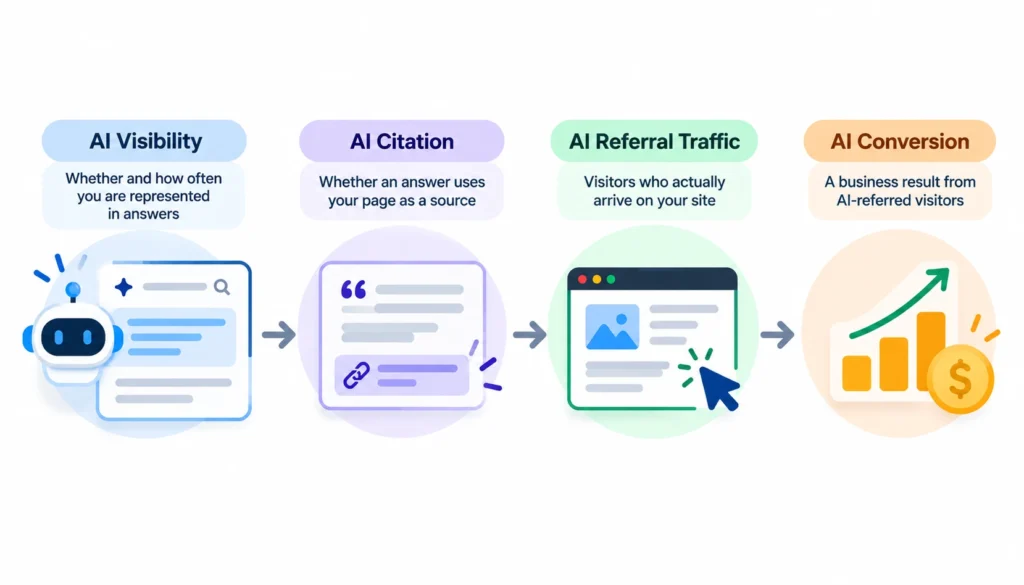
These ideas get mixed up, and mixing them leads to bad reporting.
| Concept | What it tells you |
| AI visibility | Whether and how often you are represented in answers |
| AI citation | Whether an answer uses your page as a source |
| AI referral traffic | Visitors who actually arrive on your site |
| AI conversion | A business result from AI-referred visitors |
Visibility is the top of the chain. Revenue is at the bottom. A lot can happen in between, so do not report the first as if it were the last.
How to Track AI Search Visibility at Scale
Once your manual method works, you may want to automate it. There are three common stages:
- Manual monitoring: a spreadsheet and a fixed prompt list. Cheap and educational.
- AI visibility checkers: lightweight tools that test a brand or a few prompts.
- Tracking platforms: tools that run large prompt sets across platforms on a schedule. Examples include Semrush, Ahrefs, SE Ranking, Similarweb, Frase, and Conductor.
Most of these vendors sell their own tool, so read their definitions with that in mind. Check what each one actually measures, how many times it runs each prompt, and how it handles variation.
What Are the Limitations of AI Search Visibility?
Here is what visibility data cannot tell you.
- Answers change. Models, sources, and interfaces update often.
- Platforms differ. Results on one do not predict results on another.
- The same prompt can vary. One run is never the full picture.
- Scores are not standardized. Two tools can give you very different numbers for the same brand.
- A mention is not a click. Users may read the answer and never visit.
- A citation is not praise. You can be cited in a negative or neutral context.
- Visibility is not revenue. High presence does not automatically mean sales.
It works the other way too. Low visibility does not always mean your SEO is poor. It may simply mean the AI has little to go on.
Frequently Asked Questions About AI Search Visibility
1. What is AI search visibility?
It is how often and how prominently your brand, site, or product appears in AI-generated answers on platforms like ChatGPT, Gemini, Perplexity, and Google’s AI features.
2. How do you measure AI search visibility?
Test a fixed set of real customer prompts across several AI platforms. Record mentions, citations, recommendations, and competitors. Calculate your share of voice, then repeat on a schedule to see the trend.
3. What is an AI visibility score?
It is a number, calculated by a tool, that summarizes how often you appear in AI answers. Methods differ by vendor, so scores from different tools are not directly comparable.
4. Why does my site rank on Google but not appear in ChatGPT?
Google rankings and AI answers use different selection processes. AI tools blend several sources and often weigh brand reputation, third-party mentions, and how easy a page is to extract facts from.
5. Is AI search visibility the same as GEO?
No. Visibility is the result you measure. GEO is the set of actions you take to improve it.
6. Is AI visibility the same as SEO?
Not exactly. SEO focuses on rankings and clicks. AI visibility focuses on inclusion in generated answers. They support each other, and strong SEO is still a useful foundation.
7. What is the difference between an AI mention and a citation?
A mention names your brand. A citation uses your page as a source. You can have one without the other.
8. How can I improve my AI search visibility?
Publish clear, well-supported content, build topical depth, earn credible third-party mentions, keep brand details consistent, and fix technical barriers. Then measure and repeat.
9. Which AI platforms should I monitor?
Start with ChatGPT, Google AI Overviews and AI Mode, Gemini, and Perplexity. Add Copilot, Claude, and others based on where your audience actually searches.
10. Can you guarantee AI visibility?
No. No one controls what an AI system says. You can improve your odds, but you cannot guarantee a mention.
11. How long does it take to improve AI visibility?
There is no reliable timeline. Technical fixes may show up faster than authority-building, which can take months. Track trends rather than expecting overnight change.
Conclusion
So, what is AI search visibility? It is your presence inside AI-generated answers, and it runs from being retrieved, to being mentioned, to being cited, to being recommended, and finally to being described accurately. Seeing it as a spectrum, not a yes-or-no, is what makes it useful.
Traditional SEO is still the foundation, but it no longer tells the whole story. Mentions, citations, and recommendations are different outcomes, and answers can shift from one run to the next. That is why repeated, consistent measurement beats a single screenshot, and why comparing yourself with direct competitors beats chasing one universal score.
Start small. Build a prompt list, test it across a few platforms, record what you find, and fix the biggest gap first. If you keep your measurement honest and tie it back to traffic and revenue, understanding AI search visibility becomes a practical advantage, not a buzzword.

Nazish is a skilled content writer dedicated to creating high-quality, engaging, and SEO-focused blogs. She specializes in strategic keyword usage, search intent, and informative content that connects with readers while helping websites strengthen their visibility and rankings in search results.