
AI SEO ranking factors are the signals that help AI search tools find, trust and cite your content. They mix the classic basics (crawlability, relevance, authority, helpful content) with newer needs: clear answers an AI can lift out of a page, well-defined entities, and credible mentions from other sites. No major AI search platform publishes a complete formula, so part of what you read online is documented and part is educated guessing.
This guide separates the two. Every factor below carries an evidence label, so you can see what Google and OpenAI have actually said, what research and testing suggest, and what is still a hunch. You’ll also see how Google AI Overviews, ChatGPT, Perplexity and Copilot differ, what to fix first, and how to check whether your work paid off.
Quick answer: AI search visibility comes from solid traditional SEO (crawlable, relevant, trustworthy pages) plus content that is easy to retrieve, understand and cite. Nobody publishes the full ranking formula, so treat every factor as confirmed, supported, observed or untested, and measure your own results.
What Are AI SEO Ranking Factors?
AI SEO ranking factors are the signals AI-powered search systems use to decide which pages to retrieve, trust and show as sources in generated answers. Some are long-standing ranking signals. Others, like how quotable a passage is, matter mainly because an AI has to pull a piece of your page into a new answer.
The term is a little loose. “Ranking” suggests a ten-blue-links list, but AI answers don’t work that way. A page can rank well and never get cited. Another can sit lower and get quoted all the time.
AI SEO ranking factors vs traditional SEO ranking factors
Traditional SEO is the foundation. Google has said that AI Overviews and AI Mode are built on the same core systems as Search, and that pages need to be indexed and eligible to show a snippet to appear as supporting links. No special markup or file is required.
So think of it this way: traditional SEO gets you into the pool. AI search optimization improves your odds of being picked from the pool.
Ranking vs retrieval vs citation vs mention
These are different outcomes, and you should track them separately.
- Rank: your position in a normal results page.
- Retrieve: the AI system finds your content as a candidate.
- Cite: your URL appears as a source.
- Mention: your brand is named in the answer, with or without a link.
- Recommend: the AI actively suggests you.
- Convert: someone takes action after seeing you.
A brand can get mentioned often without earning many clicks. That’s still useful, and it’s one reason AI visibility matters even without the clicks. It’s just a different goal from traffic.
Why there is no single AI ranking algorithm
Google AI Overviews, ChatGPT search, Perplexity and Copilot each use different retrieval systems, different data sources and different models. Advice that works for one may do little for another. Anyone selling “the” AI ranking formula is guessing.
How to read the evidence labels
I use five labels in this guide.
| Label | Meaning |
| Confirmed | Stated in official platform documentation |
| Strong evidence | Backed by multiple credible studies or sources |
| Observed | Repeatedly noticed by practitioners, but not confirmed |
| Best practice | Sound SEO, not proven as an AI-specific signal |
| Speculative | A hypothesis worth testing, nothing more |
How AI Search Engines Decide Which Sources to Use
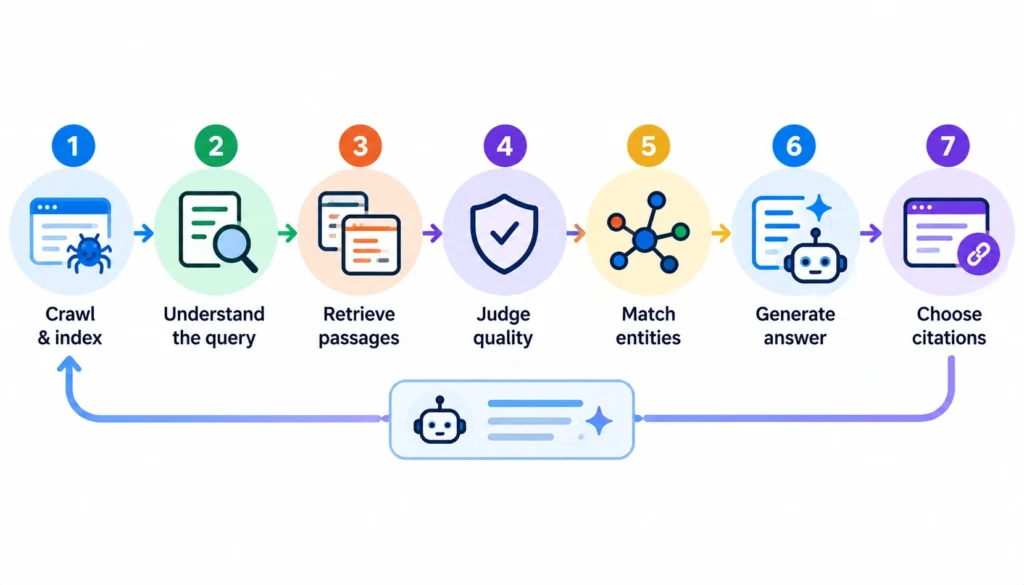
Most AI search tools follow a pattern called retrieval-augmented generation, or RAG. In plain English: the system searches for relevant material first, then writes an answer using what it found.
The exact steps vary by platform, but the flow usually looks like this:
- Crawl and index. The page must be reachable and stored.
- Understand the query. The system works out what the person really wants. Google has described AI Mode as breaking a question into related subtopics and searching for each, which it calls query fan-out.
- Retrieve passages. The system pulls relevant chunks of content, not always whole pages.
- Judge quality and trust. Signals like authority, accuracy and usefulness filter the candidates.
- Match entities. The system connects the names and concepts in your content to things it already knows.
- Generate and ground the answer. The model writes a response tied to the retrieved sources.
- Choose citations. A subset of sources gets shown.
This is why the top-ranking result isn’t always the one cited. The AI may need a specific sub-answer that a lower-ranking page states more clearly. Make your page the clearest answer to a narrow question, and you give it a reason to pick you.
The Most Important AI SEO Ranking Factors
Here are the twelve factors I’d focus on, in rough order of priority. Each one has an evidence label.
1. Crawlability and indexability
Evidence: Confirmed.
If a system can’t fetch your page, nothing else matters. Google says a page must be indexed and snippet-eligible to appear in AI features. OpenAI says that to appear in ChatGPT search results, sites should allow its search crawler, OAI-SearchBot.
Check your robots.txt file, your CDN and any firewall rules. I’ve seen sites block AI crawlers by accident through a security plugin, then wonder why they never showed up. Also make sure key content isn’t hidden behind heavy JavaScript.
2. Search intent and query alignment
Evidence: Strong evidence.
AI systems try to satisfy the goal behind a question. Match the intent, whether the person wants a definition, a comparison, a how-to or a product to buy.
Write for conversational phrasing too. People ask AI tools longer, more specific questions than they type into a search box. A page that answers “what’s the best project tool for a five-person agency?” beats one that only targets “project management software.”
3. Helpful, complete content
Evidence: Confirmed (for Google’s general approach), Strong evidence for AI features.
Google’s guidance consistently points to people-first, useful content. In AI search this shows up as coverage: if a query splits into several subquestions, a page that answers most of them gives the system more to work with.
Answer the main question first. Then cover the follow-ups a reader would naturally ask. Cut filler. Depth should match the question, and a simple query doesn’t need 4,000 words.
4. Extractability and quotability
Evidence: Observed, and Best practice.
This is the factor most specific to AI search. An AI has to lift a piece of your page into an answer. Make that easy.
- Put a direct answer right under the heading.
- Write paragraphs that make sense on their own.
- Use descriptive headings, ideally phrased like real questions.
- Use lists and tables for steps and comparisons.
- Back claims with a named source or number.
Here’s the difference in practice.
Hard to extract: “There are many things to think about when it comes to this, and as we mentioned above, it really depends on several variables.”
Easy to extract: “Robots.txt is a text file that tells crawlers which parts of a site they can access. Blocking OAI-SearchBot in it can keep your pages out of ChatGPT search results.”
The second one works even if it’s the only paragraph the AI sees.
Note the label. Plenty of practitioners report this helps, and it’s good writing anyway, but no platform has published a “quotability score.”
5. E-E-A-T and source trust
Evidence: Confirmed for Google Search, Observed for other platforms.
E-E-A-T stands for experience, expertise, authoritativeness and trustworthiness. Google uses it as a framework in its quality guidelines, and says trust is the most important part. It’s not a single score. It’s a set of qualities that Google’s systems try to reward.
The practical moves are simple:
- Show who wrote the page and why they’re qualified.
- Share first-hand experience: tests you ran, results you saw.
- Cite primary sources.
- Keep claims accurate and checkable.
6. Topical authority and internal linking
Evidence: Observed, Best practice.
Topical authority is the idea that a site covering a subject deeply is treated as more reliable on it. Google hasn’t confirmed a metric by that name, but covering a topic well tends to earn more links, more mentions and more relevant matches.
Build a cluster: one strong pillar page, supported by detailed pages on subtopics. Link them with descriptive anchor text so both people and crawlers understand how they relate. Avoid isolated keyword pages that don’t connect to anything.
7. Entity clarity
Evidence: Strong evidence (entities matter in modern search), Observed for AI-specific impact.
An entity is a distinct thing: a company, person, product, place or concept. Search engines use knowledge graphs to track entities and how they connect.
Help systems understand who you are:
- Use the same brand name and description across your site and profiles.
- Have a clear About page and author pages.
- Link your site to your official profiles.
- Be specific about what your products and services are.
If an AI can’t tell which “Apex” you are, it may skip you.
8. Original information
Evidence: Observed, Best practice.
If your page repeats what ten others say, an AI has no reason to prefer yours. Original research, your own data, expert commentary and real case studies give it something unique to cite.
You don’t need a huge study. A small test with honest methodology, such as “we checked 50 pages for AI crawler access and 14 were blocked,” can be more useful than a vague trend piece. Just only publish numbers you really collected.
9. Third-party mentions and reputation
Evidence: Observed. Backlinks specifically: Strong evidence for Google’s core ranking, less clear for other AI tools.
AI tools learn about brands partly from what other sites say about them. Editorial coverage, reviews, industry publications, comparison pages and active communities all contribute.
Backlinks still matter for traditional Google ranking, which feeds AI Overviews. Whether a link directly boosts ChatGPT or Perplexity visibility is less clear. Mentions on credible, relevant sites seem helpful across platforms, but treat that as observed rather than proven.
One caution: don’t confuse reputation with link volume. A few relevant, editorial mentions are worth more than a pile of low-quality ones.
10. Structured data
Evidence: Confirmed that it’s not required for AI features; Best practice for clarity.
Google states you don’t need special schema to appear in AI Overviews. Still, structured data helps search systems understand what a page is about. Organization, Article, Product and Person markup are sensible defaults.
One rule: markup must match what’s visible on the page. Use schema to clarify content, not to claim things the page doesn’t show. And don’t expect it to guarantee a citation.
11. Freshness and accuracy
Evidence: Observed, Best practice.
Freshness matters most where facts change: pricing, product features, regulations, statistics and fast-moving topics. It matters little for stable subjects like how photosynthesis works.
Update content when something real changes. Changing the date without changing the substance doesn’t help readers and may erode trust. Keep a visible “last updated” date that you can stand behind.
12. Page experience and technical health
Evidence: Confirmed as a general Google consideration; Best practice for AI.
Fast, mobile-friendly, stable pages are good for people. They also reduce crawl and rendering problems. Core Web Vitals are unlikely to be the reason you win or lose a citation, but a broken, slow site hurts everything else on this list.
Images, video and original charts help too, especially as AI search becomes more multimodal. Add clear alt text and captions so the visuals have context.
AI SEO Ranking Factors by Search Engine
Google AI Overviews
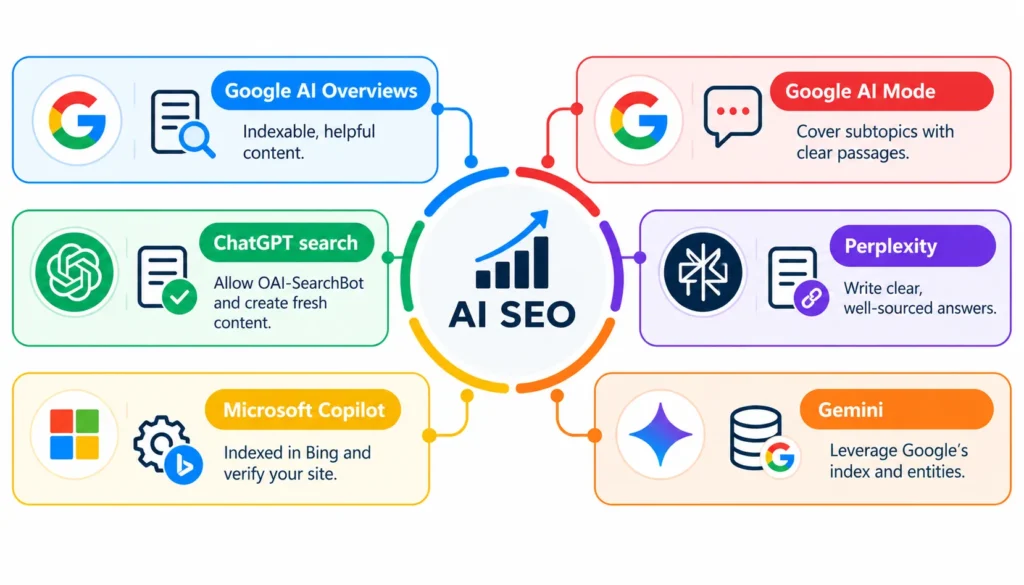
AI Overviews draw on Google’s existing ranking and quality systems. Google’s own guidance says the same SEO fundamentals apply, and that there’s no extra step required for eligibility. Focus on indexing, helpful content, strong entities and clear passages.
Google AI Mode
AI Mode is a more conversational experience. Google has described it as using query fan-out, running multiple related searches to build one answer. That makes broad subtopic coverage and clear, specific passages especially useful. Multimodal search is part of it too, so image quality and context count.
ChatGPT search
OpenAI documents that sites should allow OAI-SearchBot to be included in ChatGPT search results. Note that OAI-SearchBot is separate from GPTBot, which relates to training. You can allow one and block the other.
OpenAI has also said ChatGPT search uses a mix of its own systems and third-party search providers. Beyond that, most claims about what ChatGPT prefers are observed patterns, such as favoring fresh, clearly written content from reputable sources. Test them rather than trusting them.
Perplexity
Perplexity searches the web in real time and shows numbered source citations. It tends to reward clear, direct, well-sourced passages, but the company hasn’t published a ranking formula. Allowing its crawler and writing quotable answers are reasonable moves.
Microsoft Copilot
Copilot is closely tied to the Bing ecosystem. Make sure your site is indexed in Bing and verified in Bing Webmaster Tools. This step is easy to forget when most SEO work focuses on Google.
Gemini
Gemini sits in the Google ecosystem, so Google’s index, entity understanding and quality systems are the sensible starting point. Public detail on its source selection is limited.
Google AI Overviews vs ChatGPT vs Perplexity: Factor Comparison
This table shows how much weight each factor likely carries, and how sure we can be.
| Factor | Google AI Overviews | ChatGPT search | Perplexity | Evidence level |
| Crawl access | Required | Required (OAI-SearchBot) | Required | Confirmed |
| Search intent match | High | High | High | Strong |
| Helpful, complete content | High | High | High | Strong |
| Direct, extractable passages | High | High | High | Observed |
| E-E-A-T signals | High | Likely helpful | Likely helpful | Confirmed (Google), Observed (others) |
| Entity clarity | High | Likely helpful | Likely helpful | Strong (Google), Speculative (others) |
| Third-party mentions | High | High | Likely helpful | Observed |
| Backlinks | Indirect but relevant | Unclear | Unclear | Strong (Google), Speculative (others) |
| Freshness | Topic dependent | Often noted | Often noted | Observed |
| Schema markup | Optional, helpful | Unclear | Unclear | Confirmed not required |
| llms.txt | No confirmed use | No confirmed use | No confirmed use | Speculative |
Where a cell says “likely helpful,” read it as a reasonable bet, not a fact.
How to Optimize Your Website for AI Search
Here’s the order I’d work in. The early steps are cheap and have the biggest downside if skipped.
- Fix crawlability. Review robots.txt, firewall rules and rendering. Decide deliberately which bots to allow, including OAI-SearchBot and Googlebot.
- Check indexing in Google and Bing. Use Google Search Console and Bing Webmaster Tools.
- Define your entities. List your brand, products, people and core topics. Make names and descriptions consistent.
- Map intent for your target queries. Note whether each wants a definition, comparison, steps or a purchase.
- Cover the subquestions. List the follow-up questions around each topic and answer them.
- Lead with direct answers. Put a clear 40 to 60 word answer under key headings.
- Make passages self-contained. Each section should make sense if read alone.
- Add original evidence. Include your own data, examples, screenshots or expert input.
- Strengthen E-E-A-T. Add real author bios, sources and update dates.
- Earn external mentions. Pitch useful data to relevant publications and join relevant communities.
- Add accurate structured data. Organization, Article, Product or Person markup, matching visible content.
- Measure and iterate. Track results (see below) and adjust.
If you only have time for three, do steps 1, 6 and 8.
How to Measure AI SEO Performance
Measurement is the weakest part of most AI SEO advice, and it’s where you can prove your work.
Start with a fixed set of prompts. Choose 30 to 100 questions your customers really ask, split into branded and non-branded. Run them on a regular schedule across the platforms you care about, and record what happens. You can do this by hand or with SEO automation that runs the checks for you.
AI answers can vary from run to run, so track trends over weeks, not single checks.
| Metric | What it tells you |
| Citation rate | How often your URLs are cited |
| Mention rate | How often your brand is named |
| Share of voice | Your visibility compared with competitors |
| Citation position | Where your source appears in the answer |
| Prompt coverage | How many tracked questions include you |
| Sentiment | How the AI describes your brand |
| AI referral traffic | Visits from AI platforms in your analytics |
| Assisted conversions | Business impact after AI exposure |
Two practical notes. First, referral data is imperfect, since some AI traffic arrives with no clear referrer. Second, look at which competitor pages get cited when you don’t. Those pages show you what the AI considers a good answer.
Common AI SEO Myths
“AI ranking has nothing to do with traditional SEO.” Google says AI features build on its Search systems. Foundations still matter.
“You need thousands of AI-written articles.” Volume without value doesn’t help. Original, useful pages do.
“Keyword density drives AI visibility.” There’s no evidence for it. Clear, complete answers matter more.
“Schema guarantees citations.” It doesn’t. Google says it’s not required, and no platform promises a boost.
“Backlinks no longer matter.” They still influence Google’s core ranking. Their direct effect on other AI tools is less certain.
“You need an llms.txt file.” No major platform has confirmed using it as a ranking signal. It’s harmless to add, but don’t count on it.
“Ranking #1 guarantees a citation.” It doesn’t. Retrieval and source selection work differently from the results page.
“AI content is automatically penalized.” Google’s stated position is that it targets low-quality, manipulative content, however it’s produced. Quality is the issue, not the tool.
AI SEO Ranking Factors Checklist
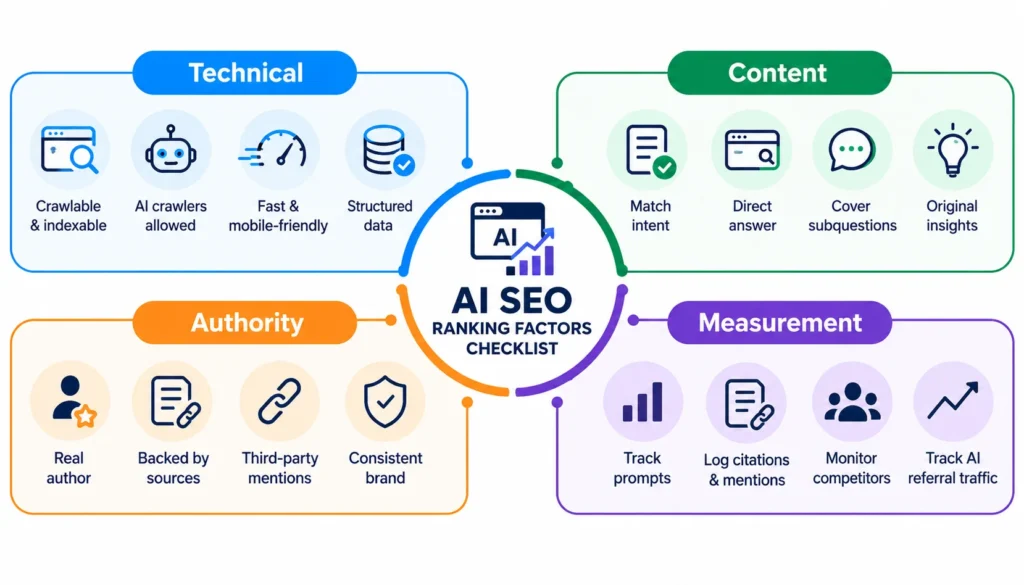
Technical
- Pages are crawlable and indexable in Google and Bing
- AI crawlers are allowed on purpose, not by accident
- Site is fast and mobile-friendly
- Structured data matches visible content
Content
- Intent is matched
- A direct answer sits near the top
- Related subquestions are covered
- Passages are self-contained
- Original insight or data is included
- Facts and dates are current
Authority
- Real author with relevant experience
- Claims backed by named sources
- Relevant third-party mentions and links
- Consistent brand and entity information
Measurement
- Prompt set defined and tracked
- Citations and mentions logged
- Competitors monitored
- AI referral traffic tracked
Frequently Asked Questions About AI SEO Ranking Factors
1. What are AI SEO ranking factors?
They are the signals that help AI search tools retrieve, trust and cite your content. They combine traditional SEO factors like crawlability, relevance and authority with AI-specific needs like extractable answers and clear entities. No platform publishes the full list.
2. How do you rank in Google AI Overviews?
Google’s guidance is to follow standard SEO fundamentals. Make sure your page is indexed and snippet-eligible, write helpful content, and answer questions clearly. There is no separate submission or special markup required.
3. How do you get ChatGPT to cite your website?
Allow OAI-SearchBot, publish clear and credible content, and build mentions on reputable sites. No one can guarantee a citation, because OpenAI doesn’t publish its source selection rules.
4. Does traditional SEO still matter for AI search?
Yes. For Google’s AI features, it’s the foundation. Indexing, relevance, quality and authority all still apply.
5. Does E-E-A-T affect AI search?
For Google, E-E-A-T guides how quality is assessed, and its AI features build on those systems. For other platforms, the effect is likely but not documented.
6. Do backlinks matter for AI search?
They matter for Google’s core ranking, which feeds AI Overviews. Their direct role in ChatGPT or Perplexity isn’t confirmed.
7. Does schema markup help AI search?
It helps search systems understand your page, but Google says it isn’t required for AI features. Use it for clarity, not as a shortcut.
8. How do AI engines choose which sites to cite?
They typically retrieve relevant passages, filter by quality and trust, and cite sources that support the generated answer. Details differ by platform and are mostly undisclosed.
9. How do you measure AI search visibility?
Track a fixed set of prompts over time, log citations and mentions, compare competitors, and monitor AI referral traffic and conversions in your analytics.
10. Is GEO the same as AI SEO?
Mostly. Generative engine optimization (GEO) and answer engine optimization (AEO) are newer names for optimizing visibility in AI-generated answers. Different people draw the lines slightly differently, and the practical work overlaps heavily with SEO.
Final Takeaway: Focus on AI SEO Ranking Factors You Can Actually Verify
The most reliable AI SEO ranking factors are the ones that make your content easy to find, easy to understand and worth trusting: crawl access, clear intent matching, complete answers, strong entities, original information and credible outside mentions. Most of these are good SEO that now has a second job, helping AI systems pick your page as a source.
Separate what is confirmed from what is only observed, test your own assumptions, and measure results over time. Be discoverable, be clear, be credible, be quotable, and then check whether it worked.

Nazish is a skilled content writer dedicated to creating high-quality, engaging, and SEO-focused blogs. She specializes in strategic keyword usage, search intent, and informative content that connects with readers while helping websites strengthen their visibility and rankings in search results.