

To get your website cited by AI search engines, make your content crawlable, easy to extract, backed by evidence, clearly tied to your brand, and confirmed by other trusted sources on the web. No AI company publishes a full citation formula, so the steps below combine official documentation, patterns researchers keep observing, and my own recommendations. I label which is which as we go.
The framework I use is simple: Reachability, Relevance, Extractability, Evidence, Authority, Monitoring. Each step in this guide fixes one of those six things, in the order an AI system meets your site.
What Does It Mean to Be Cited by an AI Search Engine?
An AI search citation is a link or source reference that an AI tool shows next to a generated answer, pointing to the page it used. Google AI Overviews, ChatGPT search, Perplexity, Gemini, Claude and Microsoft Copilot all do this in some form. The citation tells the reader where a claim came from and sends a small share of them to your page.
Most AI search tools use a pattern called retrieval-augmented generation. In plain English: the system looks up fresh pages first, then writes an answer using what it found. Your goal is to be one of the pages it looks up and trusts.
Citation vs. Google ranking
Ranking is your position in a list of blue links. A citation is a source inside a written answer. The two overlap but they are not the same. Google says its AI features draw on the same foundation as regular Search, and the page has to be indexed and eligible to show a snippet. Its AI features documentation says there is no special markup required. Other tools, such as ChatGPT or Perplexity, build answers from their own retrieval systems, so a strong Google rank does not guarantee a citation there.
Citation vs. mention vs. referral traffic
These three get mixed up all the time. A citation links to you. A mention names your brand without a link. A referral is an actual visit that arrives from an AI tool. You can have a mention with no citation, and a citation with almost no clicks. Track all three separately, because they tell you different things.
Why it matters
More people now read an AI summary before they decide whether to click anything, which is why AI-focused SEO has become a priority for many brands. If your competitor is the named source and you are not, they get the trust and the shortlist spot. Even when clicks are low, being named in an answer shapes which brands people remember.
How AI Search Engines Decide Which Websites to Cite
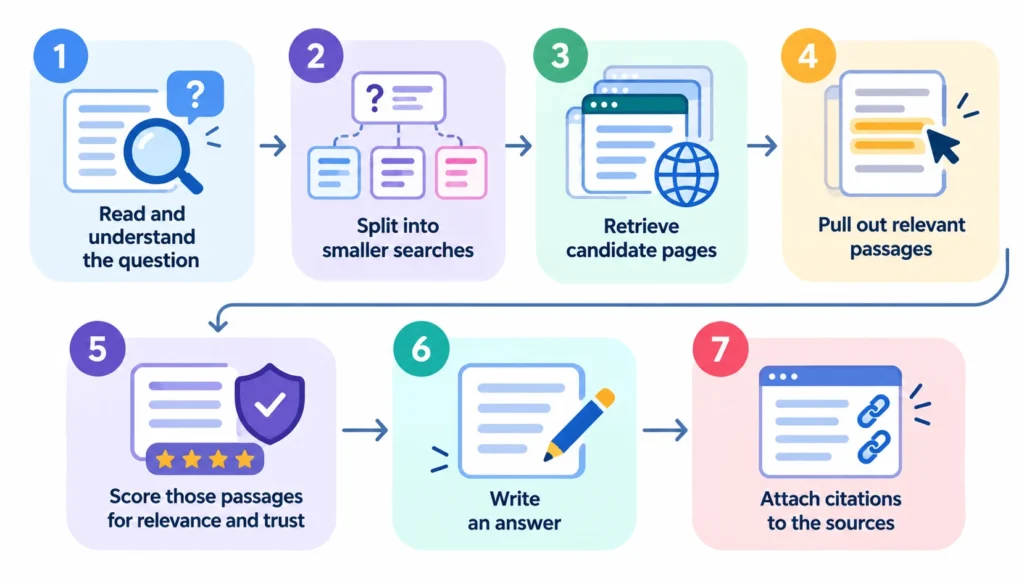
The exact details differ by product and change often. The general flow looks like this:
- The system reads the question and works out what the person wants.
- It may split the question into several smaller searches.
- It retrieves candidate pages from a search index or the live web.
- It pulls out passages that might answer each part.
- It scores those passages for relevance and trust.
- It writes an answer.
- It attaches citations to the sources it relied on.
You cannot control every step. You can make your site easy to get through at each one.
Query fan-out: one question becomes many
Google has described a technique it calls query fan-out for AI Mode, where one question triggers several related searches at once. Say someone asks, “How can I improve my website’s AI visibility?” Behind the scenes, the system may also look for what GEO is, which crawlers matter, whether schema helps, and how to measure results.
The lesson is practical. A page that only repeats the main keyword covers one of those sub-questions at best. A page that answers the neighbouring questions has more chances to be picked.
Passage-level retrieval: sections get cited, not just pages
AI systems often work with chunks of text, not whole pages. A paragraph that makes sense on its own can be lifted out and used. A paragraph that says “as mentioned above, this approach works well” cannot, because the answer is somewhere else.
So write every section as if it might be read alone.
Why being #1 on Google does not guarantee a citation
A page can rank well and still lose the citation. Maybe the answer sits in paragraph nine. Maybe the claim has no source. Maybe a competitor says the same thing with a clearer number. Researchers who compare AI citations with organic rankings regularly find that cited URLs do not map neatly onto the top ten results. Treat rankings as a helpful signal, not a guarantee.
| Traditional SEO | GEO (AI search optimization) |
| Goal is ranking position | Goal is being cited or mentioned |
| Built around keywords | Built around topics and entities |
| Page is the unit | Passage is the unit |
| Links signal authority | Links plus brand corroboration |
| Success is a click | Success is a citation, mention or click |
How to Get Your Website Cited by AI Search Engines: The 10-Step Framework
Work through these in order. Steps 1 to 4 make you eligible. Steps 5 to 8 make you believable. Steps 9 and 10 keep you consistent.
Step 1: Make sure AI crawlers can reach your site
Crawl access is an entry ticket, not a guarantee. If a system cannot fetch your page, it cannot cite it.
Robots.txt. Open yourdomain.com/robots.txt and look for blanket blocks. A robots.txt file tells bots what they may fetch. Many sites block AI bots by accident, usually through a security plugin or a copied template.
Most AI companies run separate bots for separate jobs, and the difference matters:
- OpenAI lists GPTBot (training), OAI-SearchBot (search results) and ChatGPT-User (user-triggered visits) in its bot documentation.
- Perplexity documents PerplexityBot and Perplexity-User in its crawler guide.
- Anthropic runs ClaudeBot and separate bots for search and user requests. Check Anthropic’s current help pages for the exact names.
- Google uses Googlebot for Search. The Google-Extended token controls some Gemini uses but does not change how Search works.
Because the bots have different jobs, you can allow search bots and still block training bots if you prefer. That is a business decision. Just make it on purpose.
Status codes. Important pages should return 200. Watch for soft 404s, long redirect chains and 403 errors that your firewall serves only to bots.
Indexability. Check for stray noindex tags and wrong canonical tags. Submit an XML sitemap through Google Search Console and Bing Webmaster Tools. Bing matters because Copilot is built on Microsoft’s ecosystem, and some other AI tools have been reported to use Bing data too.
JavaScript. Many crawlers do not run JavaScript the way a browser does. If your main text only appears after a script loads, view the raw HTML source. If your answer is missing there, move it into server-rendered HTML.
CDN and WAF rules. Cloudflare and similar services can challenge or block bots by default. Check your bot settings and logs.
PDFs and images. If key facts live only in a PDF or an image, repeat them as plain text on the page.
Step 2: Build each page around one search need
Pages that try to answer everything usually answer nothing well. Pick one main question per page, then cover the two or three follow-ups a reader would ask next.
A quick scenario: a small accounting firm has a page titled “Our Services.” It lists ten services in one paragraph each. An AI tool asked “how much does bookkeeping cost for a small business?” has no clean passage to lift. If the firm builds a dedicated bookkeeping pricing page, with a clear price range, what changes the price, and who it suits, that page now has a real shot.
Step 3: Put the answer before the explanation
Journalists call this the inverted pyramid. State the answer in the first one or two sentences under a heading, then explain.
Weak:
AI search is changing how marketing works, and many businesses are wondering what to do next.
Citation-ready:
AI search tools pull short passages that answer a question directly, so each section should open with a self-contained answer and then add evidence.
The second version can be quoted by itself. The first cannot.
Step 4: Structure content so it is easy to extract
Good structure helps people and machines alike.
- Write headings as the question a reader would type.
- Keep paragraphs to two to four sentences.
- Define a term the first time you use it, in one sentence.
- Use numbered lists for steps and tables for comparisons.
- Keep a fact next to the claim it supports, not three paragraphs away.
Don’t chop good writing into fragments just to look “structured.” The test is whether a single section still makes sense if someone pastes it into an email.
Step 5: Add evidence other pages don’t have
If your page repeats what ten others already say, an AI system gains nothing by citing yours. SEO folks call the missing ingredient information gain: something new the reader (or the model) can’t get elsewhere.
Practical ways to add it:
- Publish your own numbers, even small ones. A survey of 80 customers is still original.
- Describe what you tried and what happened, including what failed.
- Link to primary sources, such as official documentation or the original study, instead of a blog that summarizes it.
- Name the method behind any statistic you quote.
- Add expert quotes from people you can name.
Never invent a statistic to look credible. A smaller true number beats a bigger vague one, and wrong figures get repeated by AI tools just like right ones.
Step 6: Show who is behind the content
Google’s quality guidelines describe E-E-A-T: experience, expertise, authoritativeness and trust. It is not a single ranking switch, but it is a useful checklist for what readers need to see.
- Put a real author name and short bio on every article.
- State the author’s relevant background in a sentence or two.
- Share first-hand material: screenshots, examples, client situations you can describe without breaking confidentiality.
- Show a published date and a last-updated date.
- Link to your sources.
- Say what you don’t know. A line like “results vary by industry” builds more trust than a promise.
Step 7: Make your brand easy to recognize
An entity is just a clearly identified thing: a company, a person, a product, a place. Search systems use knowledge graphs to connect these things. If your brand appears under three slightly different names, the system has a harder time connecting the dots.
Run this consistency check:
- Use the same company name, address and description across your site, LinkedIn page, directories and review profiles.
- Link each author to a real author page and to their professional profiles.
- Say plainly what you do and who you do it for on your About page.
- Keep product and service names identical everywhere.
It is dull work, and it pays off. When an AI tool has to decide whether a source is really the company it claims to be, consistent details help.
Step 8: Earn mentions beyond your own website
AI systems tend to trust claims that several independent sources agree on. That is why off-site corroboration matters, and it is not the same as link building. A news mention with no link still tells the world your brand exists and does what you say.
Where to look:
- Industry publications that accept expert contributions.
- Podcasts and webinars where you are named as a guest.
- Review platforms in your category.
- Respected directories and associations.
- Community discussions. Forums like r/SEO show up in AI answers often enough that it is worth taking part honestly, with a real name and real answers, not drive-by self-promotion.
A caution from experience: a flood of low-quality guest posts or paid links can hurt you and teaches the AI nothing useful. A few mentions from sources your customers actually read beat fifty from sites nobody visits.
Step 9: Use structured data, but know its limits
Structured data is code that labels what a page contains, using the Schema.org vocabulary. It removes guesswork about who wrote the page, what the organization is, or what a product costs.
Useful types for most sites:
- Organization for your company details.
- Person for authors.
- Article for posts, with dates and author.
- Product for e-commerce pages.
- BreadcrumbList for site structure.
A note on FAQPage markup: Google cut back the FAQ rich results it displays in 2023, so don’t add it expecting a visual boost. It does no harm if the questions truly appear on the page.
Here is the honest limit. Google states that no special schema is needed for its AI features, and no platform has promised that markup earns a citation. Think of it as clear labeling, not a ranking lever.
Step 10: Keep information fresh and consistent
Outdated pages cause two problems. They lose trust, and they sometimes get cited with old numbers anyway.
- Review your most important pages every three to six months.
- Replace old statistics and re-check your sources.
- Update prices, features and team details everywhere they appear.
- Remove or merge pages that contradict each other.
- Change the visible “last updated” date only when you actually changed something.
How to Optimize a Single Page for AI Citations
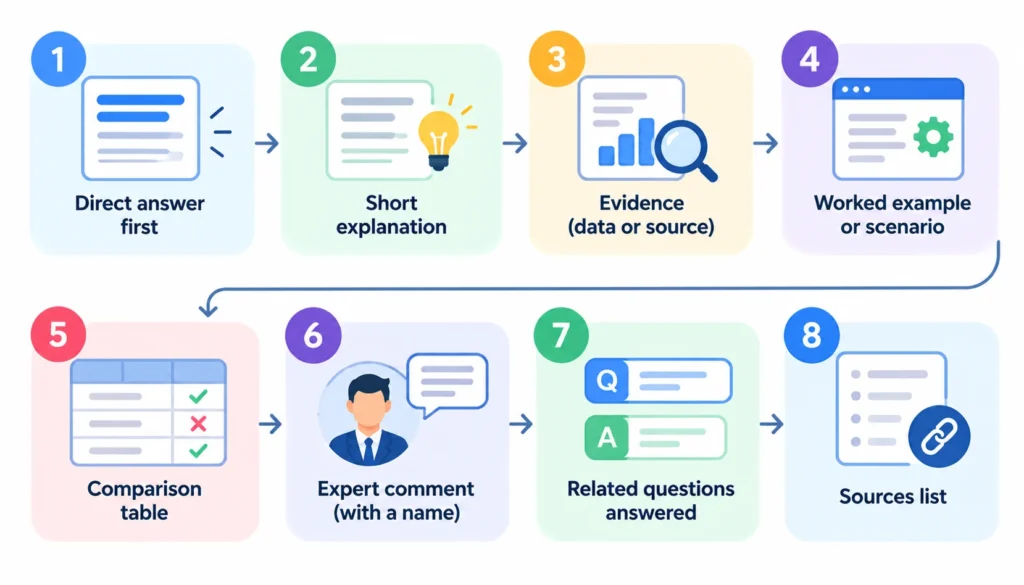
Here is the page layout I recommend as a starting template:
- A direct answer in the first two sentences.
- A short explanation in plain language.
- Evidence: data, a source, or a documented example.
- A worked example or scenario.
- A table where you compare things.
- An expert comment, with a named person.
- Related questions, answered briefly.
- A sources list.
Before and after: rewriting one paragraph
Before:
Our team is passionate about helping clients succeed with solutions that make a difference in today’s fast-moving world.
After:
We build custom bookkeeping systems for restaurants with 5 to 30 staff. Most clients move off spreadsheets within three weeks, and our fees start at a flat monthly rate listed on the pricing page.
The first version says nothing a model could reuse. The second names the audience, gives a timeframe and points to a fact. It is also something a competitor can’t copy without doing the work.
How to Optimize for Different AI Search Engines
Every platform works a little differently, and they all change without notice. Read the table below as observed tendencies, not rules.
| Platform | Where to focus |
| Google AI Overviews | Standard SEO: indexed, snippet-eligible, relevant, trustworthy pages |
| Google AI Mode | Broad coverage of related questions (fan-out) |
| ChatGPT | Allowing search bots, clear entities, well-sourced pages |
| Perplexity | Direct answers, clear sources, fresh content |
| Gemini | Google ecosystem signals, entity clarity |
| Claude | Retrievable, clearly sourced pages (where web search is on) |
| Microsoft Copilot | Bing indexing and discoverability |
Google AI Overviews: Do good SEO. Google’s documentation says the same fundamentals apply, so fix indexing problems first, and read how AI Overviews impact your search performance to see what else needs to change.
ChatGPT: Check that OAI-SearchBot is not blocked, then work on clarity and corroboration. Some site owners treat training and search bots differently, which is possible with separate rules.
Perplexity: It shows its sources prominently, which makes it a good place to test your own pages. Short, direct passages and recent dates seem to help.
Gemini, Claude and Copilot: The same basics apply. For Copilot, submit your site to Bing Webmaster Tools and watch your Bing indexing.
How Query Fan-Out Changes Your Content Plan
If one question becomes several searches, you need pages for the family of questions, not just the headline term.
Take the query “best project management software.” A system might also look into:
- best tools for small teams
- pricing
- integrations
- ease of use
- alternatives
- security
- mobile apps
To find your own fan-out opportunities, type your target question into ChatGPT, Perplexity and Google AI Mode, then note the follow-up questions and subtopics they bring up. Cross-check with Google’s People Also Ask box and the questions customers send your support team. Then build one useful page for each gap, and link them together.
Build Topical Authority Around the Subject
Topical authority just means you cover a subject thoroughly and consistently. In practice:
- Pick one main topic and publish a central guide.
- Add supporting pages for definitions, comparisons, use cases and common problems.
- Link those pages to each other with descriptive anchor text.
- Spread original insights across the cluster instead of saving them for one post.
- Make sure the same brand and author names appear everywhere.
This is where classic search engine optimization and GEO meet. The work that builds a strong topic cluster for Google also gives AI systems more passages to choose from.
How to Measure AI Search Visibility
AI answers vary from one run to the next, so one screenshot proves nothing. Use a repeatable method.
- Build a fixed prompt set. Start with 20 to 50 prompts per topic that real customers would ask.
- Run them on a schedule. Monthly works for most teams. Run each prompt more than once, since answers change.
- Record the results. Note whether you were cited, mentioned or absent, and which URL and passage was used.
- Track competitors. Log who gets cited when you don’t.
- Check accuracy. Note any wrong claims about your brand.
- Watch referral traffic. Look for visits from AI tools in your analytics. Some arrive labeled and some arrive as plain direct traffic, so treat the numbers as a floor.
A simple score you can calculate yourself:
AI share of voice = your citations ÷ (your citations + tracked competitor citations) × 100
If you appear in 12 of 80 total citations across your prompt set, your share is 15%. Improve it, then re-measure.
The 30-Minute AI Citation Audit
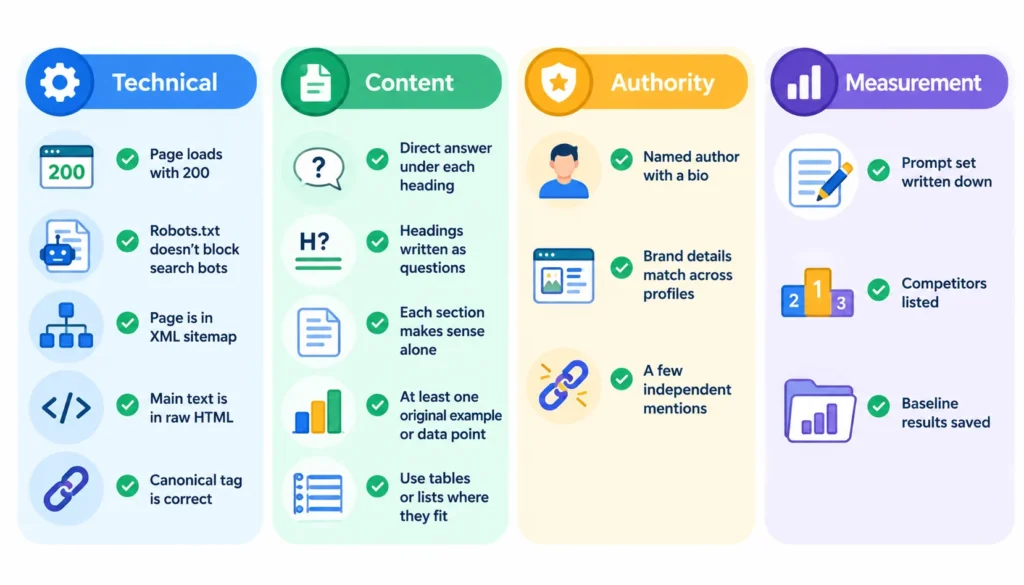
Set a timer and go through this list on your most important page.
Technical
- Page loads with a 200 status
- Robots.txt does not block search bots you want
- Page is in the XML sitemap
- Main text is in the raw HTML
- Canonical tag points to the right URL
Content
- Direct answer under each heading
- Headings written as questions
- Each section makes sense alone
- At least one original data point or example
- Tables or lists where they fit
Authority
- Named author with a bio
- Brand details match across profiles
- At least a few independent mentions
Measurement
- Prompt set written down
- Competitors listed
- Baseline results saved
What Does Not Work
Some habits waste time or do harm.
- Keyword stuffing. It makes passages harder to read and harder to quote.
- Mass-producing generic AI articles. If a page adds nothing new, there is no reason to cite it.
- Adding schema and waiting. Markup helps machines read a page. It does not replace good content.
- Blocking every bot. If you block search bots, you remove yourself from consideration.
- Publishing dozens of thin pages. Fewer, deeper pages do better.
- Chasing links with no topic focus. Authority works best when it matches your subject.
- Optimizing for one platform. Tools change quickly, so rely on fundamentals.
- Treating it as a one-off project. Answers shift, so measurement has to repeat.
Common Problems and Fixes
| Problem | Likely cause | Fix |
| Site never appears | Crawl or access issue | Run the technical checks in Step 1 |
| Site appears but is not cited | Weak relevance or buried answers | Rewrite passages with answers first |
| Competitors get cited instead | Stronger evidence or more mentions | Add original data, earn corroboration |
| Wrong page is cited | Unclear site structure | Tighten internal links and page focus |
| Brand described incorrectly | Inconsistent entity details | Standardize names and descriptions |
| Old information is cited | Outdated pages | Refresh data and dates |
Frequently Asked Questions
1. How do I get my website cited by ChatGPT?
Allow OpenAI’s search crawler, publish clear and well-sourced pages, and earn mentions on other trusted sites. OpenAI documents its bots separately for training, search and user visits, so you can set rules for each. No tactic guarantees a citation.
2. How do I get cited by Google AI Overviews?
Follow standard SEO. Google says pages must be indexed and eligible to appear with a snippet, and no special markup is required. Answer questions directly, show real expertise, and keep your pages technically healthy.
3. How do I get cited by Perplexity?
Let PerplexityBot crawl you, write direct passages, cite your sources and keep content current. Perplexity displays its sources openly, so you can test your own prompts and see what it picks.
4. Does SEO help with AI citations?
Yes, mostly because the basics overlap: crawlability, relevance, trust and quality. But SEO alone is not enough, since AI tools also care about extractable passages and outside corroboration.
5. Does schema markup help?
It helps machines understand your pages, but Google says it is not required for its AI features, and no platform promises citations from it. Use it for clarity, not as a shortcut.
6. Should I allow AI crawlers?
If you want visibility in AI answers, allow the search-related bots. Training bots are a separate choice. Review each company’s documentation, because names and policies change.
6. Do backlinks and brand mentions matter?
Both appear to help, since they show that other sources vouch for you. Relevant, trusted mentions seem more useful than raw link counts. The evidence is observational, not official.
7. How long does it take to get AI citations?
There is no fixed timeline. Technical fixes can show up within weeks once pages are re-crawled. Authority and corroboration take months. Measure monthly and judge the trend.
8. Can a low-ranking page get cited?
Yes. Studies of AI answers often find cited pages that do not rank in the top ten for the original query, partly because of fan-out searches. A page that answers a narrow sub-question well can win a citation.
9. How do I track AI citations?
Create a fixed prompt set, run it on a schedule, and log citations, mentions and competitors. Paid tools can automate this, but a spreadsheet works fine to start.
The AI Citation Readiness Scorecard
This rubric is my own, not an industry standard. Score each area from 0 to its maximum, then add them up.
| Area | Max points |
| Crawlability | 15 |
| Content extractability | 20 |
| Relevance and intent coverage | 15 |
| Evidence and original insight | 15 |
| E-E-A-T signals | 15 |
| Entity clarity | 10 |
| Off-site authority | 10 |
- 0 to 39: Not ready. Start with crawl access and page structure.
- 40 to 59: Basic readiness. Work on evidence and entity consistency.
- 60 to 79: Strong foundation. Focus on original data and off-site mentions.
- 80 to 100: Citation-ready. Keep measuring and refreshing.
Conclusion
If you want to get your website cited by AI search engines, the path is clear even if the exact formulas are not. Let the right bots in, answer questions directly, back your claims with evidence, make your brand easy to identify, and earn mentions from sources other people trust. Then measure the results with a fixed set of prompts and keep improving what you find.
Start small. Run the 30-minute audit on your most important page this week, rewrite one weak paragraph, and record a baseline of 20 prompts. That alone puts you ahead of most sites, and it gives you real numbers to build on.

Nazish is a skilled content writer dedicated to creating high-quality, engaging, and SEO-focused blogs. She specializes in strategic keyword usage, search intent, and informative content that connects with readers while helping websites strengthen their visibility and rankings in search results.