

Notice that Google AI Overviews are changing SEO by putting an AI-written answer above the search results. This can reduce clicks to pages that still rank well. SEO still matters. SEO is no longer the only part of the story. As search becomes more complex, from automation in SEO to visibility across AI-powered results, success now means being mentioned inside the AI answer, earning the clicks that follow and turning that visit into business. This guide explains what has changed what research shows and how to adjust your strategy.
How Do Google AI Overviews Affect SEO?
Google AI Overviews change SEO in three ways. First they push listings further down the page. Second, they can answer a question without a click. Third they create a way to be seen: as a cited source inside the answer. SEO now includes rankings, citations, clicks and conversions together.
Imagine a page that ranks first for “how long does a roof last.” That page received steady traffic. Today Google displays a summary at the top. Many visitors read that summary and then leave. The page still holds the position. It simply receives visits.
The gap between ranking and traffic is the core of this discussion. Here is what drives that gap.
The biggest changes AI Overviews introduce
The AI answer takes up space that used to belong to the first few organic results. That alone changes how much attention your listing gets.
Zero‑click behavior rises on questions where the summary alone is enough. At the time being named as a source can put your brand before people who never scroll to the listings. The search journey also gets longer because people can ask questions inside Google.
What Are Google AI Overviews?
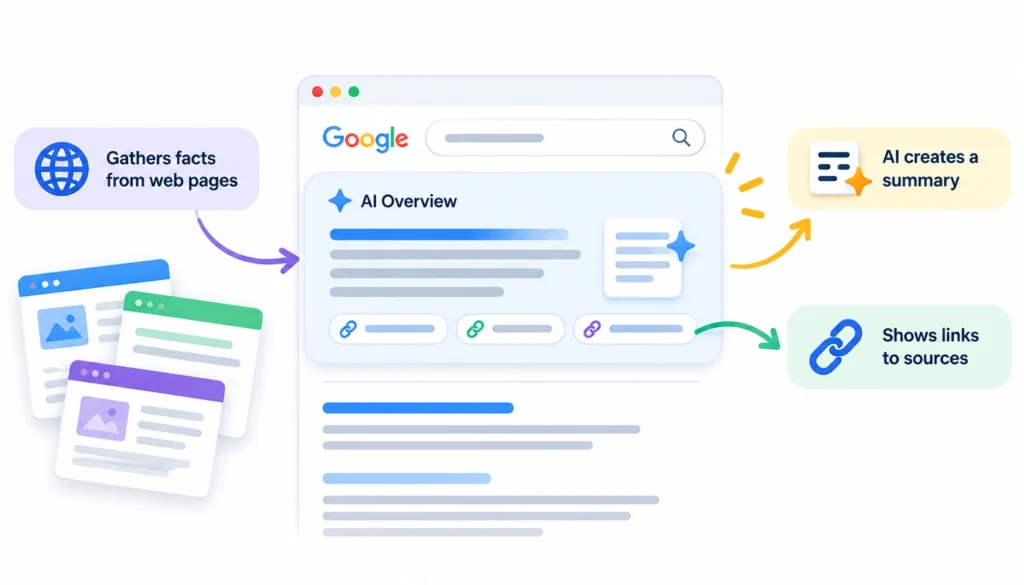
Google AI Overviews are summaries created by intelligence. They appear at the top of search results. Google AI Overviews gather facts from web pages and provide links to the sources used. Google AI Overviews are shown mainly when a fast combined answer is helpful.
How AI Overviews work
Google’s model reads your query, gathers relevant information from its index, and writes a short answer with links to supporting pages.
How AI Overviews differ from traditional results
A traditional result is simply a link. You decide which one to open. An AI Overview on the hand reads for you at the first stage. It shows a synthesis and places links next to or below the answer.
AI Overviews vs featured snippets
A featured snippet quotes one page, usually in a box. An AI Overview blends several sources into new wording. A snippet points to one winner. An overview spreads credit across a handful of pages.
AI Overviews vs Google AI Mode
AI Mode is a more conversational search experience. Google says that AI Overviews and AI Mode can use models and techniques so they should not be treated as the same thing when you read data or plan your work.
What is a query fan-out?
Query fan-out means that Google may run related searches behind one query across subtopics and data sources then combine what it finds. Google confirms this in its documentation.
In practice one search for ” way to learn guitar” might trigger sub-searches, about beginner chords, practice schedules and apps. A page that covers those angles well has more chances to be picked up than a page built around one exact phrase.
7 Major Ways AI Overviews Are Changing SEO
AI Overviews are changing SEO in seven ways: lower click‑through rates on some queries, a link between ranking and traffic, more zero‑click searches, a new citation layer, stronger focus on intent, more value in topical depth and harder measurement. Each of these changes affects planning and reporting.
1. Organic CTR can decline
When an AI answer sits above your result fewer people click through on informational queries. The size of the drop depends on the query and the next sections cover the data.
2. Ranking #1 is no longer the whole visibility story
Position one used to mean the most attention. Now it can sit below a large AI block. Rank still helps, but it no longer guarantees traffic.
3. Zero-click searches matter more
A zero-click search ends without a visit to any website. AI Overviews make that outcome more likely for simple questions. Your content may inform the answer while the person never lands on your site.
4. AI citations create a new layer of visibility
Being linked inside the overview is a form of exposure. It can build recognition even when clicks are low. Most teams don’t track it yet, which is why it deserves attention now.
5. Search intent matters more
Quick factual questions are the ones likely to be answered on the page. Queries that need comparison, judgment, tools or a purchase still send people to websites. Knowing which of your queries fall in which group is now SEO work.
6. Topical authority gains value
Because of query fan‑out covering a subject in depth gives you ways to be matched. A cluster of well‑linked pages can beat a thin page aimed at one keyword.
7. Measurement gets harder
Rankings and clicks no longer describe the picture. You also need to know whether an overview appears, whether you are cited and what the visit is worth. A later section gives you a framework for this.
Do AI Overviews Reduce Organic Traffic?
Often, yes, for informational questions but the amount can be different. Ahrefs saw lower click‑through rates on top pages when an AI Overview showed. That data comes from a party not from Google overall and it should be considered with its limits.
What the available research shows
In 2025, Ahrefs reported that position-one pages had a 34.5% lower average CTR when an AI Overview was present. A later 2026 update from the same team put the figure at 58%.
Treat these numbers as Ahrefs own measurements from its dataset. They show a link but they do not prove that an AI Overview alone caused every lost click and they do not cover every site or industry.
Why traffic impact varies
Two sites can see very different results from the same change. The main reasons are:
- Query type. Definitions and simple facts lose more clicks than complex decisions.
- Search intent. Informational searches are hit harder than transactional ones.
- Position. A top result and a fifth result feel the change differently.
- Device. Mobile screens give an AI block more of the view.
- Brand strength. People search for known brands by name and click them anyway.
- Overview coverage. Some queries trigger an overview often, others rarely.
This is why a sitewide traffic number can hide the real story. Break it down by query group before you draw conclusions.
Why lower CTR doesn’t always mean lower business value
Fewer clicks can still bring the same revenue if the clicks you get are better ones. Someone who already read the summary and clicked tends to be along in their decision making.
That is why you should follow the path: impressions, clicks, engaged sessions, leads, conversions and revenue. A page that lost 20% of its traffic but kept its conversions has a problem than a page that lost both.
How AI Overviews Affect Rankings vs Citations
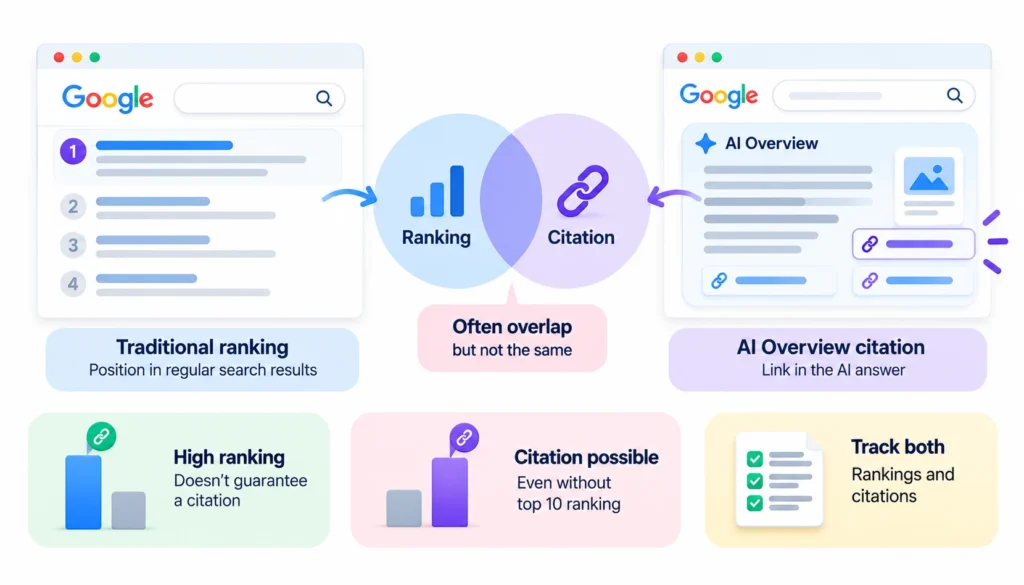
Ranking and citation are two outcomes. A ranking is where your page sits in the results. A citation is a link to your page inside the AI answer. They often overlap, but a high ranking does not guarantee a citation and a citation does not require a ranking.
Traditional ranking
A ranking comes from Google’s regular systems that score pages against a query. You can see it in Search Console or any rank tracker.
AI Overview citation
A citation means Googles AI used your page as support for part of its answer. It is chosen for how it helps build that specific answer.
Why they aren’t the same thing
The AI answer is built from several sub-questions, not only the exact query you typed. A page that ranks well for the main keyword may not cover the sub-questions. A page that ranks lower might cover one of them clearly.
Can a page be cited without ranking in the top 10?
Research suggests it can. A 2026 academic study on arXiv analyzed 55,393 queries across 19 categories. It found that 30% of cited domains did not appear on the accompanying first page of results.
That is one study so treat it as evidence rather than a rule. It does support the idea that ranking and citation are separate.
What this means for strategy
Don’t stop at “can I rank?” Ask “does my page answer the sub-questions clearly enough to be used?” Track both rankings and citations for your important queries, and treat them as two scorecards.
What Determines Which Websites Appear in AI Overviews?
Google has not published a list of ranking factors for AI Overviews. It says a page needs to be indexed and eligible to show in Search with a snippet. Beyond that, what we know comes from third-party research and industry observation, so label each claim honestly.
Here is how to separate the three levels.
Confirmed by Google. Your page must be indexed and eligible for Search. There are no special technical requirements and no special schema needed for AI Overviews. Google also says its AI features use the same foundational SEO practices as regular Search.
Observed by researchers. Cited sources often differ from the first page of results. Studies like the arXiv paper above look at source quality and how sources are used, but they describe patterns, not rules.
Industry hypotheses. Many SEOs believe clear answers, topical depth, original data, and strong author and brand signals help. These ideas are sensible and consistent with Google’s quality guidance, but they are not confirmed factors.
With that in mind, these are the areas worth working on:
- Relevance to the full topic, not one phrase
- Content quality and accuracy
- Clear, extractable answers near the top of each section
- Coverage of related subtopics
- Trust signals such as real authors and a clear brand
- Original information that others don’t have
- Pages that Google can crawl and index
How to Optimize Your SEO Strategy for AI Overviews
Optimizing for AI Overviews mostly means doing good SEO well. Keep your pages crawlable and helpful, answer questions directly, cover related subtopics, and add original value. Google says there is no separate AI-specific technique required. The steps below put that into practice.
1. Keep following Google’s fundamentals
Make sure important pages are crawlable, indexed and fast. Google’s guidance on AI features points to normal practices: good internal links, content available as text, a solid page experience, and structured data that matches what is on the page.
2. Answer the main question clearly
Start each section with a short, direct answer of about 40 to 60 words. Then add depth. This helps readers and makes it easy for any system to pull a clean answer from your page.
3. Structure content around related questions
Use your headings to cover the follow-up questions a person would ask. This fits how query fan-out works.
4. Build topical authority
Publish a connected set of pages on a subject instead of scattered one-offs. Link them in a way that makes sense to a reader.
5. Strengthen internal linking
Internal links help Google find pages and understand how they relate. Use descriptive anchor text and link from strong pages to ones you want to lift.
6. Show first-hand experience
Explain what you actually did, tested or saw. A line like “we moved this page’s answer to the first paragraph and saw it picked up for three more questions” beats generic advice. Only write it if it is true.
7. Add original research and data
A small survey, a dataset or a documented test gives people a reason to cite you. Information that exists nowhere else is hard to replace.
8. Strengthen author and brand entities
Show who wrote the content and why they are qualified. Keep your brand name, About page and profiles consistent. A LinkedIn profile that matches your author bio is a simple place to start.
9. Keep important information in text
Don’t hide key facts inside images or scripts. If it matters, put it in readable text.
10. Keep content accurate and current
Out-of-date numbers hurt trust. Review your top pages on a schedule and fix anything that changed.
How to Measure the Impact of AI Overviews on SEO
To measure AI Overview impact, track impressions, clicks, CTR and conversions for affected queries, then compare them with unaffected queries. Add checks for whether an overview appears and whether you are cited. Judge results by revenue and leads, not traffic alone.
Google says traffic from AI features is counted in Search Console under the Web search type. That means you can’t pull out an “AI Overview only” report there, so you need to build a clean comparison yourself.
Track impressions, clicks and CTR
Start with Search Console. Look at page and query level trends, not just the sitewide total. Falling CTR with steady impressions often points to a SERP change instead of a ranking problem.
Track conversions
Use your analytics tool to follow organic sessions through to leads or sales. This tells you whether the lost clicks mattered.
Monitor AI Overview presence
SEO tools such as Ahrefs, Semrush and others can flag which tracked keywords trigger an overview. Build a list of your priority queries and note which ones show one.
Track citations and mentions
Check whether your pages are linked in the overview for your key queries. Do this by hand for a small set, or use a tool that records it. Log the results monthly.
Compare affected and unaffected queries
Split your query list in two groups: those with an overview and those without. Compare their click and conversion trends over the same period. This is the cleanest way to see the effect on your own site.
Measure revenue, not traffic alone
Use this chain to keep the full picture in view:
Query → AI Overview present? → Ranking → Citation → Impression → Click → Engagement → Conversion → Revenue
How AI Overviews Affect Different Types of SEO
The effect is not the same across search types. Informational queries see the most change. Commercial, ecommerce, local, B2B and brand searches are affected in different ways, so your response should depend on the type of traffic you rely on.
Informational SEO. This is where clicks are most at risk, because short answers satisfy many people on the results page. Go deeper than the summary: examples, tools, original data and clear next steps.
Commercial SEO. Semrush’s 2026 research found that AI Overviews are spreading beyond purely informational queries into commercial-intent searches. Comparison and review content needs real testing and clear criteria.
Ecommerce SEO. Product pages and category pages depend on shopping features and clear product information. Keep details accurate, in text, and consistent with your structured data.
Local SEO. Local searches rely heavily on map listings and business profiles. Keep your profile complete and your reviews healthy.
B2B SEO. Buyers research for a long time and often use detailed queries. Case studies, specific data and expert content give you something a general summary can’t replace.
Brand SEO. People who search for your name want your site. Strong brand recognition protects clicks, which is another reason to build it.
What AI Overviews Mean for Keyword Research
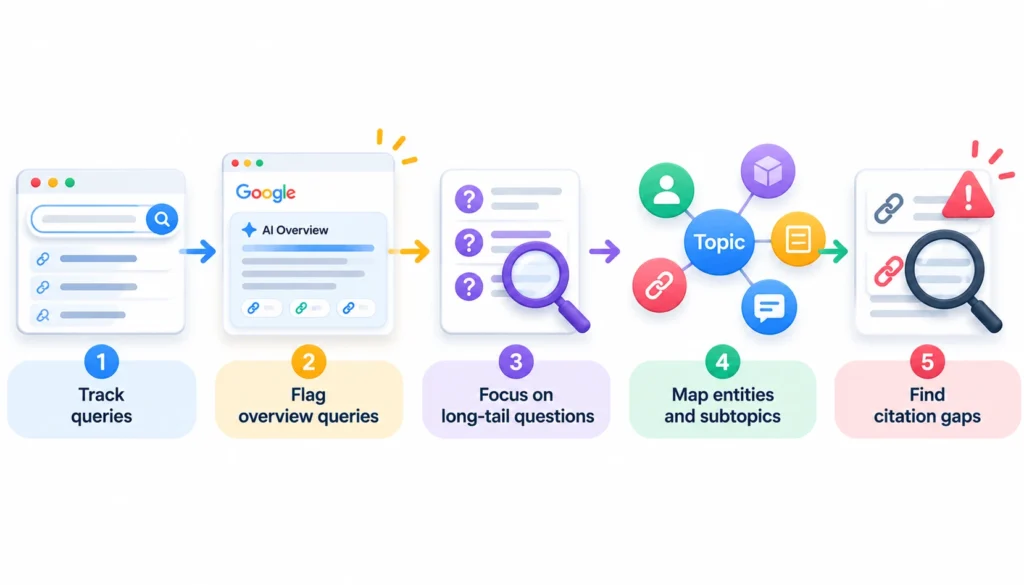
I think keyword research needs a query‑level view. Of picking one phrase per page map the questions and subtopics around a theme, mark which ones trigger AI Overviews and find the gaps where a clear original answer could earn a citation.
- Track queries, not only keywords. Real searches are longer and more specific than the head term.
- Flag overview-triggering queries. Mark them in your tracker so you can report on them separately.
- Prioritize long-tail questions. They often show clear intent and give you room to be specific.
- Map entities and subtopics. List the people, products, concepts and questions linked to your theme.
- Look for citation gaps. If the overview cites weak sources on a topic you know well, that is an opening.
Does Traditional SEO Still Matter After AI Overviews?
Yes. Google says its AI features rely on the foundational SEO practices and pages must still be indexed and eligible to appear. What has changed is how visibility is earned and measured. Search has grown beyond ten links but the base work still counts. The difference is that traditional SEO now works alongside strategies designed for AI-powered search, rather than replacing them. This is explored further in our comparison of AI SEO vs traditional SEO.
The idea that AI Overviews have made SEO obsolete does not match Google’s guidance. The work has widened not disappeared.
What hasn’t changed
- Crawling and indexing
- Relevance to the query
- Helpful, original content
- Internal links
- Technical health
- Authority
- User experience
What has changed
- How much of the results page the AI answer takes up
- How people move through a search
- How CTR behaves on some queries
- The role of citations
- How people find brands
- What you need to measure
Can You Opt Out of Google AI Overviews?
You can limit how your content is shown, but there is no simple switch that removes your site from AI Overviews alone. Google documents snippet controls that affect how your content appears in Search, including in AI features. Using them can also reduce your normal visibility.
What Google allows
Publishers can use nosnippet, data-nosnippet and max-snippet to restrict what Google shows from a page. These are covered in Google’s AI features documentation.
The trade-off
These controls apply to snippets in general so limiting them can shrink how my page looks in results too. Before you use them think about whether the lost exposure’s worth it for the pages in question.
Google AI Overviews vs Traditional SEO: What’s the Difference?
Traditional SEO aims to rank and earn a click. SEO in the AI Overviews era adds a second aim: be seen and cited inside the answer then earn a smaller but often better click. The goals overlap,. The scorecard is wider.
| Factor | Traditional SEO | AI Overview era |
| Main objective | Rank | Be visible |
| Visibility | Organic listings | Listings plus AI citations |
| Core metric | Rankings and CTR | Visibility, CTR and conversions |
| Content focus | Keywords | Intent, entities and topics |
| Authority | Page and domain strength | Authority, relevance and source value |
| Search journey | Click to website | AI answer, then a possible click |
| Measurement | Rankings and traffic | Rankings, citations, traffic and conversions |
The Future of SEO in the AI Overview Era
Nobody can say exactly where AI search will go, and anyone offering exact future percentages is guessing. A few directions look likely based on what we see now.
- Visibility will have more layers. Listings, citations and mentions will all count.
- Brand will matter more. People who know you will click you, no matter what the AI shows.
- Original information will be hard to replace. A summary can repeat common facts, but it can’t invent your data.
- SEO and AI search work will overlap. The same quality signals help in both.
- Traffic won’t be the only success measure. Leads, revenue and brand reach will join it.
Frequently Asked Questions About AI Overviews and SEO
1. How do Google AI Overviews affect SEO?
They add an AI-written answer above organic results. That can lower clicks on some queries while creating new chances to be cited. SEO now covers rankings, citations, clicks and conversions.
2. Do AI Overviews reduce organic traffic?
Often on informational queries. Ahrefs reported CTR drops of 34.5% in 2025 and 58% in a 2026 update for top-ranking pages. Those are Ahrefs’ findings, and results differ by site and query type.
3. Do AI Overviews affect Google rankings?
They don’t change how your page ranks in the normal results by themselves. They change how much attention those results get, because the AI block sits above them.
4. How do AI Overviews choose sources?
Google hasn’t published a full list of selection factors. A 2026 study found that many cited domains weren’t on the first page for the same query, which suggests citation and ranking are separate processes.
5. Does SEO still matter with AI Overviews?
Yes. Google says foundational SEO practices still apply to its AI features, and pages need to be indexed and eligible to show in Search.
6. Can you optimize content for AI Overviews?
You can improve your chances by writing helpful well-structured content that covers related questions. Google says no special markup or AI-specific technical work is required.
7. Do backlinks matter for AI Overviews?
Google hasn’t confirmed backlinks as a factor for AI Overview citations. Backlinks still support your overall authority in Search, so they remain useful for general SEO.
8. Can a website appear in an AI Overview without ranking #1?
Yes. The 2026 arXiv study found that nearly 30% of cited domains were absent from the accompanying first page of results.
9. How can I measure AI Overview visibility?
Use Search Console for impressions and clicks your analytics tool for conversions and an SEO platform or manual checks to see whether overviews appear and whether you are cited. Compare affected and unaffected queries.
10. Can websites opt out of AI Overviews?
You can restrict snippets with nosnippet data-nosnippet and max-snippet. These controls can also limit how your page appears in regular results.
Conclusion
Google AI Overviews affect SEO by changing where attention goes on the results page not by ending the need for search work. Rankings still matter. A page can now rank well and still lose clicks or be cited without ranking at the top.
The best response is practical: keep your technical basics sound, answer questions directly, add information nobody else has and measure results all the way to conversions and revenue.
Google says normal SEO practices still apply. The plan is not to start over. It is to widen what you track and what you aim for.

Nazish is a skilled content writer dedicated to creating high-quality, engaging, and SEO-focused blogs. She specializes in strategic keyword usage, search intent, and informative content that connects with readers while helping websites strengthen their visibility and rankings in search results.