A few months ago, a friend who runs a small software company asked me a simple question. “Do I need to throw out everything I know about SEO now that people ask ChatGPT for answers?”
I hear versions of that question every week. The short answer is no. But the AI SEO vs traditional SEO debate is messier than most articles admit, partly because “AI SEO” means two different things.
This guide explains the difference, shows what stays the same, and gives you a workflow for both. It also flags where the data is thin, because many confident claims in this space rest on small studies.
what is the difference between AI SEO and traditional SEO?
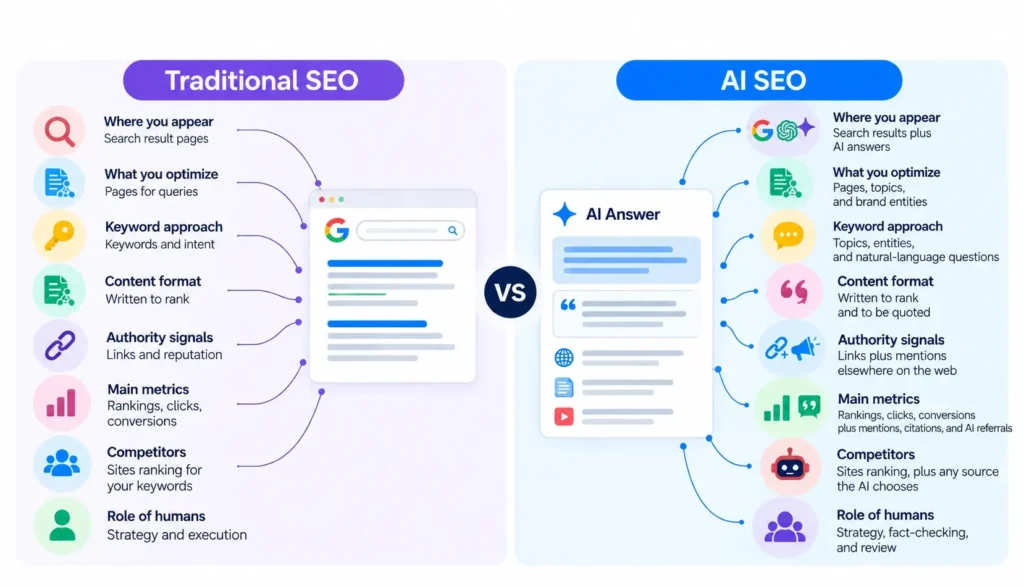
Traditional SEO aims to earn visibility in conventional search results, measured by rankings, clicks, and conversions. AI SEO extends that work to AI-generated answers, so it adds citations, brand mentions, entities, and conversational queries. The two overlap heavily. Technical health, useful content, and authority matter in both.
AI SEO vs traditional SEO at a glance
| Factor | Traditional SEO | AI SEO |
| Where you appear | Search result pages | Search results plus AI answers |
| What you optimize | Pages for queries | Pages, topics, and brand entities |
| Keyword approach | Keywords and intent | Topics, entities, and natural-language questions |
| Content format | Written to rank | Written to rank and to be quoted |
| Authority signals | Links and reputation | Links plus mentions elsewhere on the web |
| Main metrics | Rankings, clicks, conversions | Those, plus mentions, citations, and AI referrals |
| Competitors | Sites ranking for your keywords | Sites ranking, plus any source the AI chooses |
| Role of humans | Strategy and execution | Strategy, fact-checking, and review |
What is traditional SEO?
Traditional SEO is the work of making your pages easy to find, crawl, understand, and trust, so they show up when people search on Google or Bing.
In practice, it covers four core jobs:
- Keyword and intent research. You find what people type and what they want when they type it.
- On-page work. Titles, headings, copy, images, and internal links.
- Technical work. Crawlability, indexing, page speed, and clean site structure.
- Authority building. Earning links and mentions from other sites.
The traditional funnel is simple. Someone sees your result, clicks, reads, and converts. You can track each step, which is why SEO has been easy to report on for so long.
What is AI SEO? Two meanings you need to separate
Most confusion comes from mixing up these two ideas.
Meaning one: Using AI to do SEO means using AI as a tool to support SEO tasks. For example, you can use AI to cluster keywords, create content briefs, identify technical issues, suggest internal links, and summarize reports. The primary goal is to improve efficiency while working toward the same SEO objectives.
Meaning two: Optimizing for AI-powered search means optimizing your content to appear in responses generated by Google’s AI Overviews, Google’s AI Mode, ChatGPT, Gemini, and Perplexity. The goal is to get your content cited, your brand mentioned, or your business recommended in AI-generated answers.
Both are legitimate, and they need different skills. When someone says they “do AI SEO,” ask which one they mean. When this article compares AI SEO vs traditional SEO, it mostly means the second definition. The first gets its own section later.
The 10 differences between AI SEO and traditional SEO
1. Ranked links vs generated answers
A search result page shows a list of links. An AI answer shows a written response, usually with some sources attached. You’re no longer only competing for a position on a list. You’re also competing to be one of the sources the system picks and uses.
2. Keywords vs topics, entities, and questions
Traditional SEO often starts with a keyword, such as “project management software.” AI search users tend to write full questions: “What’s the best project management tool for a five-person design studio on a tight budget?”
An entity is a clearly identifiable thing, like a company, a person, or a product. Search systems use entities to understand meaning, and Wikipedia’s page on knowledge graphs shows how that works. In AI SEO, you cover the topic and the things connected to it, not just the phrase.
3. Clicks vs citations and mentions
A person can read an AI answer, see your brand named, and never visit your site. That still has value, but it doesn’t show up as a session in your analytics. Clicks remain a core metric. They just aren’t the only sign that you were seen.
4. Page relevance vs wider context
Classic SEO asks whether a page matches a query. AI systems can also draw on what the wider web says about a brand. If your site claims you lead the payroll software market and nobody else mentions you, that gap can hurt you.
5. Optimized copy vs quotable copy
AI systems pull short passages out of pages. Clear definitions, direct answers under question-style headings, tables, and numbered steps are easy to lift. Long, winding paragraphs are harder to use.
6. Backlinks vs backlinks plus corroboration
Links still matter. Reviews, industry mentions, expert quotes, and consistent business details across the web can also help systems trust you. Think of it as reputation beyond your own domain.
7. Manual workflows vs AI-assisted workflows
Research, analysis, and drafting used to be done by hand. Now AI can do a first pass on each. A human still has to check whether it’s right.
8. Rank tracking vs multi-surface measurement
You still track rankings, impressions, and conversions. You also test whether AI tools mention or cite you for a set of prompts, and how they describe you.
9. Search competitors vs answer competitors
The sites beating you on Google may not be the sources an AI tool uses. A forum thread, a YouTube video, or a review site might get cited instead. Your real competitor list gets longer.
10. Search-only visibility vs visibility everywhere
Buyers now research across Google, AI assistants, video, and communities. The goal shifts from “rank a page” to “be a credible answer wherever the question is asked.”
What has not changed?
Many articles skip this part. A lot of SEO is the same as before.
Technical SEO still matters. If a crawler can’t reach or render your page, nothing else counts. Crawlability, indexability, clean site structure, canonical tags, and XML sitemaps are still the base.
Helpful content still wins. Pages that answer the real question, with real detail, beat thin ones on both surfaces.
Authority still matters. Trusted sites get chosen more often, whether by a ranking system or a language model.
Search intent still matters. You still need to know what the person wants before you write anything.
Human expertise matters more. Anyone can generate a generic page in seconds. Original experience, data, and opinions are harder to copy.
Google says much the same in its own documentation. Google’s page on AI features says you can apply the same foundational SEO best practices to AI Overviews and AI Mode as to Search overall, such as meeting technical requirements, following policies, and creating helpful, reliable, people-first content.
Its newer guide adds that these generative AI features are rooted in Google’s core Search ranking and quality systems. You can read both on Google Search Central: AI features and your website and Google’s guide to optimizing for generative AI features.
Does ranking #1 on Google guarantee AI visibility?
No. The two overlap, but they aren’t the same.
Semrush studied this in 2026. It found that only 44.3% of pages ranking in Google’s top 10 results appeared in at least one AI-generated answer. You can see the breakdown by platform in Semrush’s AI visibility report.
Two cautions apply. First, this comes from one vendor’s sample, so treat it as a useful data point, not a rule. Second, the direction is what matters. Ranking well helps, but it doesn’t guarantee you’ll be used in an answer.
Different AI tools also pull from different places. In an earlier Semrush study of Google’s AI Mode, the sidebar links had a 51% domain overlap and a 32% URL overlap with Google’s top 10 results. So one strategy won’t automatically cover every platform.
What this means for you: keep ranking, and test your visibility in AI tools separately.
How AI search changes your content strategy
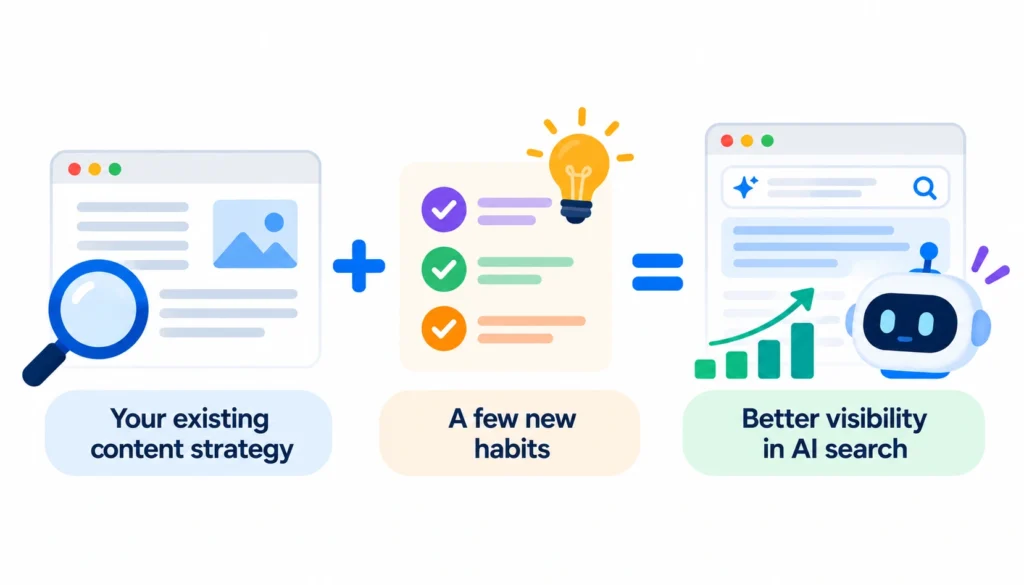
You don’t need a new playbook. You need a few new habits on top of the old one.
Answer the main question early. Put a direct answer in the first few lines under a heading, then expand. This helps readers and featured snippets too.
Cover the follow-up questions. Google says AI Overviews and AI Mode may use a “query fan-out” technique, which issues multiple related searches across subtopics and data sources to build a response. If your page only answers the first question, it may miss the others.
Add something original. Screenshots from your own tests, data from your customers, a stance you can defend. Generic summaries are what AI produces on its own, so they add little.
Make facts easy to extract. Use tables for comparisons, lists for steps, and short paragraphs for definitions. Keep your facts consistent across your site, profiles, and listings.
Build authority off-site. Get mentioned in industry publications, earn honest reviews, and take part where your buyers talk.
Keep pages current. Old prices and outdated features lead AI tools to repeat wrong information about you.
Example: one topic, two approaches
Say you run a software review site and want to rank for “best project management software.”
The traditional brief might include the main keyword, related terms like “project management tools” and “task management software,” competitor headings, a title tag, a target word count, and a list of internal links. That’s a good brief, and it could get you ranking.
A brief that also plans for AI search adds more questions to answer:
- Which tools suit a solo freelancer, a 10-person agency, and a 200-person company?
- What does each cost, and what’s missing from the cheaper plans?
- Which tools integrate with Slack, Google Workspace, or Jira?
- What are the honest downsides of each?
- What did you observe when you tested them?
- What would a buyer ask next, like “How hard is it to switch?”
The second brief isn’t just the first one with extra keywords. It changes what the page is: a decision aid instead of a keyword match. That’s also the kind of page a person wants to read, which is why it tends to work on both surfaces.
How to optimize a page for both traditional and AI search
Here’s the workflow I’d use on a real page.
- Confirm the search intent. Look at what currently ranks and what the searcher wants to do.
- Research keywords and natural-language questions. Use your keyword tool, Google Search Console, sales calls, and support tickets.
- Map the entities and related topics. List the products, people, concepts, and terms that belong in the discussion.
- Check the technical basics. The page must be crawlable, indexable, fast, and linked from relevant pages.
- Answer the main question first. Give the direct answer in 40 to 60 words under a clear heading.
- Cover the follow-up questions. Add sections, a table, or an FAQ where they help the reader.
- Add original evidence. Include your own tests, numbers, quotes, or examples.
- Strengthen internal and external signals. Link related pages together and earn mentions elsewhere.
- Add structured data where it fits. Article, Product, Organization, and similar types help machines read the page.
- Test and monitor. Track rankings and conversions, and check AI tools for how they describe you.
Then have a person review the page before it goes live.
How AI can help with traditional SEO
This is the first meaning of AI SEO. Used well, AI saves hours. Used carelessly, it publishes mistakes at scale.
| SEO task | Where AI helps | What a human still owns |
| Keyword research | Grouping large keyword lists | Choosing what fits the business |
| SERP analysis | Spotting patterns across results | Reading the intent correctly |
| Content briefs | Drafting an outline | Editorial direction |
| Writing | First drafts and rewrites | Expertise, accuracy, voice |
| Internal links | Suggesting candidates | Checking relevance |
| Technical audits | Finding issues fast | Deciding what to fix first |
| Reporting | Summarizing data | Explaining what it means for the business |
What AI should not run on its own
Some jobs need a person to make the call:
- Strategy and brand positioning.
- Fact-checking, especially figures, names, and quotes.
- First-hand experience, since an AI tool hasn’t used your product.
- Expert claims in health, money, or legal topics, where mistakes can hurt people.
- The decision to publish.
Large language models can produce fluent text that is wrong. Wikipedia’s page on large language models covers this limitation. Treat every AI draft as a rough first pass.
AI SEO, GEO, AEO, and LLMO: what’s the difference?
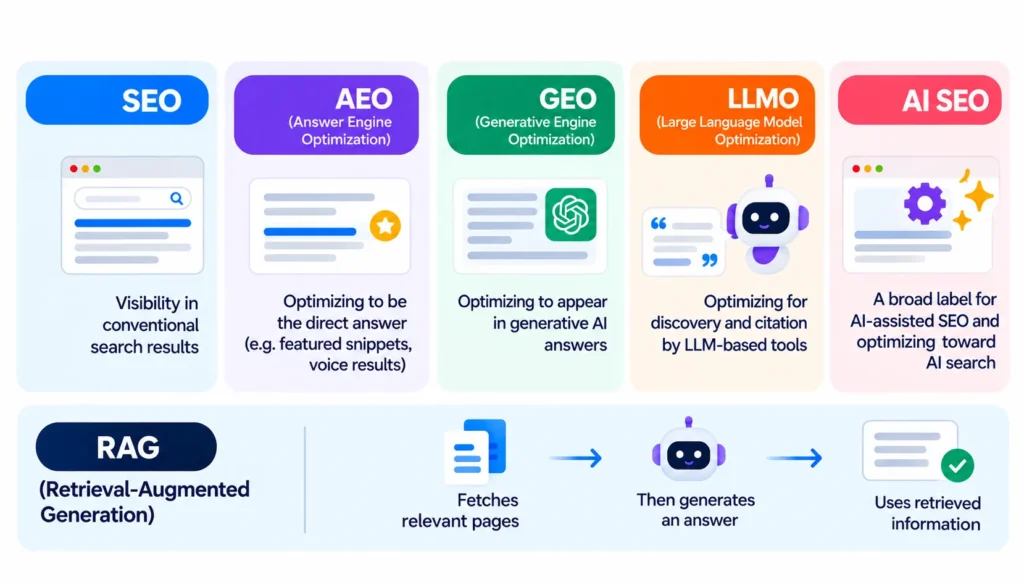
The industry hasn’t settled on one set of definitions. Here’s how the terms are commonly used. Treat this as a practical guide, not an official standard.
| Term | Common meaning |
| SEO | Visibility in conventional search results |
| AEO (answer engine optimization) | Optimizing to be the direct answer, such as in featured snippets or voice results |
| GEO (generative engine optimization) | Optimizing to appear in generative AI answers |
| LLMO (large language model optimization) | Optimizing for discovery and citation by LLM-based tools |
| AI SEO | A broad label for AI-assisted SEO and for optimizing toward AI search |
People argue over which label is right. In practice, the work behind them overlaps far more than the names suggest.
A related term is retrieval-augmented generation, or RAG. It describes AI systems that fetch documents first and then write an answer from them.
Wikipedia explains retrieval-augmented generation well, and Google’s guide says its generative AI features use RAG to retrieve relevant, up-to-date pages from its Search index.
It’s a useful mental model. If your page can’t be retrieved, it can’t be used.
How to measure AI SEO success
You need two sets of numbers, tied to one business goal.
Traditional SEO metrics: rankings, impressions, clicks, click-through rate, organic conversions, and backlinks. Google Search Console covers most of these.
On AI features, Google’s position has changed recently. Google announced Search Console reports that show impressions within generative AI features such as AI Overviews and AI Mode, with the data also kept in the overall performance report.
The reports were rolling out to a subset of websites at launch, so you may not see them yet. Check your own account.
AI visibility metrics:
- How often AI tools mention your brand for a fixed set of prompts.
- How often they cite your pages.
- Your share of citations compared with competitors.
- Whether the description of your brand is accurate.
- Referral traffic from AI tools in your analytics.
Mentions and citations are different things. Semrush’s ghost citations study found that many citations don’t lead to a brand mention, and about a quarter of brand appearances were mentions without a citation. Track both.
Business metrics: leads, sales, and revenue. If AI visibility grows but nothing else moves, ask why before celebrating.
A simple way to start is to write 20 to 30 prompts your customers would actually use. Run them monthly in the AI tools you care about and log the results in a spreadsheet. It’s manual, but it works.
Which should you focus on?
It depends on where you are.
If your SEO foundation is weak, fix that first. Technical problems, thin content, and poor site structure will hold you back everywhere.
If you already rank well, add AI visibility testing, clearer entity signals, and pages built to be quoted.
For most businesses, the answer is one combined strategy. Treating them as separate projects doubles the work and splits your message.
What AI SEO can’t promise
Anyone who guarantees you an AI citation is guessing. Here’s what nobody can promise:
- A citation from any specific AI tool.
- That a certain schema type will get you cited. Google’s documentation says no special markup or new machine-readable files are needed for its AI features.
- That ranking first on Google means you’ll appear in AI answers.
- That publishing lots of AI-written pages will build authority.
- That today’s behavior will hold, since platforms change how they retrieve and cite sources.
Much of the public research is also new, and some comes from companies that sell AI visibility tools. Read the methodology before you repeat a statistic.
Common AI SEO mistakes
- Treating AI SEO as “just use ChatGPT to write content.”
- Publishing AI drafts without editing or fact-checking.
- Chasing keywords and ignoring the questions around them.
- Assuming schema markup guarantees citations.
- Skipping technical SEO.
- Tracking rankings only.
- Writing generic content with no first-hand experience.
- Assuming every AI platform works the same way.
Frequently asked questions
1. Is AI SEO replacing traditional SEO?
No. AI search adds new places where people find answers, but Google says its AI features are rooted in its core Search systems. Traditional SEO is the foundation AI SEO builds on.
2. Do I need both AI SEO and traditional SEO?
For most businesses, yes. In practice they’re one strategy with a few extra tasks: writing quotable answers, building credibility beyond your own site, and measuring AI visibility.
3. Is AI SEO just using AI tools for SEO?
Sometimes. The term covers two things: using AI to speed up SEO tasks, and optimizing to appear in AI-generated answers. Check which one someone means.
4. Does ranking #1 on Google guarantee AI visibility?
No. In Semrush’s 2026 study, fewer than half of Google’s top 10 pages appeared in at least one AI answer. Ranking helps, but you should test AI visibility separately.
5. How does AI change keyword research?
You still use keywords, but you also research the full questions people ask and the follow-ups they’d ask next. Sales calls, support tickets, and communities like Reddit are good sources for real wording.
6. What is the difference between SEO, AEO, and GEO?
SEO aims for visibility in search results. AEO aims to be the direct answer, such as in a featured snippet. GEO aims to appear in generative AI answers. Definitions vary between sources, and the work overlaps a lot.
7. Can AI-generated content rank on Google?
It can, but quality decides. Google has said it focuses on the helpfulness of content, not how it was produced, and that using automation mainly to manipulate rankings breaks its spam policies. Edit, fact-check, and add original value.
8. How do you measure AI SEO?
Track a fixed list of prompts in the AI tools your audience uses. Log mentions, citations, and how your brand is described, then compare that with referral traffic and conversions.
9. Does schema markup help with AI search?
Structured data helps machines read explicit facts on your page, and it’s good practice. It isn’t a shortcut to AI citations, and Google says it doesn’t require special markup for its AI features.
10. What should humans still handle?
Strategy, fact-checking, first-hand experience, expert claims, brand positioning, and the final decision to publish.
Conclusion
The AI SEO vs traditional SEO question has a less dramatic answer than the headlines suggest. Traditional SEO still gets your pages found, crawled, and trusted. AI SEO adds a second goal, which is being the source an AI tool picks when it writes an answer.
The overlap is large, so most of your existing work carries over. What changes is how you structure answers, how you build credibility beyond your own site, and how you measure results across more than one surface.
Start by fixing your fundamentals, then test how AI tools describe you, and adjust one page at a time. Nobody can promise a citation, so aim to be the most useful and most verifiable answer available, and let the results show you what’s working.