

ChatGPT Search takes your question, may rewrite it into narrower web searches, pulls candidate pages from search providers, picks the passages that answer the question best and cites the sources it used. OpenAI has not published a ranking formula. Does not guarantee placement. So “how ChatGPT Search finds and ranks content” is really a question about retrieval, selection and citation.
Quick answer: what is ChatGPT Search?
ChatGPT Search is the feature that lets ChatGPT look things up on the web instead of relying only on its training data. It writes an answer in language and links to the sources behind it. OpenAI launched it in 2024 and the company’s help page, on ChatGPT search explains the basics.
That difference matters for anyone who publishes content. A Google results page shows ten links. Lets the reader choose. ChatGPT chooses for the reader then shows a handful of sources.
What OpenAI confirms, and what it doesn’t
Before going further, here is the line I’m going to hold for the whole article.
OpenAI has told us a few things clearly. It has not told us how its search results are scored. Plenty of articles on this topic blur that gap, and I’d rather not.
I’ll use three labels:
- Confirmed: OpenAI documents it.
- Observed: practitioners or studies have seen it, but OpenAI hasn’t confirmed it.
- Inference: a reasonable guess based on how retrieval systems generally work.
Here is the short version in one table.
| Claim | Label | What to do with it |
| OAI-SearchBot controls whether your pages can appear in ChatGPT Search | Confirmed | Allow it in robots.txt |
| ChatGPT may rewrite a prompt into one or more targeted searches | Confirmed | Cover related sub-questions |
| ChatGPT uses several factors to surface relevant, reliable results | Confirmed | Focus on relevance and accuracy |
| Placement is guaranteed | Not true | Don’t promise clients a position |
| Google position predicts ChatGPT citation | Not reliable | Track the two separately |
| A fixed list of weighted ranking factors exists publicly | Not published | Treat any list as an opinion |
| Clear self-contained answers are cited often | Observed / Inference | Write answer-first sections |
| Third-party mentions help trust | Observed / Inference | Build real external coverage |
If you remember one thing from this section, make it this: OpenAI says there is no guaranteed placement, so nobody can sell you a guaranteed ranking.
How ChatGPT Search works
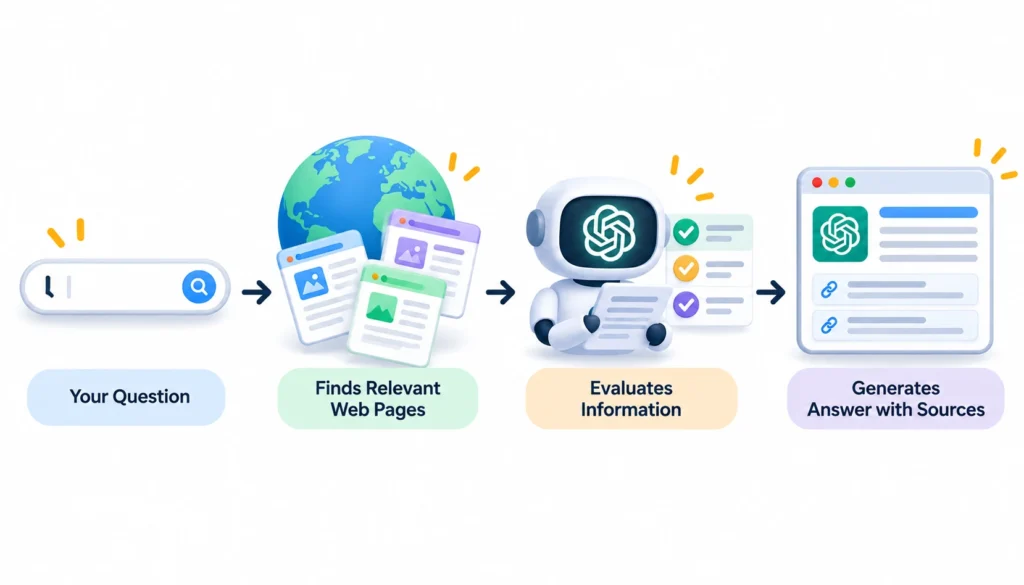
Think of it like a librarian who’s also a writer. First, the librarian finds the books. Then, the writer reads the relevant pages and puts together an answer. Each step can fail for a different reason, which is why a page can be good and still not get cited. Understanding the AI search process helps explain how ChatGPT retrieves, evaluates, and uses information.
ChatGPT’s built-in knowledge vs live search
ChatGPT has two methods for responding. It can use the information it was taught during training. It can look up the internet. If a question requires verifiable details (like prices, news, product comparisons or recent updates) it is more likely to look up the web. If you ask it to explain something it already understands well it might not look anything up at all.
In the chat window you can usually see what happened. If sources show up below the answer the internet was used.
The pipeline, step by step
Here is the flow as I understand it from OpenAI’s documentation and from how retrieval systems work in general:
- The user types a prompt.
- ChatGPT works out what the person is really after.
- It may rewrite the prompt into one or more targeted search queries.
- It retrieves results through search providers and partner content.
- It reviews the candidate pages and may run follow-up searches.
- It writes an answer from the passages it judges most useful.
- It attaches citations to the sources it used.
OpenAI confirms the plan, including changing questions and searching again. The specific details, like how people’re rated compared to each other are not known. That part is about getting information and the best example is retrieval-augmented generation, where a language model brings in documents before it gives an answer.
A concrete example
Say someone types: “What’s the best project management software for a small marketing agency?”
A person would just read the first few results. ChatGPT is more likely to split the question into parts. It might search for team project management tools features that are important, for agency work, pricing details, integrations available and other options that exist. Then it combines what it finds.
That breakdown is the single most useful thing to understand for your own content, and we’ll come back to it.
How ChatGPT interprets a query
Search intent still matters
ChatGPT has to guess what the person wants. Someone asking what a CRM is wants a definition. A page that answers the intent has a hard time getting used however well it is written.
The usual intent types still apply: commercial, navigational and transactional. If you do SEO already none of this is new.
Query rewriting and query fan-out
ChatGPT has the ability to take one sentence written in normal language and turn it into more specific search questions. OpenAI explains this process. The people who work in search engine optimization call this process “query fan-out.” It means that one question can spread out into different searches.
In words your website is not just trying to win for the exact words someone typed. It is also trying to win for the questions that are inside those words.
I don’t know how many smaller questions ChatGPT creates for each prompt and no one, outside OpenAI knows either. What I can share is that websites that explain a topic completely have chances to be found.
Why one keyword is not enough
Imagine you own a website about accounting software and have written a page for freelancers focusing on the best accounting software for freelancers. That page may match the main prompt. But ChatGPT might also search for “accounting software invoicing features,” “accounting software pricing” and “freelancer tax tools.” If you have nothing on those, someone else’s page fills the gap.
The fix isn’t stuffing those phrases into one page. It’s building a small cluster of useful, connected pages.
How ChatGPT finds candidate content
Search providers and partners
OpenAI says that ChatGPT search pulls information from third‑party search providers and also from content shared directly by partners. OpenAI does not give a list of what supplies each answer and the blend can shift over time.
Does ChatGPT Search use Bing?
Bing is widely reported to be part of the picture, and Microsoft Bing is a long-standing OpenAI partner. But OpenAI’s help documentation talks about “search providers” in general, not one named engine for every query.
So what should you do? Make sure Bing can crawl and index your site. Submit your sitemap in Bing Webmaster Tools. That’s cheap and sensible. Just don’t assume a high Bing position equals a ChatGPT citation, because retrieval is only one step in the chain.
Does Google ranking affect ChatGPT?
OpenAI has not confirmed this all. A strong Google ranking usually comes from content, good links and a healthy site. This probably helps in places. However a page that ranks first on Google can still have no citations. A page that ranks lower can have citations.
Treat these two as scoreboards. Many SEO experts compare notes about this in places, like r/SEO and r/bigseo. Those threads help spot patterns. They are only anecdotes. Label them as such in your reports.
Crawlability and OAI-SearchBot
This is the one technical point OpenAI is direct about. OpenAI runs separate crawlers for separate jobs, and its bot documentation describes them:
| Crawler | Purpose |
| OAI-SearchBot | Finds and surfaces pages in ChatGPT Search |
| GPTBot | Collects content that may be used to train models |
| ChatGPT-User | Visits pages when a user asks ChatGPT to open something |
If you want your pages to appear in ChatGPT Search, OpenAI’s publisher FAQ says to allow OAI-SearchBot. Blocking GPTBot is a separate choice about training, and it doesn’t stop search visibility on its own. OpenAI also says robots.txt changes can take about a day to take effect.
A typical robots.txt that allows search but opts out of training looks like this:
User-agent: OAI-SearchBot
Allow: /
User-agent: GPTBot
Disallow: /
Whether you block GPTBot is a business decision. Check with whoever owns your content policy
A few other basics: keep pages public, avoid accidental noindex tags and put key content in the HTML itself rather than loading it only through scripts. General web crawler limits apply here. So does robots.txt behavior.
How ChatGPT evaluates what it retrieves
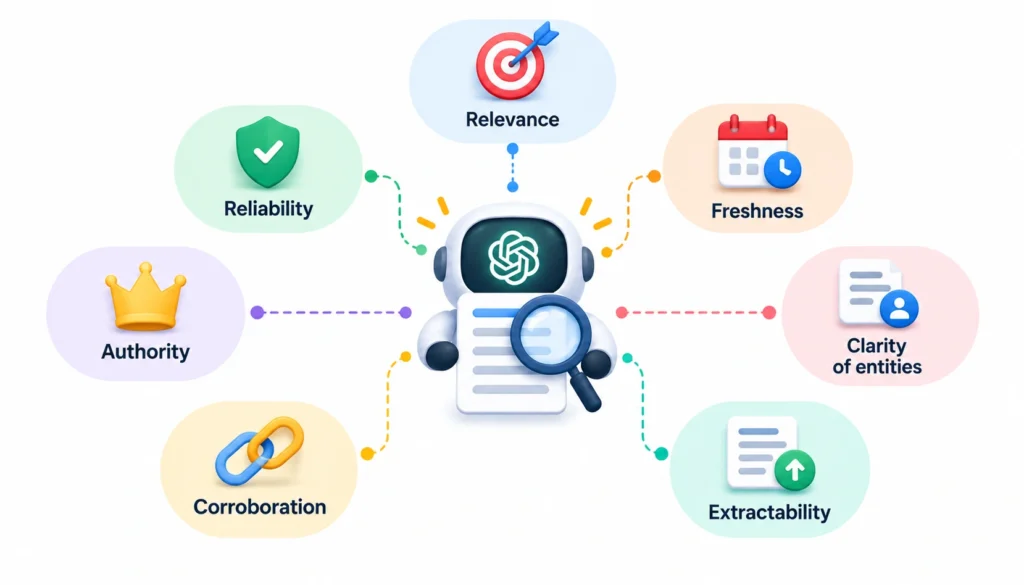
OpenAI says it uses multiple factors to surface relevant and reliable information. It doesn’t list them. Based on how retrieval systems work and what practitioners report, these are the areas worth paying attention to. I’m labeling them as inference, not fact.
Relevance. Does the page answer the exact question, or only circle it?
Reliability. Are claims correct and backed by sources? A page that contradicts well-established sources is a poor candidate to quote.
Freshness. For questions about prices, features, laws or news, newer information has an obvious edge. For timeless questions, it matters less.
Authority and reputation. Sites that are known for a topic, and that other credible sites mention, give a system more reason to trust them. This is an inference. OpenAI hasn’t said how it weighs it.
Clarity of entities. If your page makes it obvious who you are, what the product is and who it’s for, there’s less to misread.
Corroboration. A claim that also appears on other trustworthy pages is safer to repeat.
Extractability. Can a system lift a clean answer from the page without rewriting half of it?
How ChatGPT chooses which sources to cite
This is the part most guides skip, and it’s where the real work is.
Retrieval is not citation
A page can go through several stages:
- It can be reachable.
- It can be retrieved for a query.
- It can be read.
- It can shape the answer.
- It can be cited.
These aren’t the same. Being found is not the same as being cited. From the outside you only see the last step, so it’s easy to misdiagnose why a page is missing.
Why one page gets cited and another doesn’t
Nobody outside OpenAI can give you a certain answer. But there are sensible explanations:
- The cited page answered the specific sub-question more directly.
- It stated the fact in a clean, self-contained passage.
- It looked more trustworthy for that topic.
- It had more recent or more specific information.
- Another source simply fit the final wording of the answer better.
Think of it passage by passage, not page by page. ChatGPT is building one answer from pieces, and each piece needs support. A long, rambling page may be excellent for a person and still hand over nothing quotable.
Conflicting sources and shifting results
When sources disagree, a system has to pick one, hedge, or mention both. You can’t control that. What you can do is make your claims precise and well-sourced.
Citations also change between runs. Ask the same question twice and you may see different sources. That’s one reason a single check proves very little. You need repeated tests, which I cover below.
Does ChatGPT have ranking factors?
OpenAI has not released a ChatGPT Search ranking formula. That is the answer to the question many people actually ask.
What is confirmed: many factors are used for ChatGPT ranking. The goal is to provide reliable results for ChatGPT searches. Placement in ChatGPT rankings is not guaranteed. What is observed: answer‑first pages data and strong third‑party coverage appear often in practitioner reports about ChatGPT. What is speculation: exact weights, exact factor lists and any claim that one tactic always wins the ChatGPT ranking.
If an article lists “the 15 ChatGPT ranking factors”, with percentages ask where those numbers came from.
The ChatGPT Search visibility funnel
Since there’s no official ranking list, I use a funnel to organize the work. Each stage has to hold for the next one to matter.
| Stage | Question to ask | Typical fix |
| 1. Accessible | Can the crawler reach the page? | Fix robots.txt, noindex, login walls |
| 2. Retrievable | Does it match the searches being run? | Cover related sub-questions |
| 3. Relevant | Does it answer the underlying intent? | Rewrite around the real question |
| 4. Trustworthy | Can the claims be backed up? | Add sources, authors, dates |
| 5. Extractable | Can a passage stand on its own? | Answer-first sections, clear headings |
| 6. Citable | Is it the best evidence for a specific claim? | Add original data, precise facts |
| 7. Visible | Does it appear again and again across prompts? | Build topic depth and external mentions |
This is my framework, not an OpenAI one. It’s meant to help you find where a page is failing.
Signals worth optimizing for
Treat these as opportunities, not a confirmed scoring system.
- Search accessibility. Allow OAI-SearchBot and make sure pages return normal responses.
- Query relevance. Match the intent, not just the phrase.
- Clear answers. Put the answer near the top of each section.
- Topic coverage. Address the follow-up questions a reader would ask next.
- Factual accuracy. Check numbers and name your sources.
- Real freshness. Update the substance, not only the date.
- First-hand information. Original tests, screenshots, surveys and data are hard to copy.
- Brand and entity clarity. Say plainly who you are and what you do.
- Third-party mentions. Reviews, directories, press and community discussion can support trust.
- Consistency. Keep names, pricing and descriptions the same across your site and profiles.
- Structured content. Headings, lists and tables help both people and machines.
- Technical basics. Fast pages, clean canonicals and working internal links still matter.
How to optimize content for ChatGPT Search
Write answer-first sections
Open each section with a one- or two-sentence answer. Then add detail. A reader in a hurry gets what they need, and a retrieval system gets a clean passage.
Make sections self-contained
Imagine one paragraph pulled out and shown alone. Does it still make sense? Avoid leaning on “as mentioned above.” Name the subject again.
Use descriptive headings
“Pricing for solo users” says more than “Cost.” Write headings that look like real questions or clear topics.
Cover the related questions
Build each page around the main question and the two or three that naturally come next. You aren’t guessing at fan-out. You’re just being thorough about the topic.
Add original information
If you have first-hand data, use it. A small survey, a pricing comparison you ran yourself, or a documented test gives other pages nothing to copy. Be clear about method and date.
Cite primary sources
Link to the original documentation, study or official page, not to a blog that summarizes it. It makes your claims easier to check.
Keep content in crawlable HTML
If a key table only loads after a script runs, a crawler may miss it. Check the page source, not just what you see in the browser.
Update for substance
Change the facts that changed. Then note the update date honestly. Swapping a date with no real edit doesn’t help anyone.
Google SEO vs ChatGPT Search
Good search engine optimization still does most of the heavy lifting. The differences are mainly in the output and what you measure. Adapting to AI-powered search requires more than traditional optimization. It calls for smarter SEO solutions that align with how modern search systems discover and evaluate content.
| Factor | Google Search | ChatGPT Search |
| Main output | A list of ranked results | A written answer with sources |
| Who picks | The searcher | ChatGPT, then the searcher may click |
| Query handling | Mostly the query as typed, with some expansion | May be rewritten into several searches |
| Goal | Rank and earn the click | Be retrieved, used and cited |
| Structure | Helpful | Especially helpful for pulling passages |
| Measurement | Positions, impressions, clicks | Citations, mentions, referral visits |
Why Google rankings and ChatGPT citations can differ
There are a few reasons. None are definitively known. Google and ChatGPT may utilize different indexes. Systems also vary in how they process input (especially with queries) and the expected result type. Some systems prioritize links, others the content itself. Therefore, a result at position N+1 of Google may have a better answer for a query part than the first result, leading to a better position in a future result.
These differences also explain why a result in the 30th position may still be cited by a generative AI. If the AI believes it can synthesize a better answer from the page in 30th position for a component part of the query, it will.
ChatGPT Search ranking myths vs reality
| Myth | Reality |
| You can rank #1 in ChatGPT | OpenAI says placement isn’t guaranteed |
| Google #1 means ChatGPT visibility | No confirmed link |
| Bing #1 means ChatGPT visibility | Possibly helpful, never a guarantee |
| Schema markup guarantees citations | No evidence that it does |
| Keyword stuffing improves AI visibility | No documented basis |
| Longer pages win | Length alone isn’t a factor OpenAI has named |
| Being crawled means being cited | Retrieval and citation are different steps |
| GPTBot and OAI-SearchBot are the same | They serve different purposes |
| One prompt gives one stable result | Results can vary between runs |
A practical workflow
Here’s a process you can run this week. I’m describing a method, not reporting results from one.
- Pick your prompts. Choose 20 to 30 questions your customers really ask. Include comparison and “best for” prompts.
- Run them in ChatGPT. Use the same wording each time. Run each prompt a few times on different days, since answers shift.
- Record what you see. Log the cited domains, the exact pages, and whether your brand was mentioned.
- Study the cited pages. What do they cover that you don’t? Is the answer easier to lift?
- Map the gaps. List the sub-topics and questions your page misses.
- Improve the page. Add the missing answers, tighten the structure, add sources and original data.
- Build outside signals. Get your work covered or referenced by credible third parties, honestly and without spam.
- Test again. Wait a few weeks, rerun the same prompts, and compare.
A simple tracking table keeps this manageable:
| Prompt | Date | Your domain cited? | Brand mentioned? | Other domains cited |
| (your prompt) | Yes / No | Yes / No |
How to measure ChatGPT Search visibility
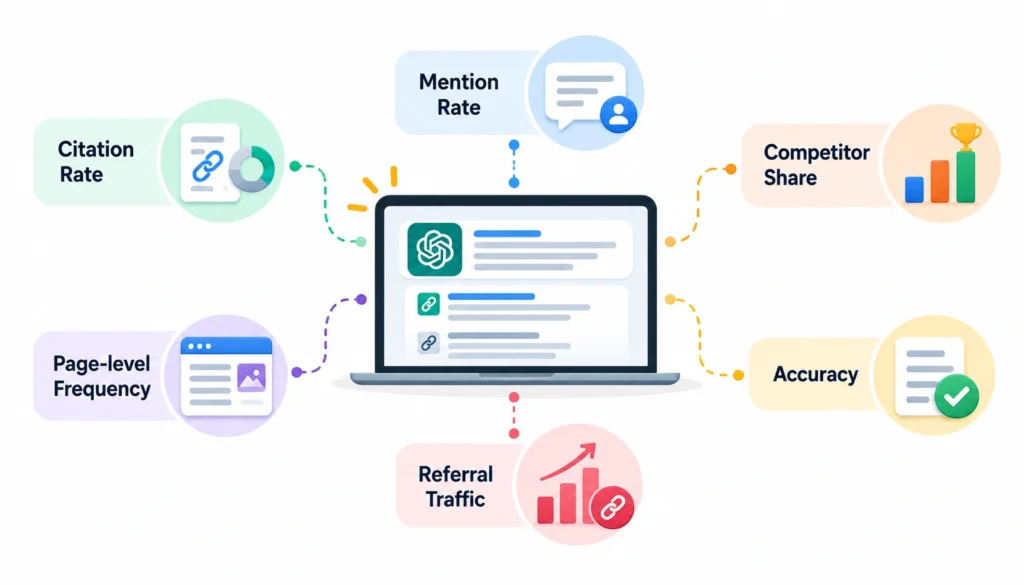
Use numbers you can repeat.
- Citation rate: the share of tracked prompts where your domain is cited.
- Mention rate: the share where your brand is named, linked or not.
- Competitor share: how often each rival is cited for the same prompts.
- Page-level frequency: which of your pages get cited, and for which prompts.
- Referral traffic: visits from ChatGPT in your analytics. Links from ChatGPT often carry a utm_source=chatgpt.com parameter, which makes them easy to filter.
- Accuracy: whether the answer describes you correctly. A citation that gets your pricing wrong is a problem worth fixing.
One caution. Because results vary, a single run is an anecdote. Look at trends over several runs.
Technical checklist
- OAI-SearchBot is allowed in robots.txt
- Important pages are public and return normal status codes
- No accidental noindex tags
- Key content is in the HTML, not hidden behind scripts
- Clean canonical URLs
- Descriptive titles and headings
- Answer-first sections
- Author names and credentials shown
- Sources linked for factual claims
- Original data where you have it
- Statistics checked and updated
- Consistent brand details across the web
- Sitemap submitted to Bing Webmaster Tools and Google Search Console
Frequently asked questions
1. How does ChatGPT Search find content?
It reads the question might change it into specific searches gets pages from search companies and partner sites and uses what it finds to create an answer with sources. OpenAI shares the plan but not the details on how things are ranked.
2. How does ChatGPT rank content?
OpenAI says it uses multiple factors to surface relevant, reliable information and doesn’t guarantee placement. There is no public ranking formula.
3. Does ChatGPT Search use Bing?
Bing is widely reported to be one source, but OpenAI describes its sources as third-party search providers and partners. Make your site indexable in Bing anyway.
4. Does Google ranking affect ChatGPT?
OpenAI hasn’t confirmed that it does. A high Google rank doesn’t guarantee a ChatGPT citation.
5. Can you rank #1 in ChatGPT?
Not in the way you can on Google. ChatGPT answers don’t have a fixed, guaranteed position that you can hold.
6. How do I get my website cited by ChatGPT?
Allow OAI-SearchBot, answer real questions clearly, cover related sub-questions, back up your claims, and add information others can’t copy. None of it guarantees a citation.
7. What is OAI-SearchBot?
It’s OpenAI’s crawler for ChatGPT Search. Allowing it is the step OpenAI recommends if you want your pages to appear and be linked in search answers.
8. What is the difference between OAI-SearchBot and GPTBot?
OAI-SearchBot is tied to search. GPTBot is tied to collecting content that may be used for training. You can set rules for each separately.
9. What is a query fan-out?
It is when one question is turned into smaller searches. OpenAI talks about changing the question and doing searches. SEO experts use the word “fan-out” to describe what happens.
10. Does ChatGPT favor fresh content?
For time-sensitive questions, newer information is likely to be more useful. OpenAI hasn’t published a freshness weighting.
11. Is ChatGPT SEO different from regular SEO?
The basics are similar. The differences are, in what you track (citations and mentions). In how important a short clear part of a page is.
Key takeaways
There is no ranking system to find things when using ChatGPT Search because the results come from how information’s found, chosen and used. Of a simple list of results ChatGPT Search focuses on what the person is trying to find.
This means the answers can change. Many different things decide what is useful and correct. There is no way to do this and you should not trust anyone who says there is.
Found does not mean the same as quoted. Let OAI-SearchBot run. Give the answer first with related questions. You can include resources and your own information.
Use Bing and Google to see how things are going. Do not treat them as the only way to measure success. When checking how well something is working use the question several times and watch for patterns instead of looking at one result only.

Nazish is a skilled content writer dedicated to creating high-quality, engaging, and SEO-focused blogs. She specializes in strategic keyword usage, search intent, and informative content that connects with readers while helping websites strengthen their visibility and rankings in search results.