

If you want to optimize content for Perplexity you must ensure PerplexityBot can crawl your page. Place an answer at the top of every section. Support each claim with a named source. Keep the information up to date. With these steps Perplexity will find a passage to pull, have a reason to trust it and a clear link to cite.
There is no formula that guarantees a citation and anyone who claims to have one is only guessing. What you can control is whether your page is accessible, relevant, easy to quote and believable. This guide walks through each of those factors in order. Then shows how to apply them to an article you already own.
What Does It Mean to Optimize Content for Perplexity?
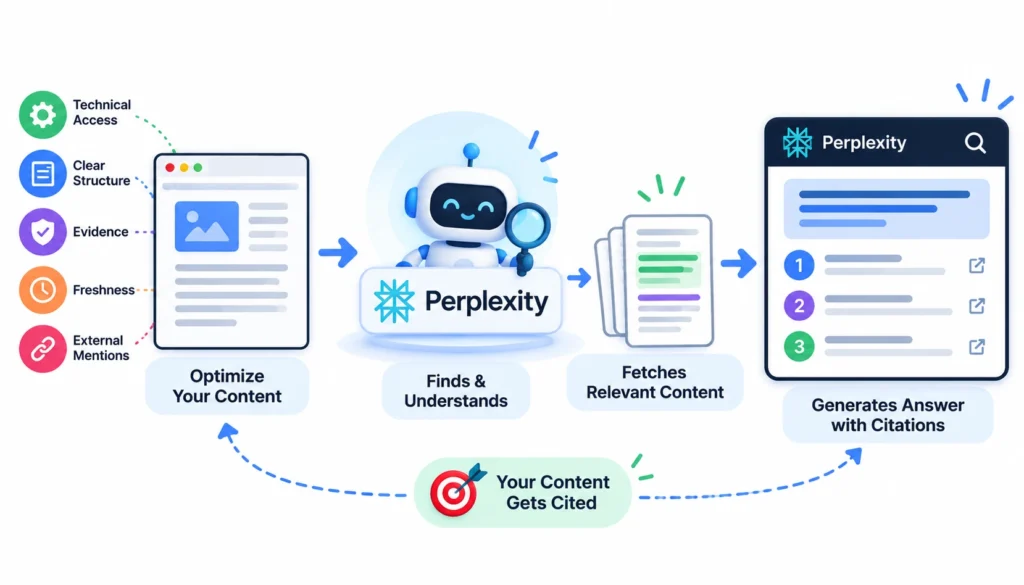
Optimizing content for Perplexity means shaping a page so that Perplexity can find it, understand it, pull a clear passage from it and credit it as a source in an answer. It covers technical access, writing structure, evidence, freshness and outside mentions. It is a platform-specific part of generative engine optimization (GEO).
Perplexity is an answer engine. Instead of a page of ten blue links, you get a written answer with numbered sources beside it. Behind the scenes it uses a pattern called retrieval-augmented generation, where the system fetches relevant documents first and then writes an answer from them. Your goal is to be one of the documents it fetches and trusts.
Perplexity optimization vs. traditional SEO
The two overlap a lot. A page that loads fast, is easy to crawl and answers a real question helps in both places. The difference is what you are chasing. Traditional search engine optimization aims for a ranking position. Perplexity optimization aims for a citation inside a written answer.
| Factor | Traditional SEO | Perplexity optimization |
| Main goal | Rank on the results page | Be cited in the answer |
| What gets judged | The whole page | Individual passages |
| Structure | Flexible | Direct and easy to extract |
| Freshness | Depends on the query | Matters a lot for changing topics |
| Authority | Links, brand, entity signals | Expertise plus mentions from other sources |
| Measurement | Rankings and clicks | Citations, mentions and referrals |
Perplexity optimization vs. GEO and AEO
GEO and answer engine optimization (AEO) are the terms for getting visible in AI‑generated answers across tools like Perplexity, ChatGPT and Google’s AI features. Perplexity optimization is one slice of that. Most of the work carries over from one platform to another though each tool has its crawler and its own habits.
Ranking is not the same as being cited
Think of four stages: your page gets crawled. Your page gets retrieved for a query. A passage gets selected. That passage gets credited. A page can fail at any stage. Many pages rank well in Google. Never get cited because their best facts are buried in long paragraphs.
It helps to split the work into two parts. Eligibility asks whether Perplexity can reach and read your page. Selection asks whether once Perplexity can your passage is the one to quote. Fix eligibility first because no amount of writing helps a page that is blocked.
How Does Perplexity Find and Select Content?
Perplexity runs a search index. It retrieves pages through an AI search process that determines which information is relevant to the question. It uses a language model to write an answer from the passages. Perplexity has said its crawler follows robots.txt rules. Perplexity also said its indexing considers how important a URL is and how often it is likely to change. Beyond that the ranking recipe is not public.
That gap matters, because a lot of articles on this topic state precise ranking percentages as fact. Most of those numbers come from outside studies with different methods. Here is a more honest way to sort what you read.
| Claim | How solid is it? |
| PerplexityBot exists and respects robots.txt | Stated by Perplexity |
| Blocking PerplexityBot can keep you out of its search results | Stated by Perplexity |
| Fresh, well-sourced, clearly written pages get cited more | Widely observed by practitioners, not officially quantified |
| Exact ranking-factor percentages | Third-party estimates, treat with caution |
| A magic word count or schema type that guarantees citations | Unsupported |
The same caution applies to Reddit. Many studies find Reddit is cited often by Perplexity. They sample different prompts and report very different shares. Use the pattern that community discussion shows up often and ignore any number.
The 10-Step Framework to Optimize Content for Perplexity
The steps below follow the order a page moves through: access, understanding, extraction, trust, then upkeep. Work through them from the top.
1. Answer the query immediately
Perplexity needs a passage it can lift without rewriting. Put the direct answer in the first one or two sentences under each heading, then explain.
Here is the same opening written two ways.
Before: “In today’s fast-moving digital world, businesses are asking how they can get more out of AI search tools. There are many factors involved, and understanding them takes time and careful thought.”
After: “To get cited by Perplexity, let PerplexityBot crawl your page, answer the question in the first two sentences, and support each claim with a named source. Keep the page updated when the facts change.”
The second version can be quoted as it stands. It names the action, the reader and the result in about 40 words. The first says nothing a reader could use.
2. Structure each section so it can stand alone
Perplexity pulls passages, not pages. A paragraph that only makes sense after reading the three before it is hard to quote.
I recommend a pattern for each important section: answer, evidence, explanation, example. State the answer. Point to proof. Explain why it holds. Show a case. Keep paragraphs short. Use a question as the heading when the topic’s a question. Use a table or numbered list when the content is truly a comparison or a sequence.
3. Build topic depth, not keyword density
Repeating “Perplexity SEO” fifteen times does not tell a retrieval system anything it didn’t know after the second. What helps is covering the ideas a knowledgeable person would expect to see.
For this topic, that means terms like PerplexityBot, robots.txt, retrieval, citations, freshness, structured data and source corroboration, explained in context. A simple test: list the concepts that the top cited pages for your query all mention, then check which ones your page skips. Fill those gaps with a real explanation, not a pasted list of terms.
Internal links do quiet work here. Linking from a broad guide to your pages on crawling, schema and freshness shows how the topics connect, and it helps crawlers find those pages.
4. Support claims with evidence
Vague claims are easy to skip. A named source is easy to verify. That is the point. Cite sources where you can such as Perplexity’s own documentation the original study behind a statistic or a standards body.
If you have your numbers use them. Original data is hard to copy. Other sites tend to link to it. A small survey of 100 customers or a before-and-after comparison from your pages is more useful than a rewrite of someone else’s statistic.
Separate fact from opinion in the text. “Perplexity’s documentation says X” and “in our experience Y” should read differently.
5. Make your page easy for PerplexityBot to crawl
This is the eligibility step, and it fails more often than people expect. According to Perplexity’s crawler documentation, PerplexityBot is meant to surface and link sites in Perplexity search results, and Perplexity recommends allowing it in robots.txt and permitting its published IP ranges. The same page says PerplexityBot is not used to collect content for training foundation models.
There is an agent, Perplexity-User, which fetches a page when a person asks about it in real time. Perplexity says it generally ignores robots.txt because a user triggered the request. Blocking one does not control the other.
Run through this list on any page you want cited:
- Open your robots.txt file and confirm nothing blocks PerplexityBot by accident, including a broad rule meant for another bot.
- Check that the page returns a normal 200 status, not a redirect loop, a 403 or a soft 404.
- Look at your CDN and firewall settings. Bot protection tools sometimes block crawlers that robots.txt allows.
- Confirm the main content appears in the HTML the server sends, not only after JavaScript runs. View the page source and search for a sentence from your article.
- Keep an up-to-date XML sitemap and a correct canonical tag.
A small example. A software company moves to a new CDN and turns on aggressive bot filtering. Their robots.txt is fine, but the firewall now returns errors to unfamiliar crawlers. Nothing looks broken to the team, yet their pages quietly fall out of AI answers. Checking server logs for PerplexityBot requests would have caught it in a day. Perplexity notes that robots.txt changes can take time to be picked up, so give edits a day or so before judging them.
6. Use structured data correctly
Schema.org markup usually added as JSON-LD marks the parts of a page: who wrote it, which organization published it, what the product is, when it was changed. Article, Organization, Person, FAQPage, HowTo and Product are the types.
Two rules keep this honest. The markup must match what is visible on the page. It is not a guarantee of anything. Perplexity has not published a rule saying schema earns citations so treat it as labeling that helps machines read your page and nothing more. Wrong or invented markup does harm than none.
7. Show real experience and expertise
Add a named author with a short bio that explains why that author is qualified. Link to a profile that can be checked. Say how you know what you know: a test you ran a client project, a dataset you analyzed.
If you run an experiment, show it. Write down the query, the page before the change, what you changed, the date and what happened next. Do not invent results. Do not generalize from one test to a rule. “We changed this on one page. Saw this” is honest and useful.
8. Build authority outside your own site
Perplexity answers often draw on several sources at once, so being mentioned elsewhere gives it a reason to trust you. That can mean an industry article that quotes you, a listing on a review site, a mention in a community thread, a post from a named expert on LinkedIn, or a citation on a Wikipedia page when your work genuinely qualifies.
Communities like r/SEO are a good place to see how practitioners talk about this topic and what questions come up. If you take part, follow each subreddit’s rules and Reddit’s own reddiquette. Answer questions, share what you know, and disclose your affiliation. Dropping links into threads or posting from fake accounts gets removed and damages trust.
The rule of thumb is simple. Earn mentions by being useful. Do not buy or manufacture them.
9. Keep content fresh without fake updates
A real update changes something a reader would notice: a statistic, a screenshot, a recommendation a source that no longer exists. Changing the date at the top without changing the content is an update and it fools nobody for long.
Match your review schedule to how fast the topic moves.
| Content type | When to refresh |
| News and trends | As things happen |
| Tool features and pricing | When the product changes |
| Statistics | When the source publishes new data |
| Evergreen guides | A thorough review a couple of times a year |
| Definitions | When the terminology shifts |
When you do make a real update, change the visible date and the dateModified value in your markup together.
10. Write for the way people ask Perplexity questions
People type questions into Perplexity and follow up. “Does PerplexityBot respect robots.txt?” is more typical than ” robots.” Use the questions people actually ask as headings and answer them directly.
A useful research habit is to run your target query in Perplexity read the related questions Perplexity suggests. Those are prompts you can answer in your content. Also think about intent. Someone comparing tools needs a table. Someone troubleshooting needs steps. Someone checking a fact needs one sentence.
How to Optimize an Existing Article for Perplexity
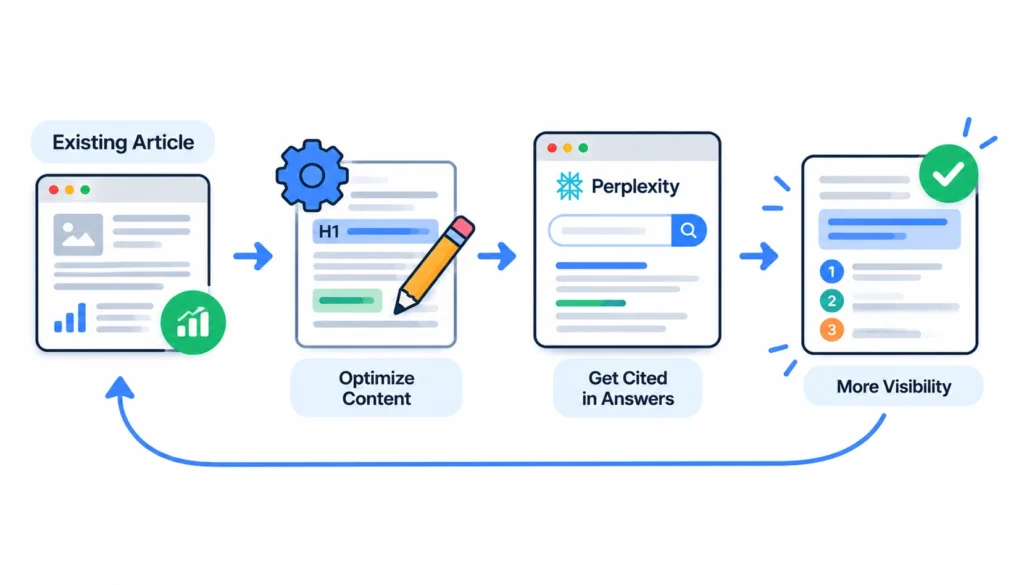
You do not need to start from scratch. Take one article that already gets some traffic and work through these steps.
- Pick one target question the article should answer.
- Run that question in Perplexity and note which sources it cites.
- Open the cited pages and list the concepts, facts and formats they use.
- Compare your article with that list and mark what is missing.
- Find claims in your article that have no source and add one, or cut the claim.
- Rewrite the opening of each major section so the answer comes first.
- Fix crawl problems: robots.txt, status codes, firewall rules, rendered HTML.
- Add or correct structured data so it matches the visible page.
- Update anything outdated, then change the visible date and dateModified.
- Publish, then check the same query again after a few weeks and record what changed.
- If a competitor overtakes you, repeat the comparison.
Keep a simple log with the date, the change and the result. After a few pages you will see what works for your niche, which is worth more than any general rule.
Perplexity Content Optimization Checklist
Use this before and after publishing.
Content
- The direct answer appears near the top
- Headings describe what each section answers
- Terms are defined in plain language
- Related concepts are covered
- Claims have named sources
- Examples or original data are included
Technical
- PerplexityBot is not blocked in robots.txt or at the firewall
- The page returns a 200 status
- Main content is in the server-sent HTML
- Sitemap and canonical tag are correct
- Schema matches the visible content
Authority
- Author name, bio and profile link are present
- Other credible sites mention or link to you
- You take part in relevant communities under your real identity
Freshness
- Statistics and examples are current
- Dead or outdated sources are replaced
- The date reflects a real change
How to Measure Perplexity Content Performance
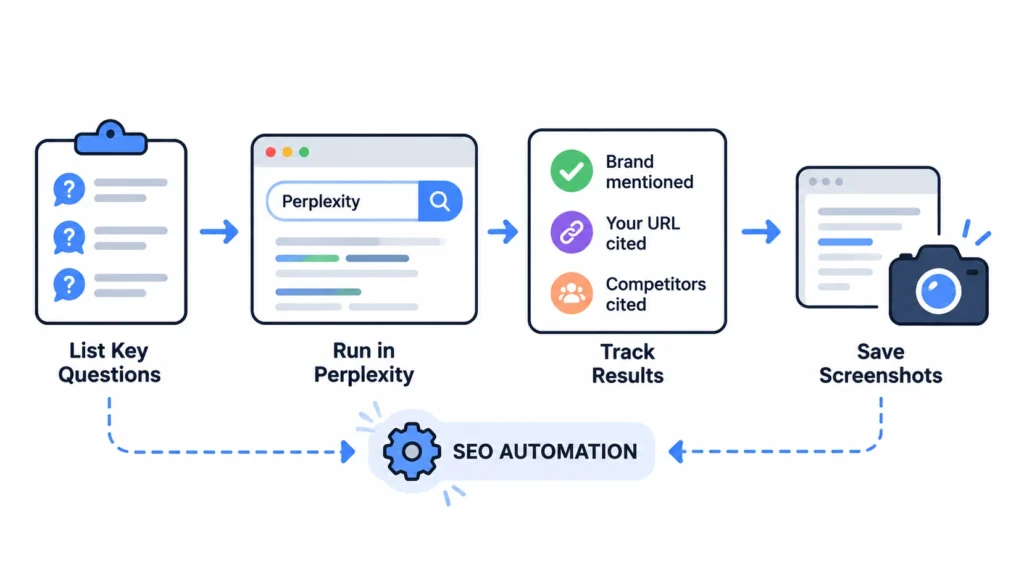
Start with a fixed list of ten to twenty questions that your audience asks. Each month run those questions in Perplexity. Record three things: whether your brand is mentioned, whether your URL is cited and which competitors are cited instead. Save screenshots so you can compare later. SEO automation can help make this type of recurring monitoring more manageable.
Also watch traffic from Perplexity in your analytics and check server logs for PerplexityBot visits to confirm that PerplexityBot can reach you. When Perplexity cites a third‑party page that mentions you, such as a review listing or a forum thread, note that page. That note tells you where your outside mentions are coming from.
Visibility and traffic are not the number. Your brand can appear in answers without generating many clicks so track both.
Answers also vary between runs and between users. Look at trends over weeks, not just one result.
Common Mistakes When You Optimize Content for Perplexity
Most failures come from a short list of habits.
- Writing for keywords instead of questions. Pages built around a phrase tend to avoid actually answering anything.
- Burying the answer. A 150-word introduction before the point means the passage Perplexity wants is not there.
- Making unsupported claims. If you cannot name where a fact comes from, expect it to be passed over.
- Faking freshness. New dates on old content waste the update.
- Over-marking pages with schema. Add only what matches the page.
- Blocking crawlers by accident. Check both robots.txt and the firewall.
- Hiding content in JavaScript. If the text is not in the first HTML response, a crawler may never see it.
- Publishing generic AI-written filler. Pages that repeat what ten others already say give Perplexity no reason to pick yours.
- Gaming communities. Fake accounts and planted links harm your reputation and break the rules of most forums.
- Assuming one citation will last. Answers change, so keep measuring.
Frequently Asked Questions
1. How do I get my website cited by Perplexity?
Allow PerplexityBot to crawl it, answer the question directly, support claims with named sources, keep the content current and earn mentions from other credible sites. No step guarantees a citation, but each one removes a reason to be skipped.
2. Does Perplexity use Google rankings?
Perplexity has not published a rule that ties citations to Google rankings. It runs its own index and retrieval. Good traditional SEO still helps, because crawlable, clear, trustworthy pages perform better everywhere.
3. What is PerplexityBot?
PerplexityBot is the crawler Perplexity uses to surface and link websites in its search results. Its documentation says it respects robots.txt and is not used to gather content for training foundation models.
4. Does robots.txt affect Perplexity?
Yes for PerplexityBot. Perplexity says the separate Perplexity-User fetcher, which runs when a person asks about a page, generally ignores robots.txt. If you want to block that one, you need controls at the server or firewall level.
5. Does schema markup help Perplexity?
It helps label your content clearly, but Perplexity has not said it ranks or cites pages because of schema. Use accurate markup as good practice and do not expect it to do the work on its own.
6. Does domain authority matter?
Strong sites have an advantage, but Perplexity does not publish a domain authority threshold. A smaller site with a precise, well-sourced answer and clear expertise can still be cited, especially on narrow topics.
7. How often should I update content for Perplexity?
It depends on how fast the topic changes. Update fast-moving topics when the facts change and review stable guides a few times a year. Always change something real.
8. Is Perplexity optimization the same as GEO?
Not quite. GEO is the wider practice of earning visibility in AI answers. Optimizing for Perplexity is the part that deals with its crawler, its citation style and the sources it leans on.
9. Can a small or new website get cited?
Yes, though it takes more outside corroboration. Focus on narrow questions you can answer better than anyone, publish something original, and get mentioned by credible sources in your field.
10. How do I track Perplexity citations?
Run a fixed set of questions on a schedule, record whether your brand and URLs appear, and compare results over time. Pair that with referral traffic and server logs for PerplexityBot.
Conclusion
To optimize content for Perplexity treat it as a sequence. First make sure PerplexityBot can reach your page. Then write each section so the answer comes first, support it with a source a reader can check and keep it current. After that earn mentions from credible places and measure what changes.
Start small. Pick one article, run the steps above and log the result. A few honest tests will teach you more about your niche than any list of ranking factors and they will keep you from building a strategy on numbers nobody can verify.

Nazish is a skilled content writer dedicated to creating high-quality, engaging, and SEO-focused blogs. She specializes in strategic keyword usage, search intent, and informative content that connects with readers while helping websites strengthen their visibility and rankings in search results.