Why AI SEO matters in [this_year] comes down to one change: people now get answers from search tools before they ever click a website. Google shows AI-written summaries at the top of results. ChatGPT, Gemini and Perplexity recommend brands directly in conversation. If those answers don’t mention you, a growing share of potential customers never see you.
SEO isn’t dead, and you don’t need to start over. The old foundations still count. What has changed is the goal. Ranking a page is no longer enough. You want to be the source that both people and AI systems understand, trust and cite.
This guide explains what changed, what didn’t, and what to do about it. It also covers how to measure results, so you can decide whether AI SEO deserves a place in your budget.
Why does AI SEO matter in [this_year]?
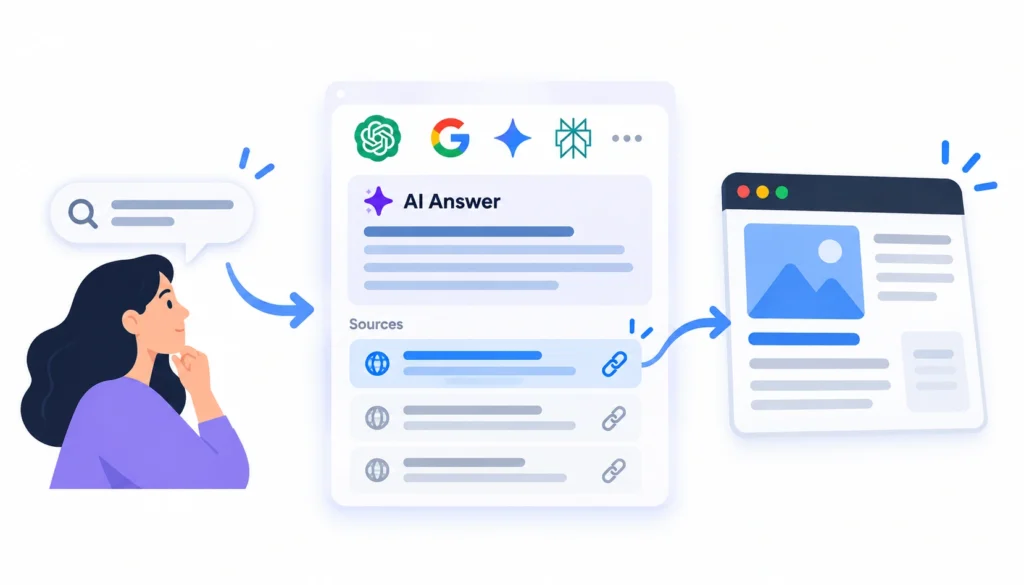
AI SEO matters in 2026 because AI-generated answers now sit between your customer and your website. Being cited inside those answers has become a separate kind of visibility from ranking underneath them.
Here is the short version:
- Search is shifting from lists of links to direct answers.
- Some searches end without a click.
- AI tools shape buying decisions before a visit happens.
- Rankings alone no longer show your full visibility.
- Brands that AI systems trust get named more often.
What is AI SEO? AI SEO is the practice of making your website easy for search engines and AI tools to find, understand, trust and cite. It builds on classic SEO and adds work for AI-generated answers, such as Google AI Overviews, ChatGPT, Gemini and Perplexity.
The goal is to be named in the answer, not only ranked under it.
You’ll also see the terms AEO (answer engine optimization) and GEO (generative engine optimization). They overlap heavily. A simple way to hold them in your head: SEO is about search visibility, AEO is about answer visibility, and GEO is about visibility inside generative AI tools.
Now the seven reasons in more detail.
1. Search is becoming answer-first
Ten blue links used to be the product. Now Google often puts an AI summary above them. Google’s AI Mode and tools like ChatGPT and Perplexity go further and let people ask follow-up questions in a conversation.
This changes how people phrase queries. They write full questions instead of short keywords. A query like “best accounting software for a three-person design studio” gets a direct recommendation, not a list of pages to browse.
2. People can get answers without clicking
This is often called zero-click search. If an AI summary answers “how long does a root canal take,” the searcher may never visit a dentist’s website.
Informational queries are the most exposed. A page that only defines a term or lists simple facts is easy for an AI to summarize, and the reader has less reason to click through. Pages with original data, tools, opinions or deep detail give people a reason to visit.
3. Citations are a new form of visibility
When an AI answer cites your page, your brand appears in front of the reader at the moment they’re looking for help. That placement can carry more weight than position four in the organic results below it.
4. AI shapes decisions before the website visit
Think about how someone chooses a project management tool today. They might ask ChatGPT for options, ask Gemini to compare two of them, check Reddit for honest opinions, and only then open a pricing page.
Your brand can win or lose in the first three steps without you ever seeing a visit in your analytics. That’s a real change in how SEO affects revenue.
5. Traditional SEO signals still feed AI visibility
AI tools don’t pull answers from nowhere. Many of them rely on web content that has been crawled, indexed and judged as trustworthy. Google’s own documentation on AI features in Search says that standard SEO best practices still apply to appearing in them.
So the basics still matter: a crawlable site, helpful content, good internal links and real authority. AI SEO sits on top of that base.
6. Brand authority carries more weight
AI systems tend to favor sources that appear consistently and credibly across the web. If your website says one thing, your LinkedIn page says another, and review sites say a third, you make it harder for any system to describe you accurately.
Consistent details about who you are, what you sell and who you serve help. So do mentions on trusted third-party sites. Backlinks still count too, which is why link building remains part of the job.
7. Early movers get an advantage
Most businesses haven’t started measuring AI visibility. That means the sources AI tools cite today are often the ones that built authority early. Once a competitor becomes the default recommendation in your niche, displacing them takes more effort than getting there first.
What has changed about SEO in [this_year]?
Five shifts matter most.
From rankings to visibility. A page can rank well and still lose attention to an AI summary above it. Visibility now includes rankings, AI mentions and citations.
From keywords to topics, entities and intent. An entity is a distinct thing a search system recognizes, like a brand, a person or a product. Search engines and AI tools care about how those things relate. Google’s Knowledge Graph is one example of that approach. Matching a keyword matters less than covering a topic fully and clearly.
From clicks to citations and mentions. Clicks still matter, but they’re no longer the only sign that content worked.
From single pages to topical authority. One great article helps. A connected set of articles that cover a subject from every angle helps more.
From one search engine to many discovery channels. Google is still the biggest, but people also use ChatGPT, Gemini, Perplexity and Bing.
| SEO before | SEO in 2026 |
| Rankings | Rankings plus AI visibility |
| Keywords | Topics and entities |
| Clicks | Clicks plus citations |
| Google plus AI platforms | |
| Backlinks | Links plus brand mentions |
| Traffic | Traffic plus influence |
Is traditional SEO still important in [this_year]?
Yes. Is SEO dead? No. AI is changing how SEO works, but the foundations (crawlability, technical health, useful content, authority and backlinks) still matter. AI SEO adds optimization for AI-generated answers, citations and conversational discovery.
What AI has changed
The format of results, the way people phrase queries, and the metrics that show success. Your content now has two audiences: the reader, and the system deciding whether to quote you.
What AI has not changed
If search engines can’t crawl or index your pages, AI tools built on that data have little to work with. These still decide whether you’re found:
- Technical SEO and crawlability
- Indexing and site structure
- Internal links
- Backlinks from trusted sites
- Page experience
- Search intent
- Content quality
Why AI SEO should complement SEO
Treat AI SEO as an extra layer, not a separate project. Teams that drop their fundamentals to chase AI visibility usually lose both. Teams that keep the fundamentals and add clear, citable content tend to cover both.
How AI search is changing the customer journey
A buyer’s path used to start with a search and end on your site. It now has more stops before your site.
Discovery. Someone asks Google, ChatGPT, Gemini or Perplexity a broad question and gets a short list of options.
Research. The AI summarizes what each option does and who it suits.
Comparison. The buyer asks for a side-by-side view of two or three brands.
Validation. They check reviews, forums and third-party sites. Reddit threads often show up here, which is why
Conversion. Finally they visit your site, often already leaning toward a choice.
The takeaway: SEO now influences the customer before the first website visit. If you only track what happens after the click, you miss most of that influence.
AI SEO vs traditional SEO: what’s the difference?
AI SEO and traditional SEO share the same foundation, but differ in their approach, goals, and how success is measured.
| Traditional SEO | AI SEO | |
| Goal | Rank pages | Be cited and recommended |
| Method | Keywords, links, technical health | Same, plus clear answers and entity clarity |
| Signals | Relevance, authority, page experience | Same, plus consistency and verifiability |
| Content | Cover the keyword well | Give direct, self-contained answers with sources |
| Measurement | Rankings, clicks, traffic | Those, plus citations, mentions, AI referrals |
| Journey | Search, click, convert | Ask, compare, validate, then visit |
In practice, the biggest difference is in content. Traditional articles often build up to the answer. AI-friendly articles state the answer early, then add the detail.
What makes content visible in AI search?
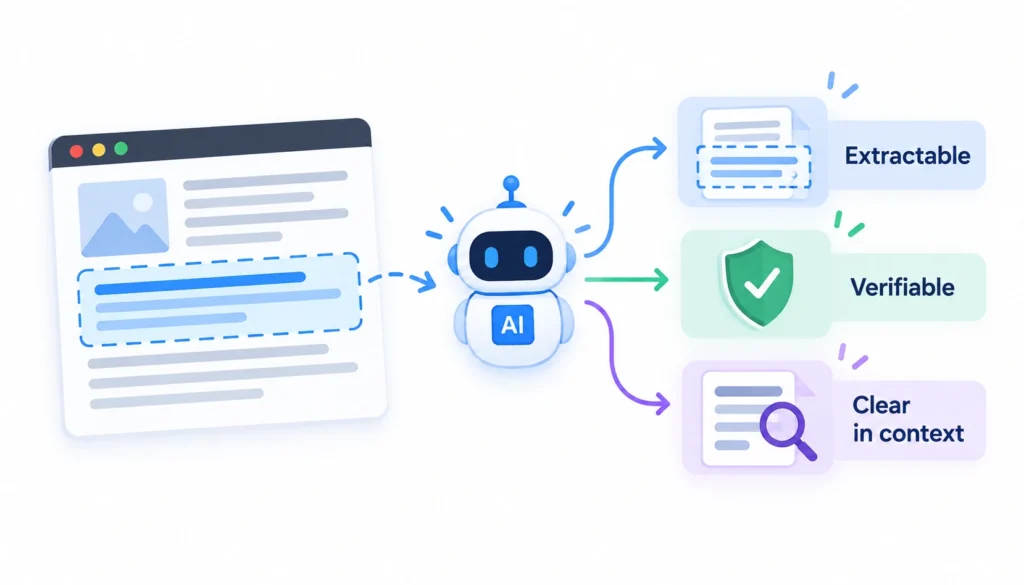
Nobody outside the AI companies knows the exact formula, and anyone who claims otherwise is guessing. What we can say, based on how these systems work and what SEO teams are testing, is that the same qualities keep coming up.
Adobe’s guidance describes good content as extractable, verifiable and clear in context. That’s a useful test. Could a system lift a section out of your page and still have it make sense? Could it check your claim against a named source?
Here is what that looks like in practice:
- Direct answers. Put the answer in the first one or two sentences under a heading.
- Full topic coverage. Cover the questions a reader would ask next.
- Clear relationships between things. Name products, people and concepts, and say how they connect.
- Original information. Share data, findings or experience that isn’t on every other page. SEOs call this information gain.
- First-hand experience. Show that someone has actually done the thing.
- Credible sources. Link to primary research and name where numbers come from.
- Consistent brand details. Keep names, descriptions and facts the same everywhere.
- Clean structure. Use headings, short paragraphs, tables and, where it fits, structured data.
- Technical access. Make sure crawlers aren’t blocked from pages you want found.
Here’s a quick example. A weak sentence reads: “AI SEO is important for businesses.”
A stronger one reads: “AI SEO helps a business get named when someone asks ChatGPT, Gemini, Perplexity or Google AI Overviews for a recommendation.” The second is specific, self-contained and easy to quote.
How to optimize your website for AI SEO in 2026
Follow these steps in order. Each one builds on the one before.
- Fix your technical base. Check crawling, indexing, site architecture, page speed, mobile usability and Core Web Vitals. Google Search Console will show most of the problems.
- Build topical authority. Pick the subjects you want to be known for and cover each one in depth with linked articles.
- Answer questions directly. Turn common customer questions into headings and answer them in the first lines below.
- Be clear about entities. Name your products, services and categories consistently, and explain how they relate.
- Show real experience. Add author bios, credentials, case examples and expert review where it makes sense.
- Add structured data where it fits. Schema markup helps search systems read your pages. Use it for what’s actually on the page.
- Publish original research. Even small surveys or internal data can give AI tools something no one else offers.
- Earn links and mentions. Digital PR, partnerships and useful resources bring in authoritative references. If you do link exchanges, favor sites with real traffic and relevance.
- Keep key pages current. Show update dates and refresh facts, prices and statistics.
- Make claims checkable. Cite sources and separate facts from predictions.
A realistic scenario shows why this matters. Imagine a SaaS company publishing a generic article on CRM software. An AI system has little reason to prefer it over hundreds of near-identical pages.
Now imagine the same company publishing a comparison based on its own customer data, with screenshots and notes from real implementations. That page offers something the others don’t.
How to measure AI SEO performance in 2026
Measurement is where most teams struggle, so keep it simple and split it into three layers.
Traditional SEO metrics. Rankings, impressions, clicks, click-through rate, organic traffic and conversions. Search Console and Google Analytics cover these.
AI search metrics. AI citations, AI mentions, citation frequency, share of AI visibility, AI referral traffic and your presence across platforms. Adobe’s guide names citation frequency, share of model and AI referral traffic as emerging measures. To track them manually, run a fixed list of prompts every month and record whether your brand appears. Specialist tools can automate this.
Business metrics. Qualified leads, conversion rate, revenue, assisted conversions, branded search growth and customer acquisition cost.
Branded search growth deserves attention. If more people search your name after AI tools mention you, that’s often a sign your visibility is working, even when direct clicks stay flat.
One caution: AI referral data is still messy. Some AI traffic arrives without clear referrer information and gets lumped in with direct traffic. Treat early numbers as directional.
What AI SEO looks like for different businesses
SaaS companies. Focus on comparison pages, integration guides and original usage data. Buyers often ask AI tools to compare products, so make your differences easy to state.
E-commerce brands. Product details, reviews and buying guides do the work here. Clear specs, honest comparisons and consistent product information across your site and marketplaces help.
B2B businesses. Long sales cycles mean buyers research heavily. Publish detailed explainers, case studies and expert commentary that a procurement team might ask an AI about.
Local businesses. Keep your Google Business Profile accurate and collect genuine reviews. A plumber or dentist wins by being clearly and consistently described wherever local information appears.
Agencies and service firms. Showcase named experts, real results and specific niches. “Marketing agency” is vague. “SEO agency for dental practices” is easier for a system to place and recommend.
Publishers. Original reporting, unique analysis and strong author profiles matter most, since summaries of generic content are easy for AI to replace.
AI SEO tools to consider in 2026
You don’t need a long stack. Match tools to the job.
1. Search research: Google Keyword Planner, Semrush and Ahrefs.
2. Technical SEO: Google Search Console and Screaming Frog.
3. Content optimization: Surfer and Scalenut.
4. AI visibility tracking: A growing group of tools now track brand mentions, citations, prompt visibility, competitor presence and AI referral traffic. Scalenut, for example, lists AI visibility tracking and citation insights among its features.
Test any tool against your own manual prompt checks before you trust its numbers.
Tools help you see problems. They don’t replace judgment about what your audience needs.
Common AI SEO mistakes to avoid
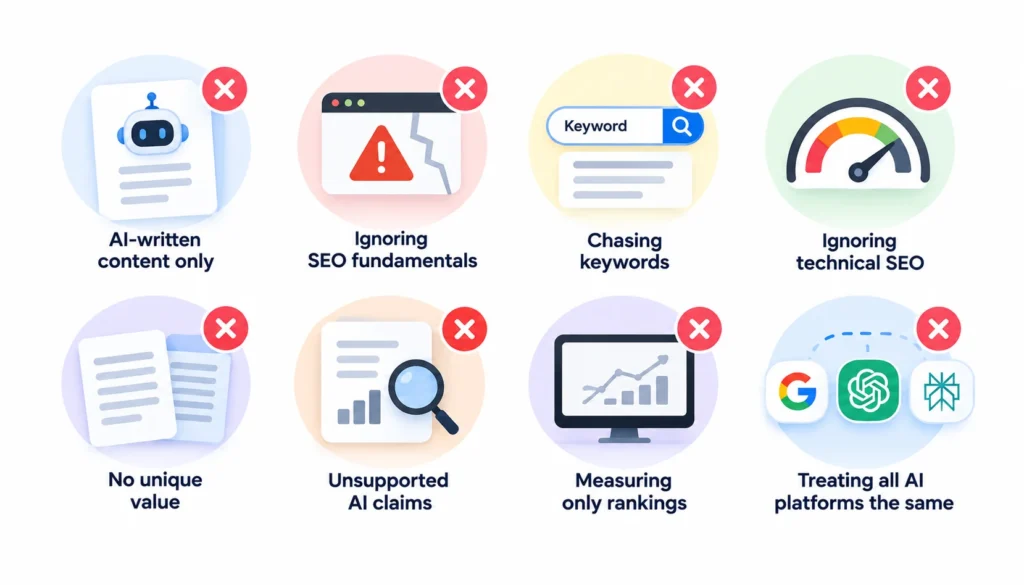
Publishing AI-written content with no expertise behind it. If a tool can write it in ten seconds, so can everyone else. Add experience, data or opinion that comes from you.
Dropping fundamentals for AI tactics. A site with crawl errors and weak content won’t be rescued by a clever prompt strategy.
Chasing keywords instead of intent. Match what the reader wants to do, not just the phrase they typed.
Ignoring technical SEO. Blocked pages and slow sites cost visibility everywhere.
Creating content that already exists everywhere. If your page adds nothing new, there’s little reason to cite it.
Making unsupported claims about AI search. The field is young and changing fast. Say what’s known, flag what’s uncertain, and cite sources.
Measuring only rankings. You’d miss the influence that happens before the click.
Treating every AI platform the same. Google AI Overviews, ChatGPT and Perplexity pull from different sources and behave differently. Test each one.
A practical AI SEO strategy for [this_year]
Here’s a 90-day plan you can adapt.
Days 1 to 30: foundation
Run a technical audit and review Search Console. Audit your existing content to find what’s outdated, thin or duplicated. Check how your brand is described across your site, social profiles and directories. Review author pages and credentials.
Days 31 to 60: authority
Build topic clusters around your core subjects. Publish expert-led pieces and at least one original data point or study. Start digital PR, pursue relevant backlinks and look for third-party mentions in your industry.
Days 61 to 90: AI visibility
Write a list of 20 to 30 prompts your customers might ask AI tools. Run them monthly and record which brands appear. Check what competitors are doing, tighten your content for direct answers, and watch AI referral traffic. Update pages based on what you find.
Is AI SEO worth the investment in 2026?
For most businesses that rely on organic discovery, yes, but the right amount depends on your situation.
When it’s worth it. You sell something people research before buying, your category is competitive, or your customers already use AI tools for recommendations.
When to fix traditional SEO first. If your site has major technical problems, thin content or almost no authority, start there. AI visibility builds on those basics.
What the investment should include. Content improvements, technical fixes, original research, link and mention building, and monthly tracking. It doesn’t need a separate team.
How to estimate ROI. Follow the chain: investment, then visibility, then traffic, then leads, then revenue. Track the early links in that chain (citations, branded searches, qualified leads) while revenue catches up.
The cost of waiting. Authority takes time to build. Starting now costs less than catching up to a competitor who is already the default answer.
Frequently asked questions about AI SEO in 2026
1. Why does AI SEO matter in 2026?
AI tools now answer many questions directly, so being cited in those answers has become a separate form of visibility from ranking in results.
2. Is AI SEO replacing traditional SEO?
No. It builds on it. Crawlability, quality content, links and authority still feed both.
3. Is SEO still relevant in 2026?
Yes. People still search, and AI tools draw heavily on web content. What has changed is where and how your content appears.
4. How does AI affect Google search?
Google now shows AI-generated summaries on many queries, which can answer a question before anyone clicks a result.
5. How do I optimize for AI Overviews?
Follow strong SEO basics, answer questions directly, structure your content clearly and back claims with sources.
6. How do I get cited by AI search engines?
Publish clear, original, well-sourced content, build authority through links and mentions, and keep your brand details consistent across the web.
7. What is the difference between7 SEO, AEO and GEO?
SEO targets search visibility, AEO targets direct-answer visibility, and GEO targets visibility inside generative AI tools. They overlap and share the same foundations.
8. Does E-E-A-T matter for AI SEO?
It’s a Google quality framework, but the qualities behind it (experience, expertise, authority, trust) are what any system needs to judge whether a source is reliable.
9. Do backlinks still matter?
Yes. They remain a strong signal of authority, and brand mentions on trusted sites add to it.
10. How do you measure AI SEO?
Track citations, mentions and AI referral traffic alongside rankings and conversions, and compare them month to month using a fixed prompt list.
Final takeaway: SEO isn’t disappearing, search visibility is expanding
Why AI SEO matters in 2026 is simple to state. Your customers now meet your brand inside AI answers before they reach your website, and those answers draw on sources they consider trustworthy.
The goal of SEO in 2026 isn’t only to rank a webpage. It’s to make your brand the source that search engines and AI systems can understand, trust, cite and recommend.
Start with your technical base, build real authority, write clear answers backed by evidence, and measure what happens