
Type a question into ChatGPT, Perplexity or Googles AI Mode. You get a written answer instead of a page of links. It takes a few seconds. Nothing on the screen shows how the system reached that answer.
That hidden process is how AI search engines work. The system interprets your question finds documents puts them in order and uses a language model to create a response based on the best information, usually with references. A regular search engine stops at the list of results. Lets you read them yourself.
How AI Search Engines Work
The process happens in nine steps: understanding the question finding the purpose expanding the search getting the information putting it in order making sure it is accurate creating the answer adding references and showing it. Each step helps turn a user question into answers with ways to understand, search order and show the evidence. This way of working helps make sure the results are correct, clear and easy to follow.
Google says that AI Overviews and AI Mode can do related searches to answer one question combining results from different searches to make sure everything is covered. ChatGPT search and Perplexity both give answers that have links, to their sources. This variety helps users see points of view and check the facts.
How AI Search Engines Work at a Glance
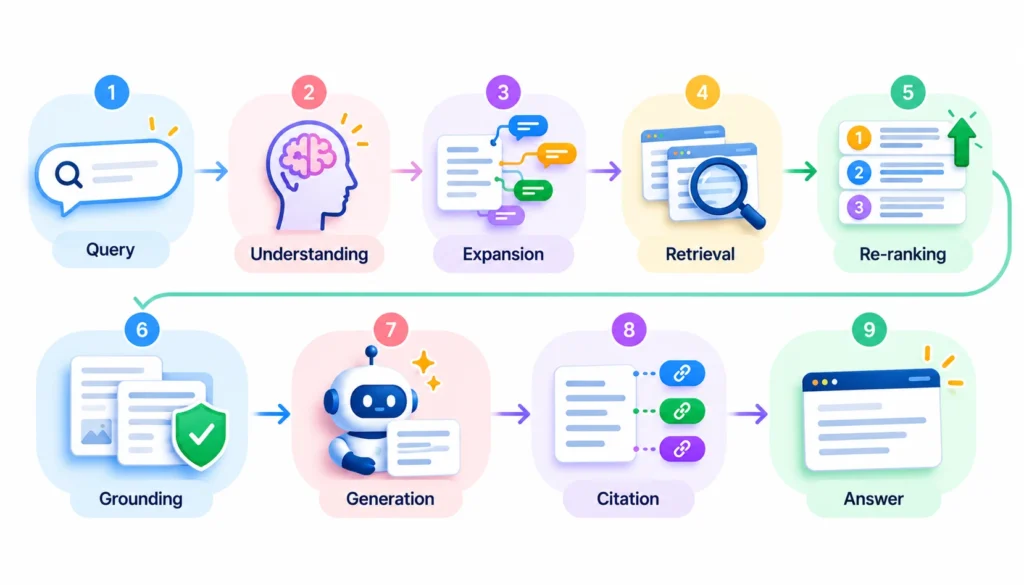
Here is the whole flow in one line:
Query → understanding → expansion → retrieval → re ranking → grounding → generation → citation → answer
Traditional search stops earlier. How AI Search Engines Work begins by crawling pages indexing them and ranking them to present links. You do the reading.
AI search keeps that machinery. Adds a second layer on top. The second layer reads the results for you and writes a response.
The pipeline in 9 steps
- It works out your intent and uses any earlier conversation as context.
- It rewrites, expands or splits the query into several searches.
- The system reads your query and works out what you mean.
- It retrieves candidate pages and passages.
- It ranks and reranks those candidates.
- It grounds the answer in the retrieved text.
- A language model writes the response.
- The system attaches citations.
- You see the answer and can ask a follow-up.
Not every product runs every step in this order. Some merge steps, and some skip one. But this is the common shape, and it’s a useful mental model.
A simple example
Say you ask: “What’s the best CRM for a 20-person SaaS company?”
A system like this could read it as a question with a team size constraint. It might split it into searches, such as CRM pricing, CRM integrations for SaaS and recent reviews. It would pull passages from pages that answer each piece drop the ones and write a short comparison, with links.
That is an illustration of the approach, not a recording of any one products internals.
Traditional search vs AI search
| Traditional search | AI search | |
| Main job | Rank pages | Answer the question |
| Output | A list of links | A written response, usually with citations |
| Matching | Keywords plus many ranking signals | Meaning-based matching plus keywords |
| Who reads the pages | You | The system reads, you check |
| What matters most | Ranking position | Being retrieved, then being used and cited |
What Is an AI Search Engine?
An AI search engine is a search system that uses language models and information retrieval to understand a natural-language question, find relevant information, and produce a direct answer, often with citations to the sources it used. Where a classic engine returns ranked webpages, an AI search engine can combine several sources into one response.
AI search is not the same as an LLM
A large language model or LLM is a system that predicts text based on patterns it learned from amounts of written data. It does not have access to the internet or real-time information. It only knows what was in its training data.
An AI search engine takes an LLM. Adds extra tools. It includes a way to search the web a method to rank the results and rules for citing sources. Think of the LLM like a writer who can produce answers but the search system is the research team that gathers facts finds reliable sources and gives the writer the right materials to work with.
AI search vs AI chatbots
AI chatbots can answer questions using only what they remember from training. They do not look for information. An AI search experience by contrast first searches for relevant information, before giving a response. When a chatbot searches the web or checks a database before answering it is acting like an AI search engine. When it answers from what it already knows it is not using AI search.
What Happens When You Enter a Query Into an AI Search Engine?
This is the core of the topic. Let’s go step by step.
Step 1: The system understands the query
First, the system has to figure out what you actually mean. People type messy questions, and the same words can mean different things.
This stage uses natural language processing. In practice, that covers a few jobs:
- Intent detection. Are you trying to learn something, compare products, or buy?
- Entity recognition. Which names, brands, places or products are in the question?
- Context. In a chat, earlier messages change what a short follow-up like “what about the cheaper one?” means.
Modern systems do this with language models built on the transformer architecture, which was introduced in the 2017 paper Attention Is All You Need.
Step 2: The query may be rewritten, expanded or split
Your exact words are often not the best words to search with. So the system may change them.
- Rewriting turns a vague or conversational question into a cleaner search.
- Expansion adds related terms and synonyms.
- Decomposition breaks a big question into smaller ones.
Google calls its version of decomposition query fan-out. Its documentation on AI features in Search says AI Overviews and AI Mode may run multiple related searches across subtopics and data sources. That part is documented.
Here is what fan-out could look like for a laptop question:
| Your question | Possible sub-searches |
| “Best laptop for SEO work” | Laptop specs for many browser tabs, battery life reviews, price comparisons, recent model releases |
The exact sub-queries a given system creates are not public. Treat any specific list as an example, not a rule.
Step 3: The system retrieves candidate information
Now the system goes looking. There are two main ways to find text, and most modern systems use both.
Lexical retrieval matches the actual words. It relies on an inverted index, which works like the index at the back of a book: it maps each word to the documents that contain it. A well-known scoring method here is BM25. It’s fast and precise when the words match.
Semantic retrieval matches meaning. The system turns text into embeddings, which are long lists of numbers that capture what a piece of text is about. Texts with similar meaning end up with similar numbers, even if they share no words.
Those embeddings are stored in a vector index or vector database. To search them quickly, systems use approximate nearest neighbor methods. These find “close enough” matches without checking every item.
Hybrid search combines both. Lexical search catches exact names, error codes and rare terms. Semantic search catches paraphrases and intent. Using both gives better coverage than either alone, and hybrid retrieval is a common pattern in the information retrieval field.
An LLM alone doesn’t do any of this. The retrieval layer is separate infrastructure.
Step 4: Candidates are ranked and re-ranked
The first retrieval pass is built for speed. It might return dozens or hundreds of candidates, and many will be only loosely relevant.
So a second pass, called re-ranking, looks more closely at a smaller set. A reranker is usually a heavier model that reads the query and each candidate together and scores how well the candidate answers the question.
Signals that can play into this include:
- how well a passage answers the specific question
- source quality and trustworthiness
- freshness, when the topic is time-sensitive
- whether the text stands on its own and is easy to quote
Which signals each product weighs, and how much, is mostly inferred. The companies haven’t published their weights.
One point trips up a lot of people: retrieval is not citation. A page can be crawled, retrieved, read by the system, and still not appear in the final answer. We’ll come back to this.
Step 5: The answer is grounded in the retrieved text
Grounding means the model writes from the evidence in front of it, not from memory.
The retrieved passages get placed into the model’s context window, which is the amount of text it can look at in one go. The model is instructed to base its answer on those passages.
This technique is called retrieval-augmented generation, or RAG. It was described in the 2020 paper Retrieval-Augmented Generation for Knowledge-Intensive NLP Tasks, and there’s a good summary on Wikipedia’s RAG page.
Grounding also has to deal with disagreement. If two sources contradict each other, the system has to pick one, mention both, or hedge. How well it handles that varies a lot between products.
Step 6: The LLM writes the answer
Now the language model does what it’s good at. It turns the selected passages into a summary, a comparison, a step list or a short explanation.
The model is not copying one page. It is blending information and rephrasing it. That’s why the same question can produce slightly different answers on different days.
Step 7: Citations are added
Most AI search products attach links to show where the answer came from. How they decide which sources to cite is not fully public.
Two things are worth knowing. A cited source usually contributed a specific fact or passage to the answer. And a retrieved source may be left out of the visible citations altogether.
This gives you a useful chain to remember:
Crawled → indexed → retrieved → considered → used → cited
Each arrow is a place where a page can drop out.
Step 8: You get the answer, and can keep going
The final output might be paragraphs, a table, a list, or a mix. Many products let you ask a follow-up, and the system carries the earlier context forward. Some also handle images and voice.
The Technologies Behind AI Search Engines
The list of terms can feel like alphabet soup. Here is how the main parts fit together.
| Component | What it does in plain English |
| Crawler and index | Collects pages and stores them so they can be searched fast |
| NLP and LLM | Reads the question and writes the answer |
| Embeddings | Turn text into numbers that represent meaning |
| Vector search | Finds text with similar meaning |
| Reranker | Re-scores the top candidates more carefully |
| RAG | Feeds retrieved text to the model before it answers |
| Knowledge graph | Stores facts about entities and how they relate |
| APIs and live data | Supply fresh facts like prices, scores or weather |
The last row matters more than people expect. A model trained months ago can’t know today’s stock price. So many systems call a live search or a data feed at answer time.
How RAG Works in AI Search
RAG deserves its short section because its the most quoted idea in this space and also the most oversimplified.
RAG works in six steps:
- The system understands the query.
- It retrieves relevant documents or passages.
- It evaluates which ones are useful.
- It assembles them into context for the model.
- The model generates an answer from that context.
- The answer is shown with citations.
Why do products use it? Because training a model is slow and expensive. Its knowledge goes stale. Retrieval lets the system pull in information without retraining.
Rag is only one part of an AI search engine. It doesn’t cover crawling, indexing, query rewriting or re-ranking. Saying “AI search is RAG” is like saying a restaurant is just a stove.
RAG also has limits. If retrieval brings back the pages the model writes a confident answer from the wrong material. If the right page isn’t, in the index it can’t help.. If the context window is full useful passages may get cut.
How AI Search Engines Choose Sources
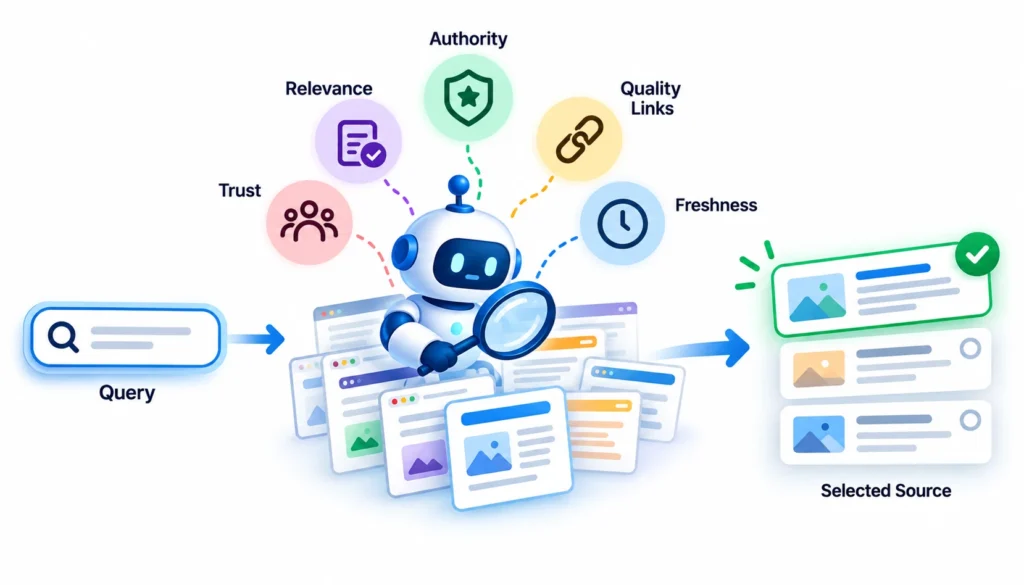
This is the question website owners care about most. The honest answer is that nobody outside these companies knows the exact recipe. But the stages above point to what likely matters.
Relevance to the exact question
A page needs to answer the specific thing that is being asked. A page that is broad and only touches the topic may lose to a page that answers it clearly and directly.
Passage-level fit
Systems often work with parts of a page not the page. A paragraph that clearly answers one question can be picked even if the rest of the page is not relevant. This is understood from how retrieval systems re designed and it matches what people who work with these systems say.
Authority and trust
Sources that look trustworthy are usually preferred especially when it comes to health, money and legal topics. Googles documentation says that its ranking systems and quality guidelines still apply to its AI features.
Freshness
For news prices and new products newer pages have an advantage. For topics that don’t change much the age of the page is not as important.
Access
If a crawler cannot reach your page nothing else matters. Blocking bots in robots.txt hiding content, behind scripts that bots cannot run or requiring a login can all prevent access. OpenAI for example has a crawler called OAI-SearchBot for ChatGPT search so website owners can allow or block it separately.
Why ranking first doesn’t guarantee a citation
Traditional rank and AI citation come from related but different systems. A page ranking first may be long, vague or hard to quote. A lower-ranking page with a crisp, self-contained answer may be the one the model uses.
That said, there is overlap. Many cited pages also rank well in regular search. So it’s best to see the two as linked, not identical.
How Different AI Search Engines Work
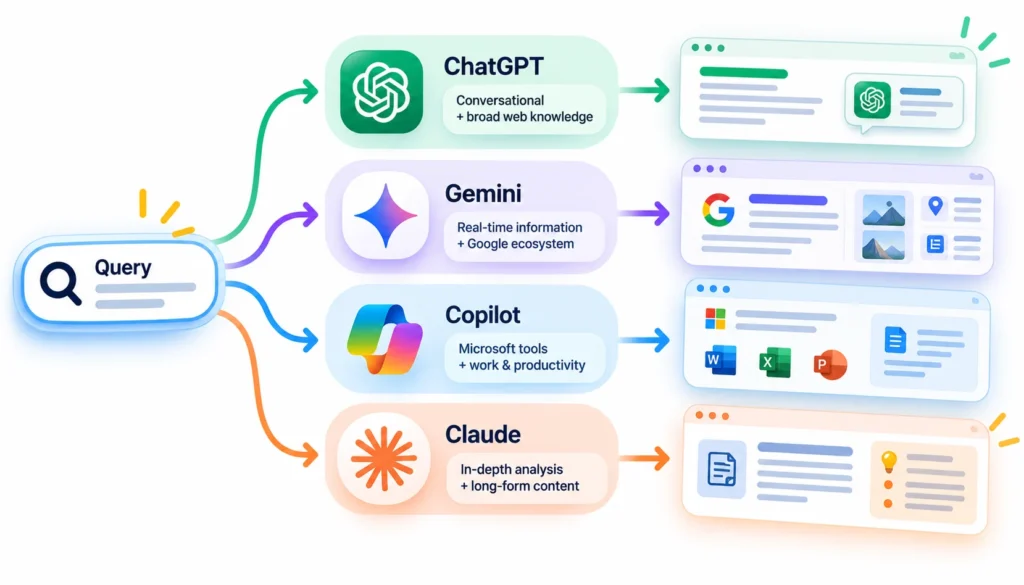
The products share a common idea but differ in the details.
Google: Google’s documentation says that a page must be indexed and must qualify to appear with a snippet in order for it to be shown as a supporting link in AI features. Google also says that no special markup is required. That is about as clear as official guidance can be.
ChatGPT: OpenAI has said that ChatGPT’s search feature pulls from web sources and displays links. The exact providers and indexes that ChatGPT relies on can change so check OpenAI’s documentation before making plans around it.
Perplexity: Perplexity is built around answers that include citations. Perplexity’s internals are not fully published.
Copilot and Gemini: Both sit inside ecosystems so their answers lean on those companies’ search and data. Copilot and Gemini product features change often so verify on each vendor’s site.
A word of caution. A word of caution: product behavior shifts every months. If you see a specific claim, about how one engine picks sources ask where it came from.
Why AI Search Engines Sometimes Get It Wrong
AI search engines can be wrong, and it helps to know why. Wikipedia has a solid overview of AI hallucination.
Common causes:
- Bad retrieval. The system fetched the wrong pages, so the answer rests on weak ground.
- Thin evidence. Few good sources exist, and the model fills gaps with plausible guesses.
- Stale sources. The retrieved page is out of date.
- Conflicting sources. Two pages disagree and the model blends them badly.
- Ambiguous questions. The system guesses the wrong meaning.
- Model habits. The model leans on patterns from training even when the evidence says otherwise.
Citations help here. They let you click through and check. If an answer matters, open the source and confirm the claim is actually there.
How AI Search Changes SEO
Here’s where the pipeline turns practical.
Traditional SEO still matters. Google’s AI features run on top of Google Search. Crawling, indexing and quality signals remain part of how pages get found.
The goal widens. Ranking is still useful, but you now also want your pages to be retrieved, used and cited.
Topics and entities matter more than single keywords. Systems match meaning, so a page that covers a topic clearly and names the right entities has an advantage over one that repeats a phrase.
Passages matter. Since systems often pull chunks, each section should make sense on its own.
Measurement is harder. Citations and mentions are less tidy to track than rankings. Many teams now spot-check target questions in several AI products by hand and log what appears. As this process becomes more continuous, SEO automation can help reduce some of the manual work involved in monitoring and optimization. That’s a practical method, not a perfect one.
How to Optimize Content for AI Search
No one can promise a method that guarantees citations. But these habits follow directly from how the pipeline works, and they also make pages better for people.
- Answer the question early. Put a clear 40 to 60 word answer right under the heading that asks it.
- Write self-contained sections. Each section should still make sense if someone reads only that part.
- Use plain headings. Phrase them like the questions people ask.
- Be specific. Name products, dates, numbers and sources. Vague text is hard to quote.
- Show real experience. Original examples, screenshots and test results give a model something it can’t get elsewhere.
- Cite primary sources. Link to documentation and research, not other summaries.
- Keep facts current. Update pages with dates, prices or versions.
- Keep pages crawlable. Check robots.text, rendering and indexation. Make sure you aren’t blocking the bots you want.
- Cover the topic in depth. Related pages that link to each other signal that you know the subject.
- Track your visibility. Test a fixed set of questions every month and note what changes.
A small scenario shows how this plays out. Imagine two pages about email deliverability. One opens with three paragraphs of background. The other opens with a two-sentence answer, then a short checklist, then details. If a system is pulling passages, the second page gives it something clean to grab. That’s an illustration of the principle, not a guaranteed result.
Does SEO Still Matter for AI Search?
Yes. I believe SEO still matters and AI search does not replace the webs search infrastructure. AI search adds a layer, on top of it. Pages still need to be found, indexed and trusted.
The phrase “SEO is dead” gets clicks. It ignores how these systems are built. What has changed is the finish line. Getting a click is no longer the win. Being quoted accurately in an answer also counts.
One trade-off is real: AI answers can satisfy people without a click. As a publisher I should plan for that. Think about what a visitor can get from my site that a summary cannot give.
Where AI Search Is Heading
Several directions are already visible.
- Agentic search, where the system runs many searches and steps on its own.
- Multimodal search, which takes text, images and voice together.
- Personalization, where answers adapt to your history and context.
- Action, where the system doesn’t just answer, it books, buys or fills in forms.
The common thread is a move from search toward answers, and from answers toward tasks. Details will change, but the pipeline logic in this guide should still help you read whatever comes next.
Frequently Asked Questions About AI Search Engines
1. How do AI search engines work?
They interpret your query, retrieve relevant information, re-rank it, and use a language model to write an answer grounded in what was retrieved. Most then attach citations to the sources used.
2. What is an AI search engine?
It’s a search system that uses AI to understand natural-language questions and generate direct answers, often with source links, instead of only returning a list of webpages.
3. How is AI search different from Google?
Classic Google search returns ranked links. Google’s AI Overviews and AI Mode add generated answers on top of Google Search. So the two are connected, not opposites.
4. Do AI search engines use RAG?
Many do. RAG means retrieving documents first and giving them to the model as context before it answers. It’s one stage in the larger pipeline, not the whole system.
5. Can AI search engines access real-time information?
Only if they’re connected to live search or data sources. A model on its own knows only its training data.
6. Why do AI search engines hallucinate?
Usually because retrieval failed, the evidence was thin or conflicting, or the question was unclear. The model then fills gaps with plausible-sounding text.
7. Can a page be cited without ranking first in Google?
Yes, it can happen. Citation depends on retrieval and passage selection, which are related to, but not identical with, classic ranking.
8. How can a website appear in AI search results?
Make sure the page is crawlable and indexed, answer questions clearly, back claims with sources, and keep content current. Google’s own documentation says no special markup is required for its AI features.
Conclusion: What to Remember About How AI Search Engines Work
How AI search engines work can be described as a chain of steps. First the system understands the question. Then it expands the question. After that it finds answers. Then it ranks those answers again.
Next it checks the text to make sure the answer is correct. Then it creates the answer. Finally it shows where the information came from.
A web page can fail at any part of this process. So being found by the search engine being chosen as an answer and being given credit are three results.
Googles AI tools work on top of Google Search. Google says no special tags are needed to be included in these tools. So the basics still matter. Make sure the pages can be seen by the search engine and are stored in the database. Answer questions, in direct parts of the text. Also link to the sources of information.