Search is evolving beyond traditional search engine results, with AI-powered platforms such as Google AI Overviews, ChatGPT, and Perplexity changing how users discover information. This shift has made AI SEO an important part of modern digital marketing.
AI SEO combines artificial intelligence with search engine optimization to improve content relevance, search visibility, and performance across evolving search experiences. It helps businesses understand search intent, identify relevant keywords, optimize website content, and create information that meets users’ needs. Beyond traditional search rankings, AI SEO also focuses on making content easier for AI-powered systems to understand and potentially reference in generated answers.
What Is AI SEO?
AI SEO (Artificial Intelligence Search Engine Optimization) is the process of using artificial intelligence to improve SEO strategies and optimize content for visibility across traditional search engines and AI-powered search platforms. It combines search intent analysis, keyword research, content optimization, and structured information to help search systems understand, retrieve, and present relevant content.
AI SEO supports AEO (Answer Engine Optimization) by making content clear, accurate, and easy to extract as direct answers, and GEO (Generative Engine Optimization) by improving the likelihood that relevant, trustworthy content is referenced or cited in AI-generated responses. The goal is to make content discoverable, useful, and accessible across evolving search experiences.
AI SEO vs. Traditional SEO
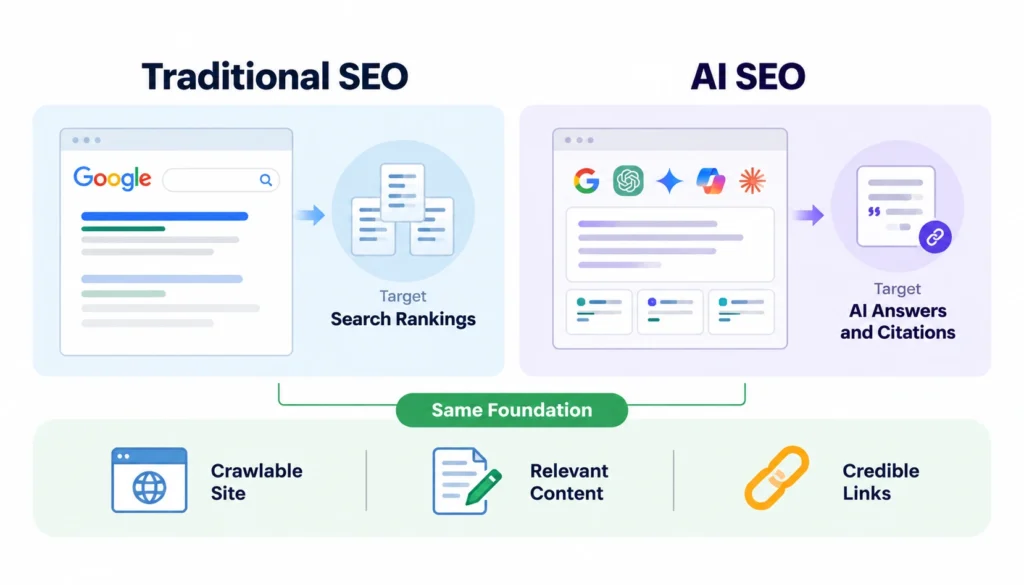
Traditional SEO and AI SEO share the same foundation. You still need a crawlable site, relevant content, and credible links. What’s changed is the target.
| Factor | Traditional SEO | AI SEO |
| Primary goal | Rank in the top 10 organic results | Rank and get cited or summarized by AI |
| What’s optimized | Pages and keywords | Pages, entities, and the facts inside them |
| Success looks like | A blue link the user clicks | A ranking, a citation, or a mention with no click at all |
| Content depth | Keyword coverage | Direct answers plus supporting evidence |
| Authority signals | Backlinks, domain age | Backlinks plus expertise, consistency, and named sources |
Traditional SEO is still the foundation. Google’s own overview of search engine optimization notes that SEO now applies across web, image, video, and AI-assisted search interfaces; it hasn’t been replaced, it’s been extended. If your site doesn’t rank well in classic search, it’s very unlikely to get pulled into an AI answer either.
How AI Search Works (The Retrieval Process)
Most people picture AI search as “the AI reads the whole internet and just knows things.” That’s not quite right, and understanding the real process is the key to writing content that performs well.
Here’s a simplified version of what happens behind the scenes when someone asks an AI system a question:
- The user asks a question. Often more conversational than a typed keyword, like “what’s the best CRM for a five-person sales team” instead of “best crm small business.”
- The system interprets the query. It figures out the intent, the entities involved, and what kind of answer would actually help.
- Relevant information is retrieved. The system pulls candidate pages and passages from an index, similar to how a search engine ranks pages. This is where traditional SEO fundamentals still matter enormously.
- Sources and passages are evaluated. Not just “is this page relevant,” but “is this specific paragraph clear, accurate, and well-supported.”
- Information is synthesized. The model combines facts from multiple sources into one coherent answer.
- The answer is generated, sometimes with citations. Depending on the tool, you’ll see links, source names, or nothing at all.
This pattern, retrieve information first, then generate an answer from it, is known in AI research as retrieval-augmented generation. It’s why a page that’s easy to crawl, clearly written, and factually specific has a real advantage: the retrieval step can’t find you if you’re buried under vague headings and thin content.
How Google AI Overviews Affect SEO
Google’s AI Overviews sit at the top of many search results and answer the query directly, often before a single organic result is visible. For a lot of informational searches, that means fewer clicks reach any website at all, a pattern often called zero-click search.
A few practical effects worth planning around:
- Rankings still matter. Google draws AI Overview content heavily from pages that already rank well organically. Skipping SEO fundamentals to chase an AI Overview doesn’t work.
- Clear, extractable answers get pulled first. Content with a direct answer near the top of the section, followed by supporting detail, is easier for the system to lift cleanly.
- Visibility doesn’t always mean traffic. You can be the cited source and still see the user never click through. That’s a real trade-off, not a flaw in your strategy.
- Coverage varies by query type. Commercial and “how-to” queries tend to trigger AI Overviews less consistently than broad informational ones. This shifts over time, so it’s worth checking your own analytics rather than assuming.
Discussion threads on r/SEO reflect this same tension. Practitioners there are actively comparing notes on whether AI-generated visibility is replacing traditional organic traffic, and the honest answer from most is “it depends on the query and the industry.”
How ChatGPT, Gemini & Perplexity Find Information
Google’s AI Overviews aren’t the only system worth optimizing for. Conversational AI tools have their own ways of finding and using web content, and they don’t all work identically.
ChatGPT (when browsing is enabled) performs live web searches and can also draw on training data for general knowledge. It tends to favor sources with clear structure and recent publication dates for anything time-sensitive.
Gemini is tied closely to Google’s search index, so a lot of the same signals that help you rank in classic Google search, crawlability, structured data, E-E-A-T, carry over directly.
Perplexity is built around live retrieval and citation by default. It shows its sources openly, which means a well-structured, specific page has a genuine shot at being the visible citation rather than an invisible input.
Across all three, the common thread is the same: these systems reward content that answers a question directly, backs it up with specifics, and doesn’t bury the point under filler. A Reddit thread in r/SEO asking whether AI SEO is “real or just a buzzword” has dozens of practitioners converging on that same conclusion: it’s not a new set of tricks, it’s the same fundamentals applied to a new retrieval layer.
AEO vs. AI SEO (and Where GEO and LLMO Fit)
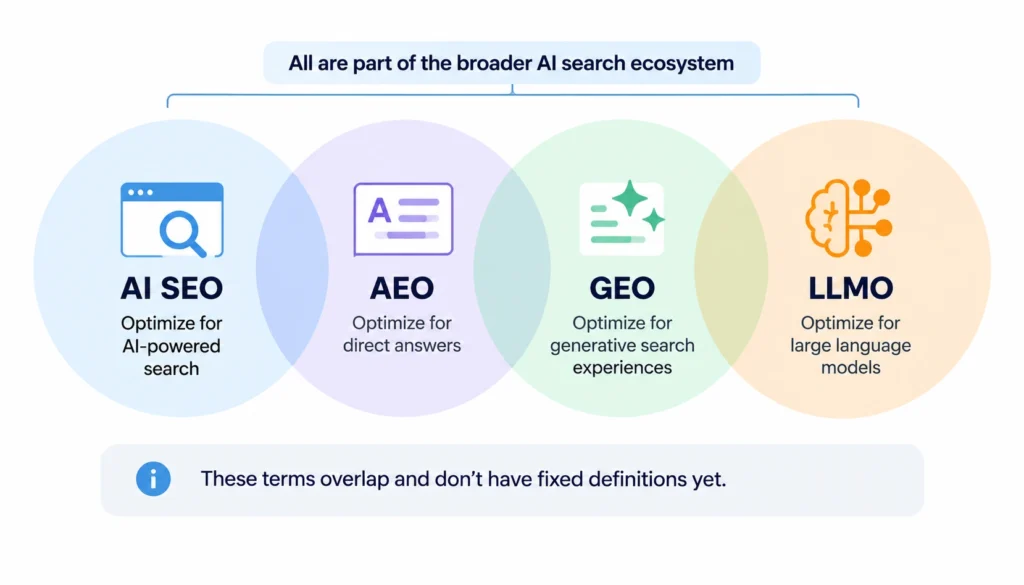
You’ll see a handful of overlapping terms floating around: AI SEO services, AEO (Answer Engine Optimization), GEO (Generative Engine Optimization), and LLMO (LLM Optimization). None of these have a single, universally agreed-on definition yet, so treat the distinctions below as generally accepted rather than fixed rules.
- AI SEO, the broadest term, covers both using AI for SEO work and optimizing for AI-powered search.
- AEO is focused specifically on structuring content to directly answer questions, originally built around featured snippets and voice search, now extended to AI answers.
- GEO is focused on optimizing for generative engines like AI Overviews and ChatGPT specifically, with an emphasis on getting cited within a generated response.
- LLMO is the narrowest term, focused on how a page performs inside large language model outputs specifically, regardless of whether there’s a live “search” step involved.
In practice, most teams don’t need to pick one term and commit to it. Think of AI SEO as the umbrella, with AEO, GEO, and LLMO as different lenses on the same underlying work: making your content clear, accurate, and easy for a machine to extract and trust.
Entity and Topical Authority
An entity is simply a specific, identifiable thing: a person, a company, a product, a concept. Search engines and AI systems don’t just match keywords anymore; they try to understand which entities a page is actually about and how those entities relate to each other.
This is why topical authority matters more now than it used to. A site with one strong article on a subject looks thin to an AI system. A site with a well-linked cluster, a pillar page plus supporting articles that cover related subtopics, questions, and comparisons, looks like a credible, comprehensive source.
Practical steps that build this:
- Group related content into clusters, with a central page linking out to detailed supporting pages.
- Be consistent about names, definitions, and facts across your own site. Contradicting yourself in different articles undermines confidence in all of them.
- Mention related entities naturally (competitors, tools, standards, people) rather than writing every page in isolation.
E-E-A-T and AI Search
E-E-A-T stands for Experience, Expertise, Authoritativeness, and Trustworthiness. Google introduced it as a quality framework for human reviewers, and it’s become just as relevant to AI-search visibility, since these systems are explicitly trying to avoid citing unreliable sources.
Experience shows up as specifics only someone who’s actually done the thing would know: a real workflow, an honest limitation, a number pulled from an actual test rather than a guess.
Expertise means explaining concepts accurately and in plain language, without hiding behind jargon to sound smarter than the content actually is.
Authoritativeness comes from being referenced by other credible sources, having clear author information, and being consistent with what established, reputable sources say on the same topic.
Trustworthiness means being upfront about limitations. AI search behavior changes often, no tactic guarantees a citation, and ranking well in classic search doesn’t guarantee inclusion in an AI answer. Pages that overstate certainty tend to age poorly.
Structured Data and AI Search
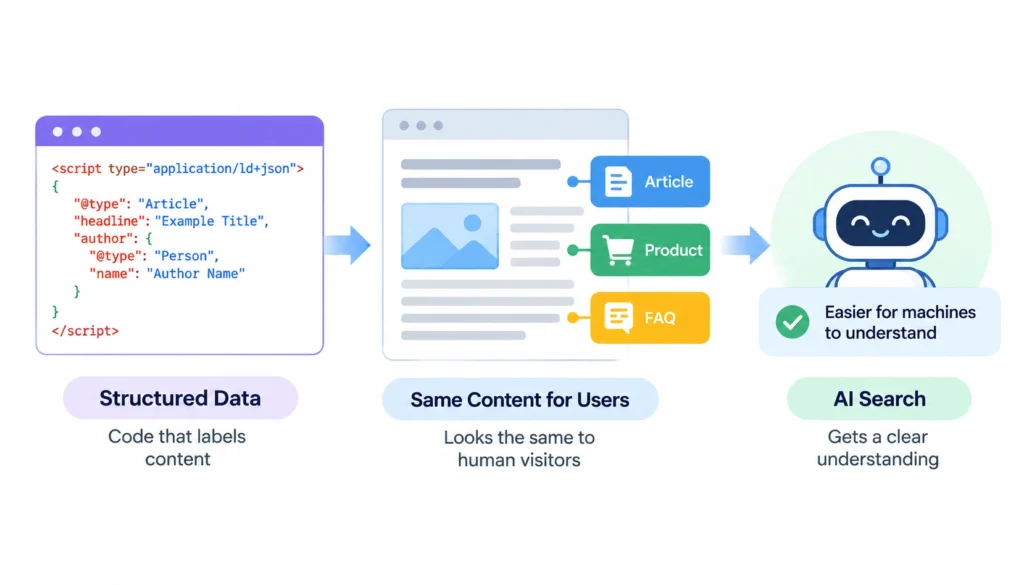
Structured data (schema markup) is code added to a page that explicitly labels what different pieces of content mean: this is an article, this is a product with this price, this is a FAQ with these questions and answers. It doesn’t change how your content reads to a human visitor; it gives machines a shortcut to understanding it.
Useful schema types for AI-search visibility include Article, Organization, Person (for author bios), Product, FAQPage, and HowTo where a process is genuinely step-by-step.
One caution worth stating plainly: schema is not a guarantee of anything. It makes your content easier to parse correctly. It doesn’t force an AI system to cite you. Think of it as removing friction, not buying a result.
How to Optimize Content for AI Search
This is where the strategy becomes concrete. A few practices consistently show up across the sources that dig deepest into this topic:
Answer first, explain second. Put the direct answer to the likely question in the first sentence or two of a section, then support it with detail. Both featured snippets and AI Overviews tend to favor this structure.
Make claims specific and checkable. “Many businesses use CRM software” says nothing. “A five-person sales team typically needs a CRM under $50 per user per month” gives a retrieval system something concrete to work with.
Write self-contained passages. Each section should make sense if it’s lifted out and shown on its own, since that’s effectively what happens when it gets pulled into a generated answer.
Add information competitors don’t have. Original data, a specific example, a documented process, anything that isn’t just a rewording of what’s already ranking.
Keep facts consistent site-wide. If your pricing page says one thing and your blog says another, that inconsistency undermines trust signals across your whole domain.
Don’t write “for the AI.” Optimize for a person who wants a clear, accurate answer. Content that reads like it was engineered for a machine tends to read badly for humans too, and both audiences notice.
AI Search Visibility
AI search visibility is the newer half of the measurement picture. It’s about how often and how accurately your brand shows up inside AI-generated answers, separate from where you rank in a traditional results page.
It has a few distinct components: how often you’re mentioned at all, how often you’re actually cited as a source, and (often overlooked) whether the AI system is representing your brand or product accurately when it does mention you. It’s entirely possible to be mentioned and misrepresented, which is its own kind of problem worth monitoring.
How to Measure AI Search Visibility
Measurement here means running two frameworks side by side, not replacing one with the other.
Traditional SEO metrics still matter: organic rankings, impressions, click-through rate, organic traffic, and conversions from search.
AI-search metrics are newer and less standardized: how often you’re cited in AI Overviews or ChatGPT answers, brand mention frequency, referral traffic from AI tools (visible in Google Analytics as traffic from domains like chatgpt.com or perplexity.ai), and whether your brand is being described accurately.
A simple way to track this without expensive tooling: periodically run your own priority queries through Google, ChatGPT, and Perplexity, and log whether you’re mentioned, cited, or absent. It’s manual, but it’s honest data, and it’s a reasonable starting point before investing in a dedicated AI-visibility platform.
Common AI SEO Mistakes
A few patterns come up again and again when AI SEO efforts under-perform:
- Treating AI SEO as a replacement for SEO, rather than an extension of it.
- Publishing large volumes of generic AI-written content with no original information or review.
- Focusing only on keywords while ignoring the entities and relationships around them.
- Skipping technical SEO. If AI crawlers can’t access or render your pages, none of the rest matters.
- Chasing AI citations exclusively, at the expense of the organic rankings that feed them in the first place.
- Making claims you can’t back up, which damages trust signals across the whole site.
- Leaving out first-hand experience, so content reads as competent but generic.
- Letting content go stale, especially on pages where facts, prices, or statistics change over time.
- Assuming a top ranking guarantees an AI citation. The two are correlated, not identical.
AI SEO Tools
Rather than another long list of software names, it’s more useful to group tools by the job they actually do:
1. Keyword and intent research: Google Keyword Planner, Semrush, Ahrefs, largely unchanged from traditional SEO, still foundational.
2. Content analysis and optimization: tools like Surfer or Clearscope help check topical coverage against what’s already ranking.
3. Technical SEO: Screaming Frog for crawl audits, Google Search Console for indexing and performance data, PageSpeed Insights for speed and Core Web Vitals.
4. AI-assisted drafting and research: ChatGPT, Gemini, and Claude are genuinely useful for first drafts, competitor analysis, and content briefs, with a human editing and fact-checking every output before it’s published.
5. AI visibility monitoring: a growing category of tools that track how often a brand appears in AI-generated answers. This space is moving fast, so it’s worth checking current reviews rather than relying on a fixed list of names.
The common thread across all of these categories: AI speeds up research and drafting, but human review is what keeps the output accurate and worth publishing.
UC Davis’s guidance on AI-assisted SEO makes this point directly: AI tools are useful accelerators, but they still hallucinate and get facts wrong, so nothing goes live without a human check.
Frequently Asked Questions About AI SEO
1. What is AI SEO?
AI SEO is the practice of using artificial intelligence to improve SEO workflows while also optimizing content so AI-powered search tools like Google AI Overviews, ChatGPT, and Perplexity can find, understand, and cite it accurately.
2. Does AI SEO replace traditional SEO?
No. AI search systems still rely heavily on the same signals traditional SEO builds: crawlability, relevance, and authority. AI SEO adds a layer on top of that foundation rather than replacing it.
3. What’s the difference between AI SEO and GEO?
AI SEO is the broader practice covering both AI-assisted SEO work and AI-search optimization. GEO is a narrower term focused specifically on getting cited inside generative AI answers.
4. Do backlinks still matter for AI search?
Yes. Backlinks remain a strong authority signal for traditional rankings, and since AI systems draw heavily from well-ranking pages, backlinks still matter indirectly for AI visibility too.
5. Does AI-generated content hurt SEO?
Not inherently, but generic, unreviewed AI content tends to lack the specificity and first-hand detail that both search engines and readers respond to. The risk is in the lack of editing, not the use of AI itself.
Final Takeaway
AI SEO goes beyond using artificial intelligence to create or optimize content. It focuses on understanding user intent, delivering accurate and helpful information, strengthening topical authority, and making content accessible to both search engines and AI-powered systems.
By combining traditional SEO with AEO and GEO practices, businesses can adapt to changing search behavior and improve their opportunities for visibility across conventional search results and AI-generated answers.
However, rankings and AI citations depend on multiple factors, so no optimization strategy can guarantee placement.